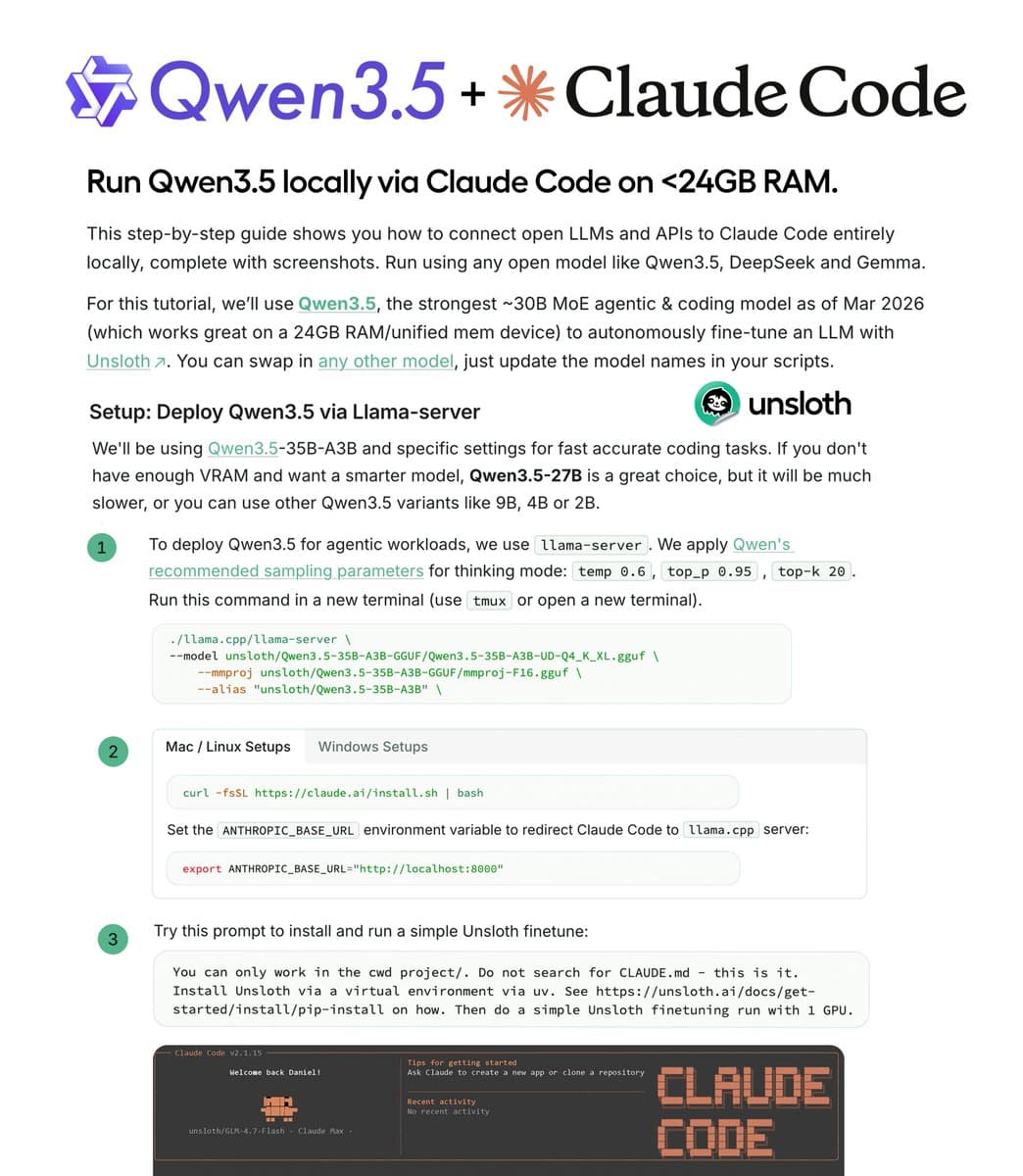
A significant development in the AI development community has emerged that could change how developers interact with coding assistants. According to developer Akshay Pachaar and the Unsloth team, it's now possible to run Anthropic's Claude Code using entirely local language models, eliminating API costs and keeping all data on your machine.
The Technical Breakthrough
The method centers around a clever workaround involving environment variables. Claude Code, Anthropic's coding-focused AI assistant, can be configured to swap its backend through a single environment variable setting. By pointing the ANTHROPIC_BASE_URL to a local llama.cpp server running on port 8001, developers can redirect all Claude Code requests to whatever model they're running locally.
The setup requires just two environment variables: ANTHROPIC_BASE_URL set to the local server address and a dummy ANTHROPIC_API_KEY. This configuration tricks Claude Code into thinking it's communicating with Anthropic's official API while actually routing requests to the local model.
Step-by-Step Implementation
The Unsloth team has created a comprehensive guide that walks developers through the entire process. According to the source material, the guide covers everything from model download to server setup to actually running Claude Code with the local configuration. While specific technical details aren't provided in the source, the approach reportedly works particularly well with models like Qwen3.5 when served through llama-server.
This method leverages the llama.cpp ecosystem, which has become increasingly sophisticated at serving various model formats locally. The key insight is that Claude Code's API interface can be intercepted and redirected without modifying the application itself, making this approach potentially applicable to other AI tools with similar API-based architectures.
Privacy and Cost Implications
The most significant implications of this development are in two areas: privacy and cost. By keeping all data on the local machine, developers can work with proprietary codebases without worrying about sensitive information being transmitted to external servers. This addresses one of the primary concerns enterprise developers have had about cloud-based AI coding assistants.
Equally important is the cost elimination. As the source notes, this approach means "no API costs" for "every agentic loop"—referring to the iterative back-and-forth interactions that characterize modern AI-assisted coding. For developers who rely heavily on coding assistants, these costs can accumulate quickly, making local execution particularly attractive for frequent users.
The Broader Trend
This development fits into a larger movement toward local AI execution that has been gaining momentum throughout 2024. As open-source models continue to improve in coding capabilities—with models like Qwen, CodeLlama, and DeepSeek-Coder approaching commercial-grade performance—the gap between proprietary and open-source coding assistants is narrowing.
The technique also highlights an interesting aspect of the current AI ecosystem: many commercial AI tools are built on standardized API interfaces that can be reverse-engineered or redirected. This creates opportunities for interoperability that the original developers may not have anticipated but that benefit the broader developer community.
Practical Considerations
While the source presents this as a straightforward solution, developers should consider several factors. Local execution requires sufficient hardware resources, particularly GPU memory for larger models. The performance of local models, while improving, may not match Claude's latest versions in all coding scenarios. Additionally, developers will need to manage model updates and maintenance themselves rather than relying on a service provider.
However, for developers with appropriate hardware and privacy requirements, this approach offers a compelling alternative to subscription-based or pay-per-token coding assistants. It represents another step toward democratizing AI tools and reducing dependency on large commercial providers.
Looking Forward
As open-source models continue to advance and techniques like this become more widely known, we may see increased pressure on commercial AI providers to offer more flexible deployment options. The ability to run coding assistants locally addresses legitimate concerns about data privacy, cost, and vendor lock-in that have become increasingly prominent in enterprise discussions about AI adoption.
This development also suggests that the future of AI-assisted development might be hybrid: using cloud-based models for certain tasks while keeping sensitive or frequent operations local. The technical approach demonstrated here—intercepting and redirecting API calls—could potentially be applied to other AI tools beyond coding assistants, opening up new possibilities for customization and control in the AI ecosystem.