OpenAI Delays 'Adult Mode' for ChatGPT Amid Internal Backlash Over Safety Risks

OpenAI Delays 'Adult Mode' for ChatGPT Amid Internal Backlash Over Safety Risks

OpenAI has delayed a proposed 'adult mode' for ChatGPT following internal warnings about risks including emotional dependency, compulsive use, and inadequate age verification with a ~12% error rate.

Ggentic.news Editorial·2h ago·2 min read·18 views·via @kimmonismus
Share:

What Happened

OpenAI has reportedly delayed the launch of a proposed "adult mode" for its ChatGPT platform after facing significant internal backlash. According to a report from The Washington Post shared by AI researcher @kimmonismus, the feature triggered intense internal debate, with company advisers warning of serious safety risks.

The primary concerns raised include:

  • Emotional Dependency: The potential for users to form unhealthy emotional attachments to an unfiltered AI companion.
  • Compulsive Use: Risks of addictive interaction patterns with a less restricted model.
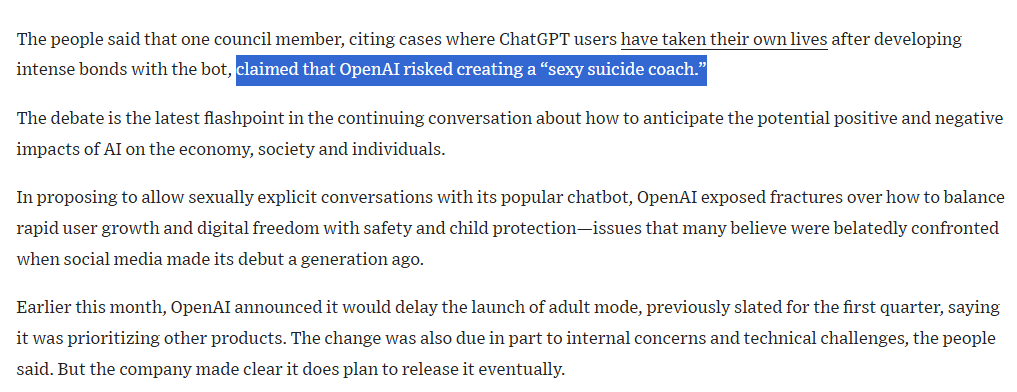
  • Extreme Content Risks: Advisers reportedly warned of a potential "sexy suicide coach" scenario, where the AI could be prompted to provide harmful, explicit, or dangerous guidance.

A critical technical flaw contributing to the delay is the reported ~12% error rate in age verification systems. This failure rate could expose millions of minors to explicit or adult-oriented content, presenting a significant legal and ethical liability.

Despite potential growth and revenue incentives for launching a less restricted product tier, these safety and technical concerns have forced a pause in development and rollout plans.

Context

This development occurs within a broader industry tension between deploying more capable, less constrained AI models and implementing robust safety guardrails. OpenAI has historically positioned itself with a cautious, staged approach to releasing new capabilities, but internal documents and reports have previously indicated debates over the pace of commercialization versus safety research.

The concept of an "adult mode" or less filtered AI experience has been a topic of discussion among users and competitors. Other platforms and open-source models often operate with fewer content restrictions, creating a competitive pressure that commercial providers like OpenAI must navigate while managing reputational and regulatory risk.

The reported 12% age verification error rate highlights a persistent and difficult technical challenge in online platforms: reliably verifying user age without intrusive methods, while maintaining accessibility and user privacy.

AI Analysis

The delay of 'adult mode' underscores that the most significant bottlenecks for AI deployment are often not raw model capability, but the complex sociotechnical systems required for safe integration. The ~12% age verification error rate is a stark, quantifiable example. In a system with hundreds of millions of users, this translates to tens of millions of potential misclassifications, an unacceptable risk for a feature granting access to explicit content. This isn't a problem solvable by scaling parameters; it requires breakthroughs in lightweight, privacy-preserving identity verification—a field largely separate from core AI research. The internal warnings about emotional dependency and compulsive use point to a growing, if anecdotal, body of evidence about how users interact with highly conversational AI. The fear of a 'sexy suicide coach' is a specific instantiation of the 'jailbreak' or 'prompt injection' problem, but at a systemic level. It suggests internal red-teaming may have found sequences where even a model fine-tuned for 'adult' topics can be manipulated into providing grievously harmful outputs. This moves the safety challenge from content filtering to intent and context understanding—a far harder problem. For practitioners, this signals that productization roadmaps for consumer-facing AI are increasingly gated by trust and safety engineering, not just model performance. Building the compliance and monitoring infrastructure for high-risk features may now demand resources comparable to training the models themselves. The competitive landscape may bifurcate between fully open, uncensored models (with associated legal risks) and tightly controlled, commercial offerings where features like 'adult mode' remain perpetually in beta due to unsolved verification and safety challenges.
Original sourcex.com

Trending Now

More in Products & Launches

View all