What Happened

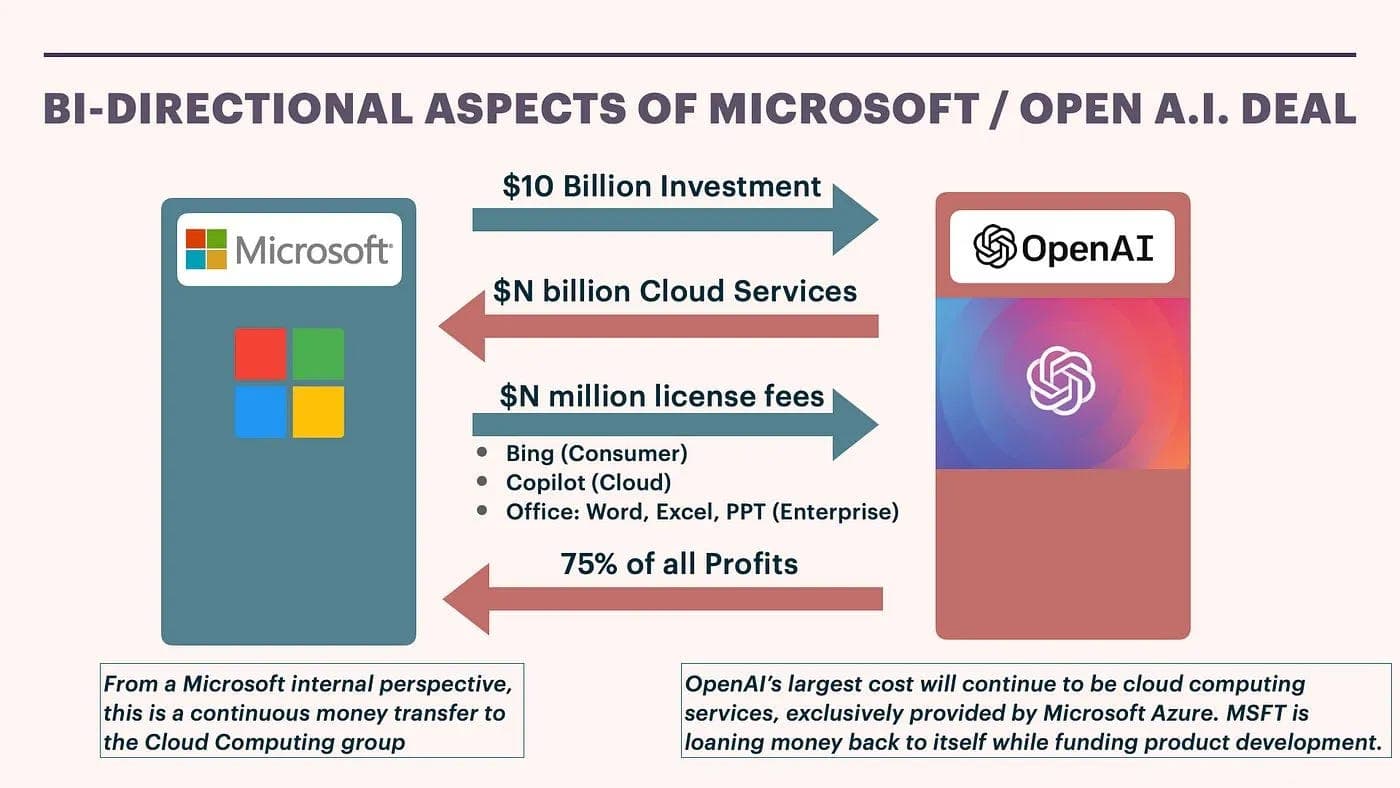
A new agreement between OpenAI and Microsoft has been finalized, according to a report from analyst @mweinbach. The deal restructures the financial and operational relationship between the two companies, with two primary effects:
- Loosens Microsoft's grip on OpenAI: The agreement reduces Microsoft's exclusive control over OpenAI's operations, likely allowing OpenAI more freedom in choosing cloud providers, licensing arrangements, or partnership structures.
- Massive increase in Azure AI revenue: Microsoft will see a significant boost in revenue from Azure AI services, crucially without any profit-sharing arrangement with OpenAI. This means Microsoft keeps 100% of the margin on the additional Azure AI workload.
Context
Microsoft has been OpenAI's primary cloud partner since 2019, investing billions into the company. The relationship has been complex: Microsoft provides the computational infrastructure for training and running OpenAI's models, while OpenAI's technology drives Microsoft's Copilot and Azure OpenAI Service offerings.
This new deal appears to be a recalibration. By loosening exclusivity, OpenAI gains strategic flexibility—potentially to negotiate with other cloud providers or to pursue its own infrastructure ambitions. For Microsoft, the trade-off is clear: more Azure revenue without sharing profits with OpenAI.
What This Means in Practice

- For OpenAI: Greater independence from Microsoft's strategic direction, potentially enabling partnerships with other enterprises or cloud providers.
- For Microsoft: A pure revenue play—Azure AI workloads increase, and Microsoft captures the full margin. This aligns with Microsoft's broader strategy of monetizing AI infrastructure rather than just AI model licensing.
- For the market: Signals that the exclusive cloud partnership model for frontier AI labs may be evolving. Expect other cloud providers (Google Cloud, AWS) to compete more aggressively for OpenAI's non-exclusive business.
Frequently Asked Questions
Does this mean OpenAI is leaving Azure?
No. OpenAI will continue to use Azure for a significant portion of its compute needs, but the deal reduces Microsoft's exclusive control. OpenAI can now potentially use other cloud providers for certain workloads.
How does this affect Microsoft's AI strategy?
Microsoft benefits from increased Azure AI revenue without profit-sharing, strengthening its cloud business. The company can still offer OpenAI models through Azure OpenAI Service, but with less strategic dependency.
Why would Microsoft agree to loosen its grip on OpenAI?
Microsoft likely calculated that the increased Azure revenue from OpenAI's growing compute needs—without sharing profits—outweighs the value of exclusivity. It's a bet on volume over control.
Does this impact OpenAI's valuation or IPO plans?
Indirectly, yes. Greater operational independence could make OpenAI more attractive to investors or partners, and could simplify any future IPO by reducing Microsoft's contractual influence.
gentic.news Analysis
This deal is a pragmatic recalibration of one of the most consequential partnerships in AI. Microsoft's original investment in OpenAI was strategic—lock in the leading AI lab to Azure, gain early access to frontier models, and build Copilot on top. But that exclusivity became a liability as OpenAI's compute demands exploded and regulatory scrutiny of the Microsoft-OpenAI relationship intensified.
By loosening the exclusivity, Microsoft trades control for cash flow. The "massive increase in Azure AI revenue" without profit-sharing is a straight-up infrastructure play—Microsoft becomes the utility provider rather than the strategic partner. This mirrors the broader trend we've covered: cloud providers are increasingly monetizing AI workloads as a volume business, not a margin business.
For OpenAI, the flexibility is valuable. The company has been exploring building its own data centers and diversifying compute sources. This deal gives them room to negotiate better terms with Azure or other providers, potentially lowering their largest cost line—inference and training compute.
The key question is: how much of OpenAI's compute will stay on Azure? If the revenue increase is truly "massive," OpenAI's total compute spend must be growing rapidly, and Microsoft is capturing a larger share of that growth. But if OpenAI shifts significant workloads elsewhere, Microsoft's gain may be short-lived. The deal structure suggests Microsoft is betting that OpenAI's growth will outpace any diversification—a reasonable bet given the current AI demand trajectory.
This also has implications for the broader AI ecosystem. Other frontier labs (Anthropic, Cohere, xAI) have their own cloud partnerships. If the OpenAI-Microsoft model shifts toward looser ties with higher revenue, we may see similar restructurings across the industry. The era of exclusive cloud-AI lab marriages may be giving way to a more transactional, multi-cloud future.