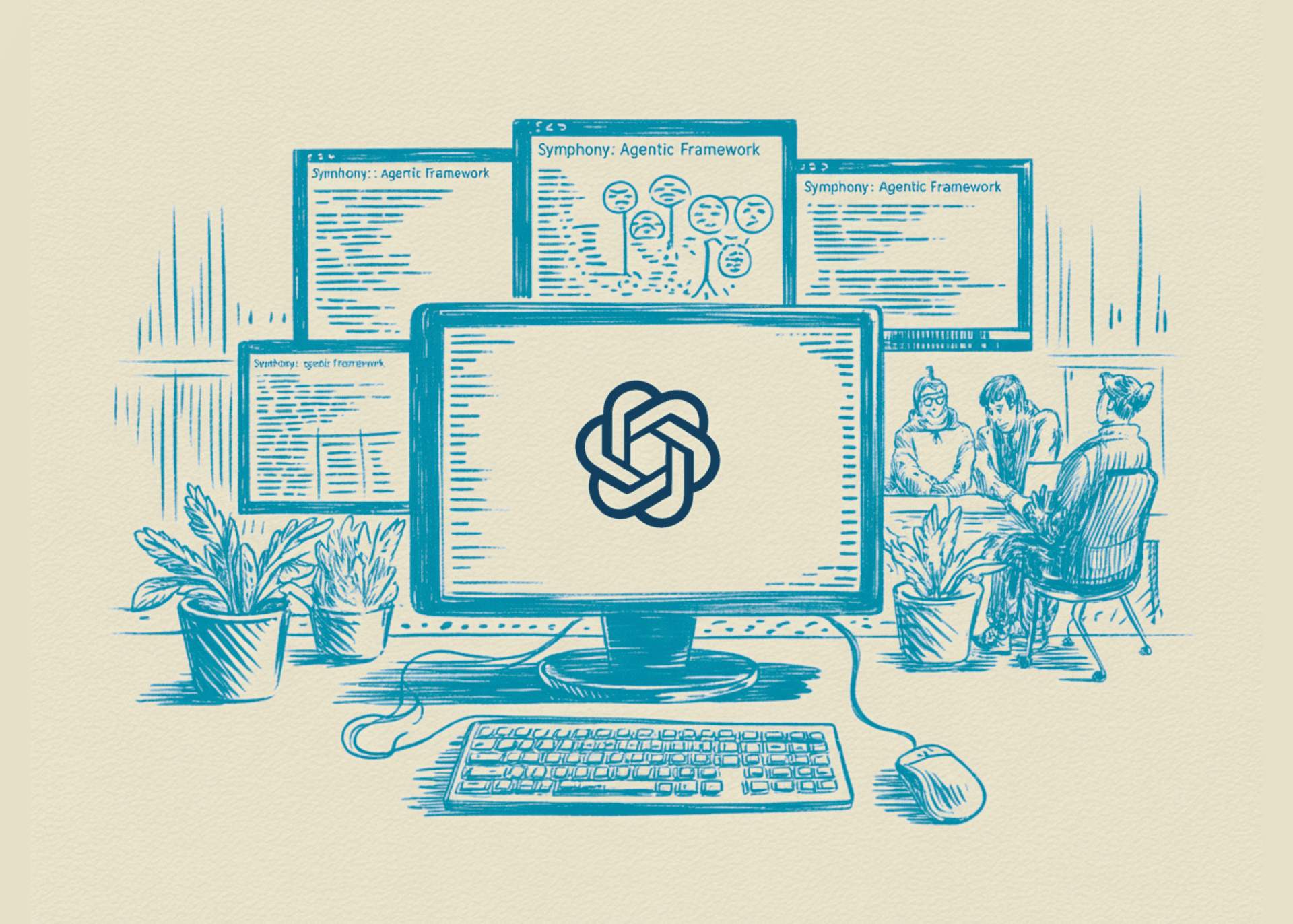
In a significant move that bridges cutting-edge AI research with practical software engineering, OpenAI has released Symphony, an open-source framework designed to orchestrate autonomous AI coding agents through structured "implementation runs." This release represents a strategic shift toward making sophisticated agentic AI systems accessible and scalable for real-world development workflows.
What Is Symphony?
Symphony is fundamentally a system for automating software development tasks by connecting issue trackers directly to LLM-based autonomous agents. The framework provides a structured approach to what OpenAI terms "implementation runs"—systematic processes where AI agents can interpret development tickets, plan solutions, write code, test implementations, and manage the entire software development lifecycle with minimal human intervention.
Unlike previous AI coding assistants that operate primarily as enhanced autocomplete tools, Symphony represents a paradigm shift toward fully autonomous development agents that can understand complex requirements, break them down into actionable steps, and execute those steps while maintaining context across multiple development cycles.
Technical Architecture: Built for Scale
One of Symphony's most notable technical choices is its foundation on Elixir and the Erlang/BEAM runtime. This stack selection is particularly significant for several reasons:

Concurrency and Fault Tolerance: The BEAM virtual machine, originally designed for telecommunications systems, provides exceptional capabilities for handling massive numbers of concurrent processes. This makes Symphony inherently suited for orchestrating multiple AI agents working simultaneously on different aspects of a software project.
Reliability: Erlang's "let it crash" philosophy, combined with supervisor trees, ensures that individual agent failures don't bring down the entire system—a critical requirement for production AI systems that must maintain continuous operation.
Distributed Computing: BEAM's native support for distributed computing aligns perfectly with the needs of enterprise software development environments where tasks might need to be distributed across multiple servers, teams, or even geographical locations.
This architectural choice suggests OpenAI has designed Symphony not as a research prototype but as a production-ready system intended for enterprise-scale deployment.
Context and Timing: Why Symphony Matters Now
Symphony's release comes at a pivotal moment in AI development. Recent reports indicate that AI agents have crossed a critical reliability threshold, fundamentally transforming programming capabilities. Simultaneously, AI is beginning to appear in official productivity statistics, potentially resolving the long-standing "productivity paradox" where technological advances haven't consistently translated to measured productivity gains.
OpenAI's own ecosystem provides important context. The company recently released GPT-5.4, which achieves 82% human parity on professional tasks, and is developing groundbreaking bidirectional audio models for natural conversations. Symphony appears designed to leverage these advanced models within structured development workflows.
Perhaps most telling is the timing relative to OpenAI's broader strategy. With partnerships spanning from the U.S. Department of Defense to McKinsey & Company and Capgemini, OpenAI is clearly positioning itself as an enterprise AI solutions provider. Symphony represents a tangible product that addresses real business needs: automating software development at scale.
The Implementation Run: Symphony's Core Innovation
At the heart of Symphony lies the concept of the "implementation run"—a structured process that guides AI agents through software development tasks. While technical details remain emerging, this likely involves:

- Requirement Interpretation: Agents parse development tickets, user stories, or bug reports to understand what needs to be built or fixed.
- Solution Planning: Breaking down complex problems into manageable coding tasks with dependencies and sequencing.
- Code Generation: Writing actual code in appropriate languages and frameworks.
- Testing and Validation: Creating and running tests to ensure code quality and functionality.
- Integration and Deployment: Managing the integration of new code into existing codebases and deployment pipelines.
This structured approach contrasts with more free-form AI coding assistance and suggests Symphony may incorporate verification mechanisms, quality gates, and rollback capabilities to ensure reliable outcomes.
Implications for Software Development
For Developers
Symphony could fundamentally change the developer's role from writing every line of code to orchestrating and supervising AI agents. This doesn't eliminate programming jobs but transforms them toward higher-level architecture, design, and quality assurance functions. Developers might spend more time defining problems clearly, reviewing AI-generated solutions, and ensuring system integration rather than manual coding.
For Organizations
Companies facing the "cost crisis in LLM implementation"—highlighted by recent reports of developers incurring $847.32 monthly bills for OpenAI usage—may find Symphony offers a more structured, efficient approach to leveraging AI in development. By automating routine coding tasks, organizations could potentially reduce development costs while accelerating delivery timelines.
For the AI Industry
Symphony represents OpenAI's entry into the increasingly competitive AI agent orchestration market. By open-sourcing the framework, OpenAI follows a familiar playbook: establish a standard, build an ecosystem, and position its proprietary models (like GPT-5.4) as the preferred engines powering that ecosystem.
This move also responds to growing competition from companies like Anthropic and Google in the AI development tools space. By providing an open framework, OpenAI may hope to attract third-party integrations and establish Symphony as a de facto standard for AI-assisted development.
Challenges and Considerations
Despite its promise, Symphony faces significant challenges:
Quality Assurance: Ensuring AI-generated code meets security, performance, and maintainability standards remains non-trivial. Symphony will need robust validation mechanisms.
Integration Complexity: Connecting Symphony to existing development tools, workflows, and corporate systems represents a substantial implementation challenge.
Skill Shifts: Organizations will need to develop new skills around AI agent orchestration, prompt engineering for development tasks, and hybrid human-AI workflow design.
Ethical and Legal Considerations: Questions around code ownership, liability for bugs, and the impact on software engineering careers will need addressing as these systems mature.
Looking Forward
Symphony represents more than just another AI tool—it's a vision for how software development itself might evolve in an AI-native era. By providing structure to AI agent orchestration, OpenAI is attempting to move beyond simple code generation toward comprehensive development automation.
The choice to build on Elixir and BEAM suggests serious intentions toward enterprise adoption, while the open-source approach aims to accelerate ecosystem development. As AI agents continue crossing reliability thresholds, frameworks like Symphony may become essential infrastructure for software development, potentially transforming how we build everything from mobile apps to enterprise systems.
What remains to be seen is how quickly the developer community embraces this paradigm, what innovations emerge around Symphony's core framework, and whether this represents the beginning of truly autonomous software development or another step in the gradual augmentation of human developers with AI capabilities.
Source: MarkTechPost, March 5, 2026