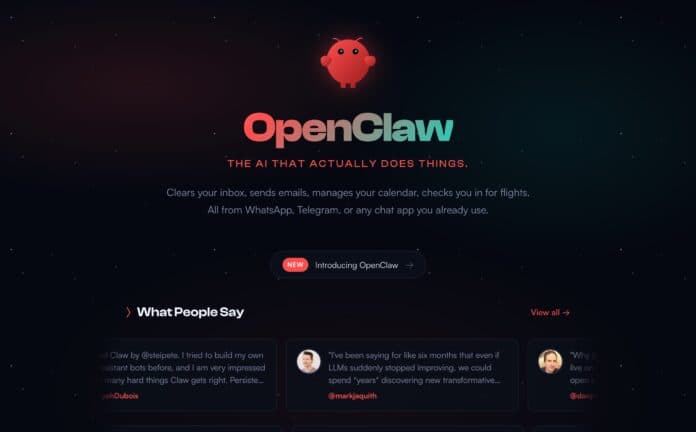
The Chinese technology sector is experiencing a significant surge, driven by intense market hype surrounding a new AI development. According to reports from industry observers, the launch or announcement of an AI agent called OpenClaw has created a wave of investor enthusiasm so powerful that it is directly impacting stock valuations.
The Market Reaction
Social media reports indicate that "tech stocks are shooting through the roof for any company" perceived to be connected to the OpenClaw ecosystem or the broader AI agent trend it represents. This suggests a classic market frenzy, where investor sentiment is rapidly capitalizing on the perceived potential of a new technological paradigm. The reaction highlights the Chinese market's acute sensitivity to breakthroughs in applied artificial intelligence, particularly in tools that promise to automate complex tasks or workflows.
Understanding the "AI Agent" Hype
While specific technical details of OpenClaw are not provided in the source, the term "AI agent" typically refers to a sophisticated software program that can perceive its environment, make decisions, and take actions to achieve specific goals autonomously. Unlike standard chatbots or copilots that respond to direct prompts, advanced AI agents can break down multi-step problems, use tools (like web browsers, calculators, or software APIs), and execute longer-term tasks with minimal human intervention.
The hype suggests OpenClaw may represent a significant leap in this capability, potentially rivaling or exceeding other international projects like OpenAI's GPT-based agents or Google's Gemini ecosystem. The excitement likely stems from its potential applications across industries—from automating customer service and data analysis to managing complex business logistics and software development pipelines.
Context: China's Competitive AI Landscape
This market event occurs within the fiercely competitive landscape of Chinese AI development. China has declared artificial intelligence a national strategic priority, leading to substantial investment and rapid innovation. Domestic tech giants like Baidu (with Ernie), Alibaba, and Tencent are in a constant race to develop and deploy cutting-edge AI.
The explosive stock market reaction to OpenClaw indicates that the market is hungry for the "next big thing" that could define a new phase of AI utility beyond large language models (LLMs). It signals a shift in investor focus from foundational model capabilities to practical, agentic applications that can generate tangible business value and productivity gains.
Implications for Global AI Development
The fervor in China serves as a leading indicator for global AI trends. When a major tech market reacts this strongly, it often presages increased investment and competitive pressure worldwide. Other global tech firms and investors will likely scrutinize the OpenClaw phenomenon, accelerating their own work on agentic AI to avoid falling behind.
Furthermore, this development underscores the bifurcated nature of the current AI race. While the U.S. leads in several foundational model categories, China is demonstrating its capacity for rapid commercialization and market-driven application innovation. The success of an agent like OpenClaw could challenge the narrative of Western dominance in applied AI.
Potential Risks and Considerations
Such rapid market euphoria also carries inherent risks. Investor excitement can outpace the actual technological maturity or commercial readiness of a product, potentially leading to volatility. There is also the question of scalability, reliability, and the real-world performance of such an agent outside controlled demonstrations.
Regulatory scrutiny may also follow, as powerful autonomous agents raise questions about accountability, data privacy, and economic disruption. How Chinese regulators approach this new wave of AI tools will be closely watched as a model for other governments.
The Road Ahead
The coming months will be critical for OpenClaw and the companies its success has buoyed. The market will shift from hype to demanding demonstrable results, user adoption metrics, and revenue impact. Whether OpenClaw becomes a transformative platform or a flash in the pan will depend on its technical robustness, developer ecosystem support, and ability to solve real-world problems at scale.
For the global AI community, the message is clear: the race to build useful, autonomous AI agents has entered a heated new phase, with China positioned as a major catalyst and competitor.
Source: Reports from industry observer @rohanpaul_ai on social media, highlighting market reactions in China.