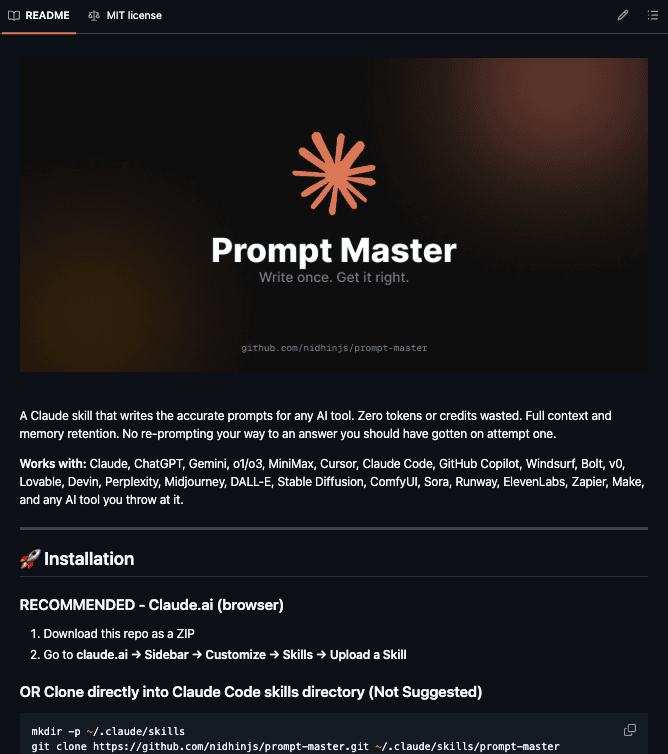
A new, free Claude skill called Prompt Master has launched, designed to generate the "perfect prompt" for a wide range of AI tools on the first attempt. The tool, which is 100% open-source, aims to eliminate the trial-and-error process of prompt engineering, reducing wasted API credits and repeated attempts.
What Prompt Master Does
Prompt Master is a skill that integrates directly with Anthropic's Claude. Its core function is to accept a user's intent or task description and output a fully optimized, ready-to-use prompt tailored for a specific AI tool. According to the announcement, it supports 18+ tools right out of the box, including:
- Text/Code Models: Claude, ChatGPT, Cursor, o3 (by xAI), Bolt
- Image Generation: Midjourney
- Voice Synthesis: ElevenLabs
- UI/Design Tools: v0 (by Vercel)
The claim is that it requires "no re-prompts" and delivers a working prompt on the "first try," positioning it as a potential efficiency booster for developers, designers, and content creators who regularly switch between different AI platforms.
Technical Details & Availability
The skill is described as a single install and is 100% open-source. This suggests developers can inspect, modify, and potentially contribute to its codebase, likely hosted on a platform like GitHub. Its primary integration point is with Claude, meaning users would activate the skill within a Claude chat session to generate prompts for other services.
There is no mentioned pricing, subscription, or credit system for Prompt Master itself—it is presented as a free tool. The value proposition is indirect savings: by generating more effective prompts on the first attempt, users waste fewer credits on the underlying, often paid, AI services like ChatGPT Plus or Midjourney.
How It Compares to Existing Prompt Tools
The prompt optimization and management space has several existing players:
- Browser Extensions & SaaS Platforms: Tools like AIPRM for ChatGPT offer curated prompt templates but are often closed-source and tied to a single platform.
- Standalone Prompt Engineers: Many guides and experts sell optimized prompt collections, but these are static and not dynamically generated for a user's specific need.
- Meta-Prompting: A common advanced technique where users ask one LLM (like Claude) to craft a prompt for another (like Midjourney). Prompt Master appears to productize and standardize this meta-prompting process across a broad toolset.
Prompt Master's differentiators are its multi-tool support, first-try optimization claim, and its open-source, free model.
What to Watch: Limitations and Practical Performance
The announcement makes a strong claim about "perfect" prompts on the "first try." In practice, prompt quality is highly subjective and task-dependent. Key questions for practitioners include:
- Benchmarking: How is "perfect" or "optimized" defined? Without published benchmarks against baseline prompts, the performance claim is anecdotal.
- Tool-Specific Nuances: Can a single skill truly master the intricate, evolving prompt syntax of 18 different tools (e.g., Midjourney's parameters, Cursor's project-aware directives)?
- Abstraction Risk: For complex tasks, the best prompt often requires deep, iterative understanding of the target model's behavior. A fully automated tool might obscure this learning process.
The true test will be community adoption and whether the generated prompts consistently produce superior outputs across the supported tools compared to manual crafting.
gentic.news Analysis
This development is a direct response to a persistent pain point in the fragmented AI tool ecosystem: high switching costs and skill transfer between platforms. Prompt Master attempts to act as a universal translator for user intent. Its emergence aligns with two broader trends we've been tracking. First, the commoditization of prompt engineering—treating effective prompting not as an arcane art but as a solvable software problem. Second, the strategic positioning of Claude as a "meta-agent" or orchestrator. Anthropic has consistently focused on Claude's reasoning and instruction-following capabilities, making it a natural platform to host a tool designed to reason about the optimal instructions for other AIs.
The decision to be open-source is significant. It invites the community to expand the tool's library, add support for new AI services as they launch (like Google's Gemini API or emerging coding agents), and build trust through transparency. This contrasts with closed, paid prompt marketplaces. However, it also places the burden of maintenance and quality control on the community. If successful, Prompt Master could lower the barrier to entry for leveraging multiple AI tools effectively, but its long-term viability will depend on the robustness of its core prompting engine and the active engagement of its open-source contributors.
Frequently Asked Questions
What is Prompt Master?
Prompt Master is a free, open-source skill for Anthropic's Claude AI that automatically generates optimized prompts for over 18 different AI tools—including ChatGPT, Midjourney, and Cursor—based on a user's simple task description. It aims to provide a working prompt on the first attempt.
Is Prompt Master really free?
Yes, the Prompt Master skill itself is free and open-source. However, you will need access to Claude (likely through Claude.ai or the API) to use it, and you will still incur normal usage costs for the target AI tools (like ChatGPT Plus, Midjourney credits, or ElevenLabs API calls).
How do I install and use Prompt Master?
While the source announcement doesn't provide detailed steps, as an open-source Claude skill, installation likely involves accessing its code repository (e.g., on GitHub) and following instructions to integrate it with your Claude interface, potentially via the Claude desktop app or API. Once installed, you would activate the skill within a Claude chat.
Can Prompt Master create prompts for any AI tool?
Currently, it supports a listed set of 18+ tools, including major players like ChatGPT, Midjourney, and ElevenLabs. Its open-source nature means the community can contribute to adding support for new tools. It is not a universal solution for every possible AI application but covers a wide range of popular categories.