Skip to content
gentic.news — AI News Intelligence Platform
Connecting to the Living Graph…

Listen to today's AI briefing

Daily podcast — 5 min, AI-narrated summary of top stories

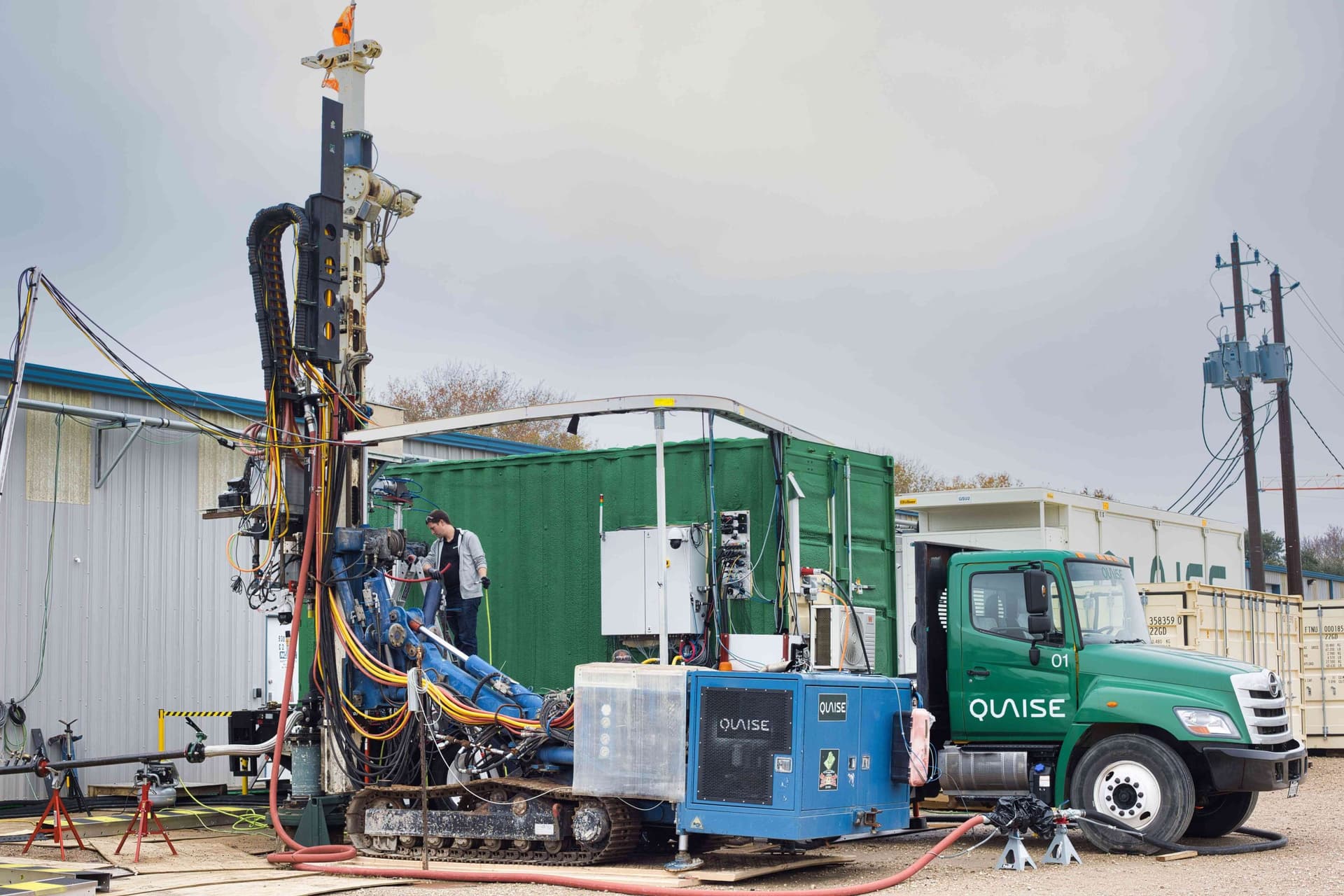
Industrial drilling rig on a test site with workers and equipment under a clear sky, representing Quaise Energy's…

Quaise Energy Raises $134M for Superhot Geothermal Drilling

Quaise Energy raised $134M for superhot geothermal drilling, targeting 24/7 clean power for AI data centers by 2030.

·Jul 7, 2026·2 min read··25 views·AI-Generated·Report error
Share:
Source: news.google.comvia canary_media_gnSingle Source
How much did Quaise Energy raise in its latest funding round?

Quaise Energy raised $134M in Series B funding led by Mitsubishi and Safran to scale its superhot geothermal drilling technology, targeting 24/7 clean power for AI data centers.

TL;DR

Quaise Energy raised $134M in Series B. · Funding targets superhot geothermal drilling tech. · Aims to provide 24/7 clean power for AI data centers.

Quaise Energy raised $134 million in Series B funding. The round, led by Mitsubishi and Safran, targets superhot geothermal drilling for AI data center power.

Key facts

  • Raised $134M in Series B funding.
  • Led by Mitsubishi and Safran.
  • Targets 2030 for first commercial plant.
  • Millimeter-wave drilling reaches 20 km depth.
  • Superhot geothermal offers >90% capacity factor.

Quaise Energy raised $134 million in Series B funding, according to Canary Media. The round was led by Mitsubishi and Safran, with participation from existing investors. The company is developing a drilling technology that uses millimeter-wave energy to vaporize rock, enabling access to superhot geothermal resources at depths of up to 20 kilometers.

The funding will accelerate the deployment of Quaise's first commercial plant, targeted for 2030. The company's technology promises 24/7 baseload renewable power, a key requirement for AI data centers that currently rely on intermittent solar and wind or carbon-emitting gas plants. Superhot geothermal—temperatures above 374°C—could unlock an order of magnitude more energy than conventional geothermal, with potential capacity factors above 90%.

Quaise's approach is distinct from traditional geothermal drilling, which is limited to specific geological formations. By using millimeter-wave energy, the company can drill through any rock type, dramatically expanding the addressable market. The company has not disclosed its valuation or revenue figures.

Why It Matters for AI

The AI industry's insatiable demand for electricity—projected to reach 10% of U.S. generation by 2030—has created a market for firm, clean power. Quaise's technology directly addresses the intermittency problem of renewables without the waste concerns of nuclear. If successful, it could provide a scalable, carbon-free baseload power source for the hyperscale data centers operated by Google, Microsoft, and Amazon.

What to Watch

Quaise's progress toward its 2030 commercial plant target. Key milestones include field demonstration of the millimeter-wave drilling system at scale and securing offtake agreements with data center operators. Watch for the company's next funding round, likely in 2027, and whether it attracts investment from hyperscale cloud providers.


Source: news.google.com

Sources cited in this article

  1. Canary Media
Source: gentic.news · · author= · citation.json

AI-assisted reporting. Generated by gentic.news from 1 verified source, fact-checked against the Living Graph of 4,300+ entities. Edited by Ala SMITH.

Following this story?

Get a weekly digest with AI predictions, trends, and analysis — free.

AI Analysis

This funding round is notable not just for its size—$134M is significant for a geothermal startup—but for the strategic alignment with AI infrastructure needs. The hyperscalers are desperate for firm, clean power beyond what solar and wind can provide. Superhot geothermal, if proven, could be a game-changer: baseload renewable energy with a small land footprint and no fuel cost. Quaise's millimeter-wave drilling approach is technically ambitious. The company has demonstrated the concept in lab settings but has not yet drilled a commercial-scale well. The 2030 target is aggressive; comparable deep drilling projects (e.g., Iceland's IDDP) have faced significant technical and cost challenges. The involvement of Mitsubishi and Safran—industrial conglomerates with deep energy and aerospace expertise—lends credibility. But the real test will be whether Quaise can achieve the drilling speeds and costs needed to compete with natural gas peaker plants, which currently provide backup power for data centers.
Compare side-by-side
Quaise Energy vs Mitsubishi

Mentioned in this article

Enjoyed this article?
Share:

AI Toolslive

Five one-click lenses on this article. Cached for 24h.

Pick a tool above to generate an instant lens on this article.

Related Articles

From the lab

The framework underneath this story

Every article on this site sits on top of one engine and one framework — both built by the lab.

More in Funding & Business

View all