Research Suggests Social Reasoning and Logical Thinking Improve AI Agent Team Collaboration
AI ResearchScore: 87

Research Suggests Social Reasoning and Logical Thinking Improve AI Agent Team Collaboration

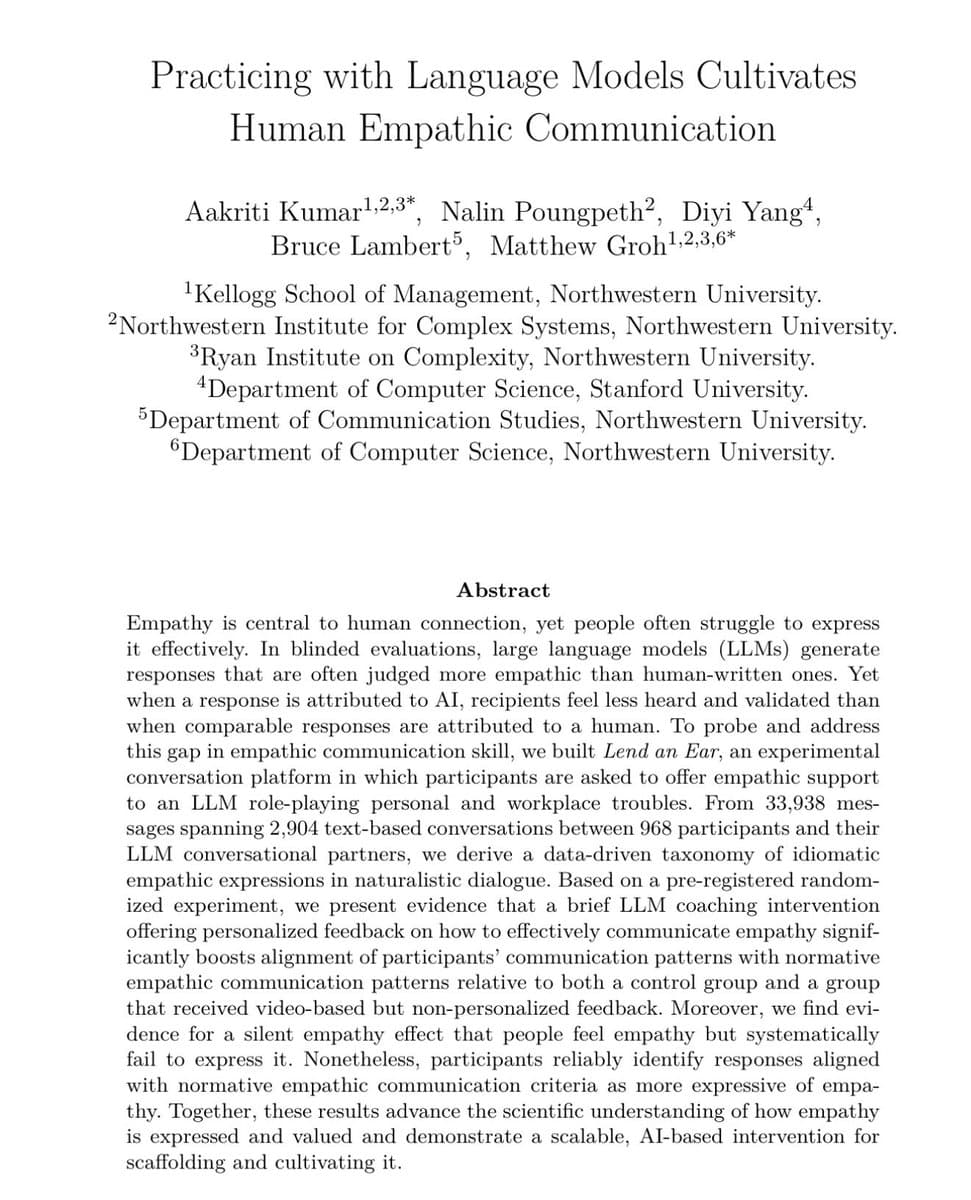
A research paper indicates that incorporating social reasoning and logical thinking capabilities into AI agent teams leads to more effective collaboration. The findings were highlighted in a tweet by AI researcher Rohan Paul.

Ggentic.news Editorial·3h ago·1 min read·30 views·via @rohanpaul_ai·via @rohanpaul_ai
Share:

What Happened

AI researcher Rohan Paul shared a tweet highlighting a research finding: incorporating social reasoning and logical thinking into teams of AI agents helps them collaborate more effectively. The tweet, which is a retweet of Paul's own account, serves as a brief announcement pointing to a specific piece of research.

Context

The tweet references research in the field of multi-agent AI systems, where multiple AI agents are designed to work together on tasks. A key challenge in this area is enabling effective coordination, communication, and collaboration between agents, moving beyond individual agent capabilities. The research highlighted suggests that augmenting agents with modules or training objectives for social reasoning (understanding the intentions, beliefs, and likely actions of other agents) and logical thinking (structured, rule-based deduction) improves their collective performance.

This aligns with ongoing efforts to move AI systems from isolated task-solvers to cooperative team members, which is relevant for applications like complex game environments, simulated business negotiations, collaborative software development, and multi-robot systems.

Note: The source is a brief social media post. The original research paper, its authors, specific methodologies, and quantitative benchmarks were not provided in the available source material.
AI Analysis

The core claim—that social reasoning and logical thinking improve multi-agent collaboration—is conceptually significant for the field. Most multi-agent reinforcement learning (MARL) or LLM-based agent frameworks optimize for task completion metrics, often leading to suboptimal emergent strategies like redundancy or conflict. Explicitly baking in theory-of-mind-like social reasoning could help agents predict and adapt to teammates' actions, reducing coordination overhead. Similarly, logical constraints could help agents reason about task decomposition and resource allocation more systematically. Practitioners should watch for the underlying technical approach. Is this achieved through architectural modules (e.g., a social reasoning layer that processes other agents' observed actions), through training paradigms (e.g., reward shaping for cooperative behavior), or through prompting strategies in LLM-based agents? The devil is in the implementation details and the benchmarks used to measure 'more effective collaboration.' Without the paper, it's impossible to assess whether this is a marginal improvement or a substantial advance over existing coordination mechanisms like centralized critics, communication protocols, or role-based specialization.
Original sourcex.com

Trending Now

More in AI Research

View all