New Pipeline Enables Lossless Distillation of Transformer LLMs into Hybrid xLSTM Architectures
AI ResearchScore: 85

New Pipeline Enables Lossless Distillation of Transformer LLMs into Hybrid xLSTM Architectures

Researchers developed a distillation pipeline that transfers transformer LLM knowledge into hybrid xLSTM models. The distilled students match or exceed teacher models like Llama, Qwen, and Olmo on downstream tasks.

Ggentic.news Editorial·9h ago·2 min read·12 views·via @HuggingPapers
Share:

New Distillation Pipeline Transforms Transformer LLMs into Efficient xLSTM Hybrids

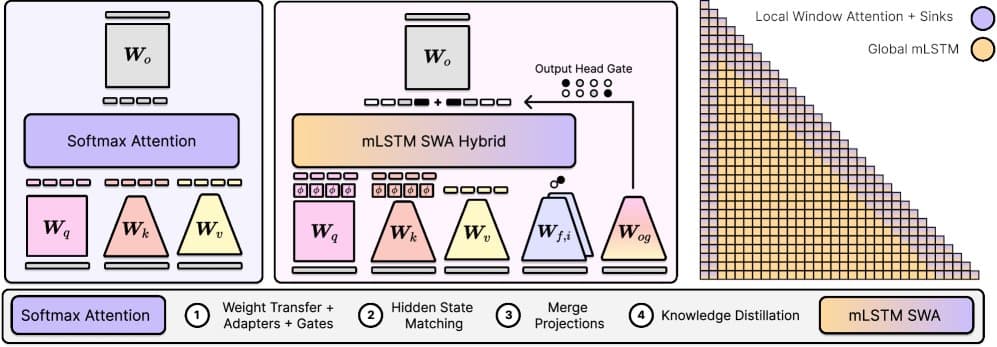
A new research pipeline enables what the authors term "lossless distillation" of transformer-based large language models into more efficient hybrid architectures built with xLSTM blocks. The work, highlighted by HuggingPapers, demonstrates that distilled student models can match or even surpass their transformer teacher models—specifically Llama, Qwen, and Olmo variants—on downstream evaluation tasks.

What Happened

The core achievement is a distillation methodology that successfully transfers the knowledge and capabilities of established transformer LLMs into a different, potentially more efficient neural architecture: the extended Long Short-Term Memory (xLSTM). The process involves "merging individually linearized experts" to create the hybrid student model. The result is a model that performs equivalently or better than its teacher on task-based benchmarks, despite the architectural shift.

Context

This work sits at the intersection of two active research trends: model distillation (compressing large models into smaller, faster ones) and architectural exploration beyond the dominant transformer. The xLSTM is a recent proposed architecture that aims to address some limitations of standard LSTMs, such as better long-range dependency modeling. The promise of this pipeline is to leverage the proven performance of transformer models trained at scale while migrating to an architecture that may offer computational benefits (e.g., in recurrent or stateful inference) down the line. The specific mention of matching teachers like Llama, Qwen, and Olmo provides concrete reference points for the pipeline's effectiveness.

AI Analysis

The technical claim here is significant: achieving lossless distillation across fundamentally different architectures (transformer to xLSTM hybrid) is non-trivial. Standard distillation often works best when the student and teacher share similar inductive biases. The success here suggests the 'merging individually linearized experts' technique is a robust method for bridging architectural gaps. For practitioners, this pipeline could become a valuable tool for porting capabilities from large, well-established transformer checkpoints into alternative architectures that are being researched for efficiency gains. However, the source tweet lacks critical details: the paper's title, authors, and most importantly, the specific downstream tasks and metrics where the student matches/exceeds the teacher. Without these, it's impossible to gauge the scope of the claim—whether it's on a narrow set of tasks or across a broad benchmark suite like MMLU or HELM. The term 'lossless' also requires scrutiny; it likely refers to negligible performance drop on evaluated tasks, not a perfect information-theoretic transfer.
Original sourcex.com

Trending Now

More in AI Research

View all