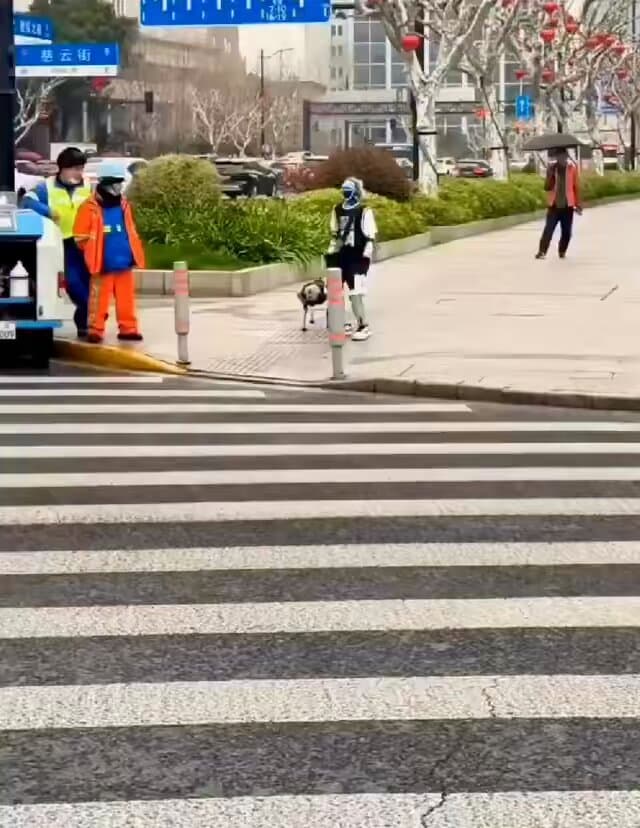
A brief video circulating on social media has captured a remarkable and somewhat surreal moment in urban robotics: a humanoid robot walking across a street in Shanghai while holding a leash attached to a robotic dog. The clip, shared by AI commentator Rohan Paul, presents a straightforward but potent visual of two distinct forms of advanced robotics operating in tandem in an everyday public setting.
The Scene on the Street
The footage shows the humanoid robot, of an unspecified make and model, navigating a crosswalk or street. Its gait appears steady and purposeful. In its hand, it holds a leash, which is connected to a quadrupedal robotic dog—a form factor popularized by companies like Boston Dynamics and widely replicated by Chinese robotics firms. The robodog follows alongside, completing the picture of a robotic "owner" walking its robotic "pet." The setting is unmistakably urban Shanghai, with typical city background elements visible.
This is not a controlled lab demo or a staged corporate presentation. The value of the clip lies in its candid, real-world context. It shows these machines operating outside a curated environment, dealing with the minor unpredictabilities of a pavement surface, potential obstacles, and the simple act of coordinated movement. The normalcy of the setting contrasts sharply with the advanced technology on display.
The Significance of Multi-Agent Collaboration
While impressive individually, the core development hinted at here is multi-agent robotic collaboration. The scene is a simple but effective demonstration of two autonomous or semi-autonomous systems working together to perform a task—in this case, coordinated locomotion. The humanoid provides high-level navigation and decision-making (where to walk, when to cross), while the leashed dog-like robot follows, potentially handling lower-level terrain adaptation.
This mirrors a fundamental direction in robotics research: moving beyond single, isolated robots to teams of heterogeneous robots that can collaborate. A humanoid can open doors, press buttons, and manipulate objects designed for humans, while a quadruped can traverse rough terrain, climb stairs, and provide a stable mobile platform. Together, they can tackle a wider range of real-world tasks than either could alone. The leash, while a simple physical tether, symbolizes a command-and-follow relationship that could be managed through more complex communication protocols in future applications.
China's Accelerating Robotics Landscape
The location—Shanghai—is no accident. China has made advanced robotics, including humanoids and quadrupedal robots, a national strategic priority. Chinese companies like Unitree Robotics (a leader in consumer and commercial robodogs) and numerous humanoid startups are pushing development at a blistering pace, often focusing on cost reduction and rapid commercialization.
Public demonstrations like this serve multiple purposes. They act as de facto stress tests in unscripted environments, generate public familiarity and acceptance, and showcase technological progress. For China's tech ecosystem, such visible milestones are also points of national pride and global signaling in a competitive field long dominated by American and Japanese firms.
From Novelty to Normalcy: The Path to Integration
The viral nature of the clip underscores how such technology remains a novelty. The sight provokes curiosity and surprise. However, the ultimate goal for developers is the opposite: for such scenes to become unremarkable. The path to useful integration of robots into human spaces—for logistics, security, assistance, or maintenance—requires them to operate reliably and safely alongside people and traffic.
This street-crossing demo touches on several key challenges:
- Navigation and Perception: Both robots must perceive curbs, moving vehicles, and pedestrians.
- Social Navigation: They must move in a predictable, non-threatening manner that adheres to social norms (e.g., using crosswalks).
- Durability and Reliability: A public street offers no guarantees of a smooth, clean operating surface.
Successfully managing this simple scenario is a small but necessary step toward more complex deployments.
Ethical and Social Considerations on the Horizon
As these technologies move from labs to streets, a new set of questions emerges. Who is liable if this robotic duo causes an obstruction or accident? How do we ensure public safety and privacy when robots with sensors become commonplace in public areas? Furthermore, what are the long-term societal implications of normalizing autonomous machines in shared human spaces?
The Shanghai scene, while seemingly lighthearted, is a concrete data point in this broader conversation. It makes the abstract future of human-robot coexistence suddenly tangible and immediate.
What Comes Next?
The video is a snapshot, not a full technical disclosure. It doesn't reveal the level of autonomy (fully autonomous, remotely supervised, or teleoperated), the specific models, or the purpose of the exercise (a test, a demonstration, or a specific functional task).
Nevertheless, it clearly points to the trend. The next steps will involve more complex collaborative tasks, longer durations of operation, and integration into practical workflows. Imagine a humanoid-robot-dog team inspecting construction sites at night, providing security patrols, or delivering packages in complex urban environments where wheeled robots struggle.
The image of a robot walking another robot down a Shanghai street is more than a quirky internet moment. It is a vivid, early-frame glimpse into a future where different forms of embodied AI will learn to work together, eventually fading into the background of our daily lives.
Source: Footage and report originally shared by Rohan Paul (@rohanpaul_ai) on X, depicting a scene in Shanghai.