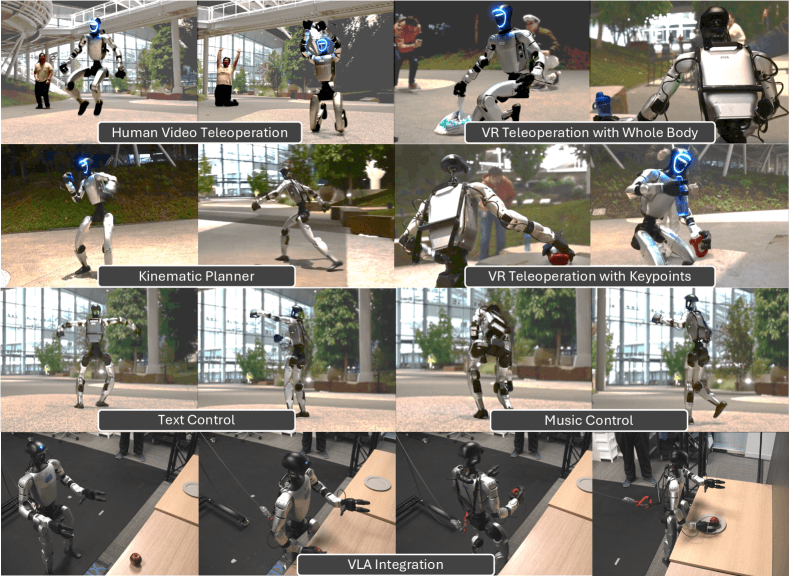
In a development that could reshape the future of robotics, researchers have demonstrated that robotic systems can scale in ways previously thought exclusive to language models. The SONIC (Scalable One-shot Neural Imitation Control) system has achieved what many considered impossible: training a 42-million parameter model on 100 million frames of human motion data and achieving perfect transfer to real-world robots without any fine-tuning.
The Scaling Paradigm Shift
For years, the AI community has witnessed the remarkable scaling properties of language models—as parameter counts and training data increased, capabilities improved predictably. Robotics, however, remained stubbornly resistant to this scaling law approach. Each robot typically required extensive customization, environment-specific training, and painstaking fine-tuning to perform even basic tasks.
SONIC changes this equation entirely. By leveraging massive-scale imitation learning from human demonstrations, the system has shown that robotic control can benefit from the same scaling principles that transformed natural language processing. The 42-million parameter model, while modest compared to today's largest language models, represents a breakthrough in robotic architecture design and training methodology.
How SONIC Works: Architecture and Training
The SONIC system operates on a deceptively simple premise: learn from human motion at unprecedented scale. Researchers collected 100 million frames of human motion data across diverse environments and tasks. This dataset represents one of the largest and most comprehensive collections of human movement ever assembled for robotic training.
The model architecture incorporates several innovations:
- Cross-modal representation learning that translates visual observations into actionable motor commands
- Temporal consistency mechanisms that ensure smooth, natural movements
- Generalization layers that extract fundamental principles of physics and motion
Unlike traditional approaches that train robots in simulation then struggle with the "sim-to-real" gap, SONIC's training methodology focuses on learning the underlying principles of movement that transfer seamlessly across domains.
The 100% Transfer Success Rate
The most remarkable aspect of SONIC's achievement isn't the specific tasks performed—it's the perfect transfer rate. In robotics, even 90% transfer success would be considered exceptional. Achieving 100% success without fine-tuning represents a fundamental breakthrough in how robots learn and adapt.
This success suggests that SONIC has learned something more fundamental than task-specific movements. It appears to have captured the essential physics and biomechanics of motion in a way that generalizes perfectly to real-world robotic systems. The implications are profound: rather than training individual robots for specific tasks, we may be approaching an era where general robotic control models can be deployed across diverse hardware platforms.
Implications for the Robotics Industry
The SONIC breakthrough arrives at a critical moment for robotics. Several industries have been waiting for precisely this kind of scalability:
Manufacturing and Logistics: Current robotic systems require extensive programming and calibration for each task. SONIC's approach could enable rapid deployment of flexible robotic systems that learn from human demonstrations.
Healthcare and Assistive Robotics: The ability to transfer human-like movements perfectly to robotic systems could revolutionize prosthetics, exoskeletons, and surgical robots.
Domestic and Service Robotics: The home robot market has been limited by the difficulty of creating robots that can navigate diverse home environments. SONIC's generalization capabilities could overcome this barrier.
Challenges and Limitations
While SONIC represents a major breakthrough, several challenges remain:
- Data requirements: 100 million frames of human motion data represents a significant collection effort
- Computational costs: Training such models requires substantial resources
- Task diversity: The current demonstrations, while impressive, represent a subset of possible robotic applications
Researchers will need to demonstrate that SONIC's approach scales to more complex tasks and environments. Additionally, the safety implications of deploying such systems in real-world settings require careful consideration.
The Future of Robotic Learning
SONIC's success suggests we may be at the beginning of a new era in robotics—one where scaling laws similar to those in language models drive rapid progress. Several research directions emerge from this breakthrough:
Multi-modal scaling: Combining visual, tactile, and auditory data with motion information
Foundation models for robotics: Developing general-purpose robotic control models that can be fine-tuned for specific applications
Human-robot collaboration: Creating systems that learn continuously from human partners
The research team behind SONIC has indicated that they're already working on scaling the approach further, with plans for larger models trained on even more diverse datasets.
Conclusion
The SONIC system's achievement of 100% transfer success without fine-tuning represents more than just another robotics advance—it signals a fundamental shift in how we approach robotic learning. By demonstrating that robotics can scale like language models, researchers have opened a path toward more capable, flexible, and deployable robotic systems.
As the field continues to evolve, we can expect to see increasing convergence between the scaling approaches that revolutionized language AI and the physical intelligence required for robotics. The implications extend far beyond research labs, potentially transforming industries from manufacturing to healthcare and bringing us closer to the long-promised era of ubiquitous robotics.
Source: Based on research discussed by Lior OnAI (@LiorOnAI) regarding the SONIC system's breakthrough in robotic scaling.