Sarvam AI, an Indian AI startup, has made a significant move in the global artificial intelligence landscape by open-sourcing two reasoning models: Sarvam 30B and Sarvam 105B. These models, built entirely in India, are positioned as globally competitive open models, challenging the dominance of Western and Chinese AI giants. The release marks a pivotal moment for India's AI ecosystem, demonstrating that the country can produce cutting-edge AI technology that stands shoulder-to-shoulder with international offerings.
The Technical Breakthrough: More Than Just Benchmarks
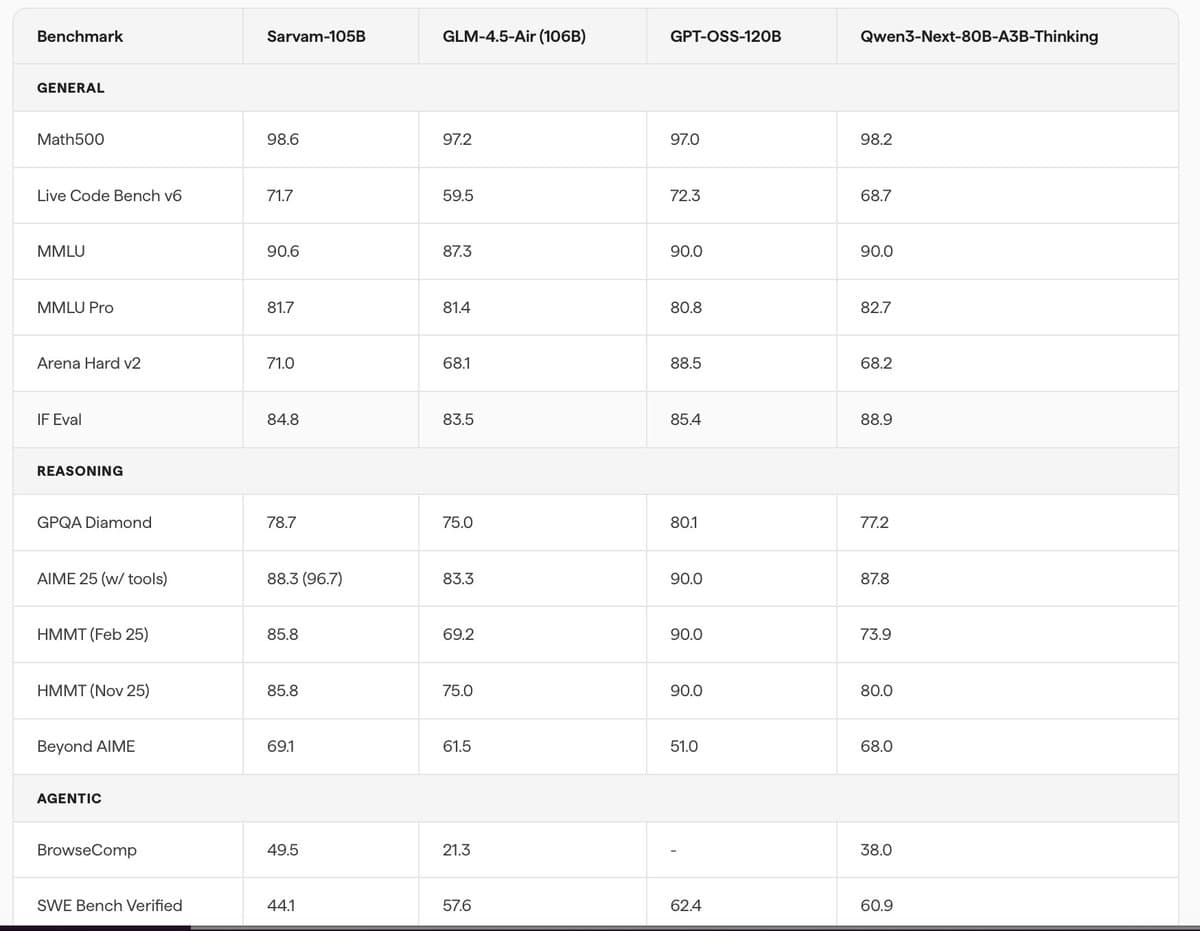
While benchmark scores are impressive—Sarvam 105B achieves 98.6 on Math500, a notable feat for mathematical reasoning—the real innovation lies in Sarvam AI's full-stack approach. The company has developed every component of its AI pipeline in-house, from data curation and model training to reinforcement learning (RL), tokenizer design, and inference optimization. This vertical integration allows for greater control over model performance, efficiency, and adaptability.
A key differentiator is Sarvam's focus on deployment efficiency. The 30B model is optimized for local deployment on consumer devices, making advanced AI accessible without reliance on cloud infrastructure. Meanwhile, the 105B model targets frontier GPUs, competing directly with top-tier models from organizations like OpenAI, Anthropic, and Meta. This dual-strategy approach ensures that Sarvam's technology can serve both resource-constrained environments and high-performance computing setups.
India's AI Ambitions: Context and Implications
India has long been a hub for IT services and software development, but its presence in foundational AI research has been relatively limited. Sarvam AI's release challenges this narrative, showcasing India's potential to innovate in core AI technologies. The open-source nature of the models is particularly strategic, aligning with global trends toward transparency and collaboration while fostering local developer ecosystems.
The Indian government's National AI Strategy emphasizes self-reliance ("Atmanirbhar Bharat") in critical technologies. Sarvam AI's work dovetails with this vision, reducing dependence on foreign AI models and creating homegrown solutions tailored to India's linguistic diversity, cultural context, and infrastructural realities. For instance, models optimized for local deployment could revolutionize AI adoption in rural areas with limited internet connectivity.
Global Competitive Landscape: Where Sarvam Fits
In the global AI race, Sarvam 105B enters a crowded field of large language models (LLMs) exceeding 100 billion parameters. However, its strong performance in reasoning tasks—especially mathematics—positions it as a specialist model rather than a general-purpose chatbot. This focus on reasoning aligns with industry trends toward vertical AI solutions that excel in specific domains.
Sarvam's open-source strategy also contrasts with the closed, proprietary approaches of companies like OpenAI. By releasing model weights and architectures publicly, Sarvam invites scrutiny, collaboration, and adaptation, potentially accelerating innovation in India's AI research community. This could inspire other Indian startups and academic institutions to pursue similar open-source initiatives.
Challenges and Future Directions
Despite the promise, Sarvam AI faces significant challenges. Maintaining competitiveness requires continuous investment in compute resources, talent, and research—areas where Indian startups often struggle against well-funded Silicon Valley counterparts. Additionally, the global AI market is increasingly saturated, with new models emerging weekly.
Looking ahead, Sarvam's success will depend on its ability to foster a robust developer community, secure enterprise partnerships, and navigate regulatory landscapes both in India and abroad. The company's focus on efficiency and local deployment could give it an edge in emerging markets, where cost and infrastructure constraints are paramount.
Conclusion: A Milestone for Indian AI
Sarvam AI's open-sourcing of Sarvam 30B and 105B is more than a technical release; it's a statement of intent. By building competitive AI models entirely in India, Sarvam demonstrates that the country can be a producer, not just a consumer, of transformative technologies. As AI becomes increasingly central to economic and strategic advantage, India's ability to innovate in this space will shape its future on the global stage.
Source: Based on reporting from @kimmonismus on X/Twitter regarding Sarvam AI's model releases.