Key Takeaways
- Researchers developed a framework to test how LLMs score similarity between documents with subtle semantic changes.
- They found models exhibit positional bias, are sensitive to topical context, and produce unique scoring 'fingerprints'.
- This matters for any application relying on LLM-as-a-Judge for document comparison.
What Happened
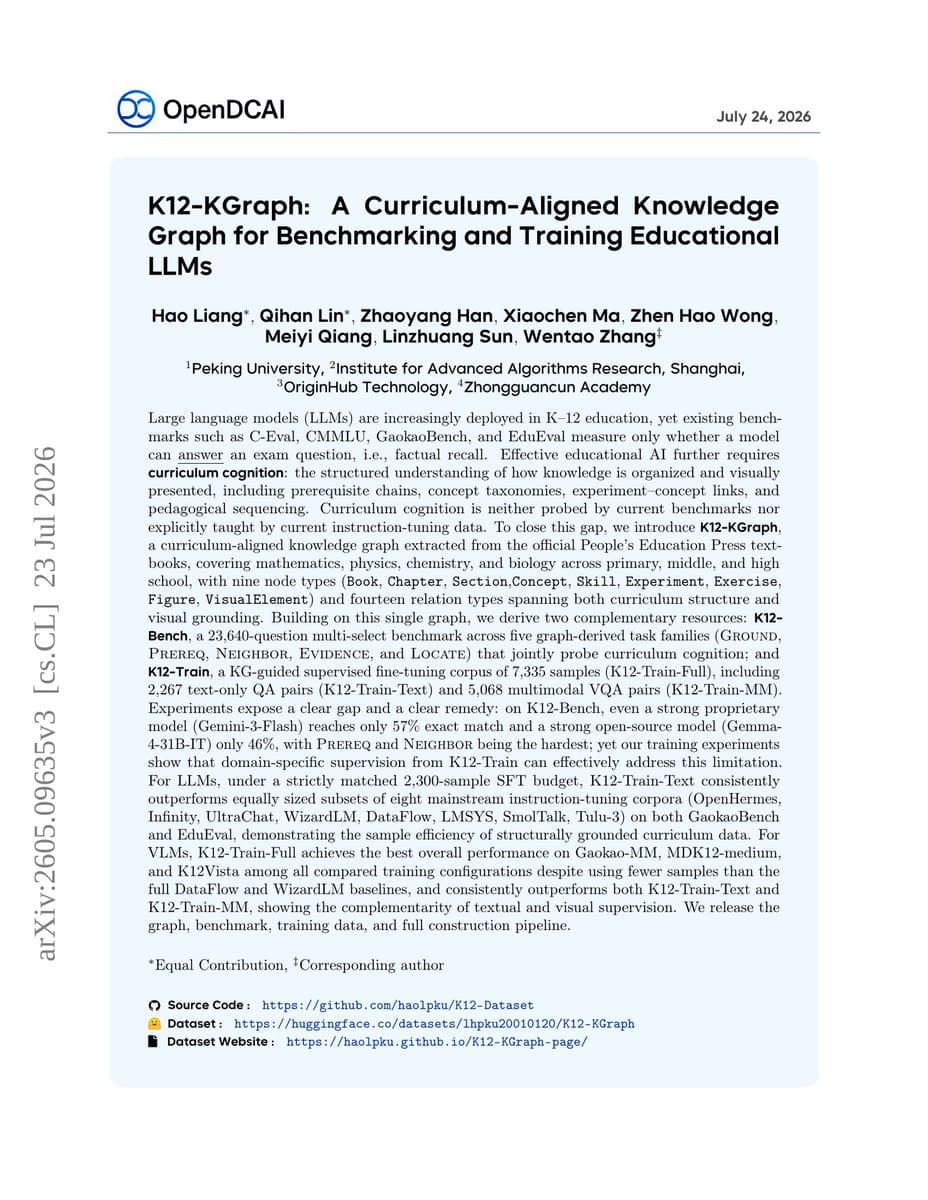
A new research paper, "Semantic Needles in Document Haystacks: Sensitivity Testing of LLM-as-a-Judge Similarity Scoring," was posted to arXiv on April 20, 2026. The study proposes a comprehensive, scalable experimental framework designed to systematically audit how Large Language Models (LLMs) behave when tasked with comparing pairs of documents that contain very subtle semantic differences.
The core analogy is a "needle-in-a-haystack" problem. Researchers embed a single, semantically altered sentence (the "needle") within a larger document (the "hay"). They then create pairs of documents—one original, one with the altered needle—and ask various LLMs to score their similarity. The framework systematically varies multiple factors:
- Perturbation Type: The nature of the semantic change (e.g., adding a negation, swapping a conjunction, replacing a named entity).
- Context Type: Whether the surrounding "hay" is topically related to the needle or is completely unrelated content.
- Needle Position: Where in the document the altered sentence appears.
- Document Length: The overall size of the document.
The team tested five different LLMs across tens of thousands of document pair combinations, creating a massive, multifactorial dataset to analyze scoring behavior.
Technical Details & Key Findings
The analysis yielded several significant and non-obvious findings about LLM behavior in similarity judgment tasks:
Within-Document Positional Bias: LLMs exhibit a clear bias based on where a semantic change occurs. Most models penalize differences more harshly when they appear earlier in a document. This is a distinct effect from previously studied "candidate-order" bias in pairwise comparisons and suggests LLMs may assign different weights to information based on its position in a sequence.
Context Coherence Drives Polarization: When the altered "needle" sentence is surrounded by topically unrelated context, it systematically lowers overall similarity scores and, more strikingly, induces a bipolarization of scores. Models tend to output either very low or very high similarity judgments in this scenario. The researchers hypothesize this is due to an "interpretive frame" effect: related context may allow the model to contextualize and downweight a minor alteration, while unrelated context disrupts this framing, making the needle stand out as a jarring anomaly.
Model-Specific "Fingerprints": Each LLM tested produced a qualitatively distinct scoring distribution—a stable "fingerprint" that remained consistent across different types of semantic perturbations. However, despite these individual quirks, all models shared a universal hierarchy in how leniently they treated different perturbation types (e.g., all were more forgiving of a named entity swap than a negation).
The overarching conclusion is that LLM semantic similarity scores are not purely a function of the semantic change itself. They are significantly influenced by document structure, context coherence, and the specific identity of the model. The proposed framework is presented as a practical, model-agnostic toolkit for auditing and comparing this scoring behavior.
Retail & Luxury Implications
While the study uses general documents, its findings have direct and critical implications for retail and luxury companies deploying LLMs for content and knowledge tasks.

1. Auditing Content Generation & Summarization: Many brands use LLMs to generate or summarize product descriptions, marketing copy, or internal reports. If an LLM is used to evaluate whether a generated description is "similar enough" to a source brief or to check for consistency across multiple drafts, the discovered biases mean its judgment is not neutral. A key change in the first sentence of a product description may be judged more harshly than the same change buried in the third paragraph, potentially leading to inconsistent quality control.
2. Evaluating Customer Feedback and Research: Analyzing large volumes of customer reviews, survey responses, or trend reports often involves clustering or deduplication based on semantic similarity. The "context coherence" finding is crucial here. A negative comment about "delivery" embedded in an otherwise glowing review about "product quality" (unrelated context) might be scored as creating a very dissimilar document, causing that critical piece of feedback to be isolated or lost in analysis. The model's ability to properly weigh the significance of a detail depends on the topical flow of the surrounding text.
3. Robustness of RAG and Knowledge Management Systems: Retrieval-Augmented Generation (RAG) systems, heavily used for internal knowledge bases and customer service chatbots, rely on accurate similarity scoring to retrieve the most relevant context chunks. If the retrieval model exhibits strong positional bias, it may over-prioritize documents where key information appears early and under-retrieve equally relevant documents where the info appears later. The model "fingerprint" effect also means swapping your underlying LLM (e.g., from GPT-4 to Claude 3) could subtly but meaningfully alter the retrieval patterns of your entire system, requiring re-auditing.
4. Legal and Compliance Documentation: For ensuring consistency in terms of service, privacy policies, or compliance manuals across regions, automated similarity checking is attractive. The study's findings serve as a stark warning: an LLM judge might miss a critical, subtle change (like a swapped conjunction altering legal meaning) if it appears late in a long document or is surrounded by standardized boilerplate text, creating compliance risk.
In essence, this research provides the diagnostic tools to proactively test and understand the quirks of any LLM being used as an evaluator, comparator, or retrieval engine for textual data. For luxury brands where nuance, consistency, and detail are paramount, blindly trusting an LLM's similarity score is a operational risk. This framework allows teams to map their model's specific biases and adjust processes accordingly—for instance, by segmenting documents before comparison or implementing consensus scoring across multiple LLMs with different fingerprints.