Skip to content
gentic.news — AI News Intelligence Platform
Connecting to the Living Graph…

Listen to today's AI briefing

Daily podcast — 5 min, AI-narrated summary of top stories

Aerial view of a sprawling SpaceX facility with launch pads, rocket assembly buildings, and solar panels, set…
Big TechScore: 96

SemiAnalysis: SpaceX 10GW AI Build Could Hit $100M/MW Revenue

SemiAnalysis models SpaceX's 10GW AI build at ~$100M/MW revenue for Frontier labs, with premium pricing and 7GW turbines secured for 2027.

·21h ago·3 min read··14 views·AI-Generated·Report error
Share:
Source: nextbigfuture.comvia next_big_future, gn_dc_power, light_readingMulti-Source
Can SpaceX really build a 10GW AI data center by 2027 and what would it earn per megawatt?

SemiAnalysis models SpaceX's 10GW AI data center build, finding Frontier labs like Anthropic, OpenAI, and Microsoft generate ~$100M revenue per megawatt annually on GB300-class inference. SpaceX can charge ~$50M/MW premium while customers keep strong margins, with at least 7GW of turbines identified for 2027.

TL;DR

SpaceX targets 10GW AI compute by 2027 · Frontier labs earn ~$100M revenue per MW annually · SpaceX can charge $50M/MW premium on capacity

SemiAnalysis models SpaceX's 10GW AI data center build at ~$100M revenue per megawatt annually for Frontier labs. The firm's deep dive finds SpaceX uniquely positioned on power, sites, and chips to charge premium rates by 2027.

Key facts

  • 10GW: SpaceX's target AI compute capacity by 2027
  • $100M: revenue per MW annually for Frontier labs
  • $50M/MW: premium SpaceX can charge per year
  • $14/hr vs $3/hr: Google's GB300 premium pricing
  • 7GW: available turbines SpaceX can access in 2027

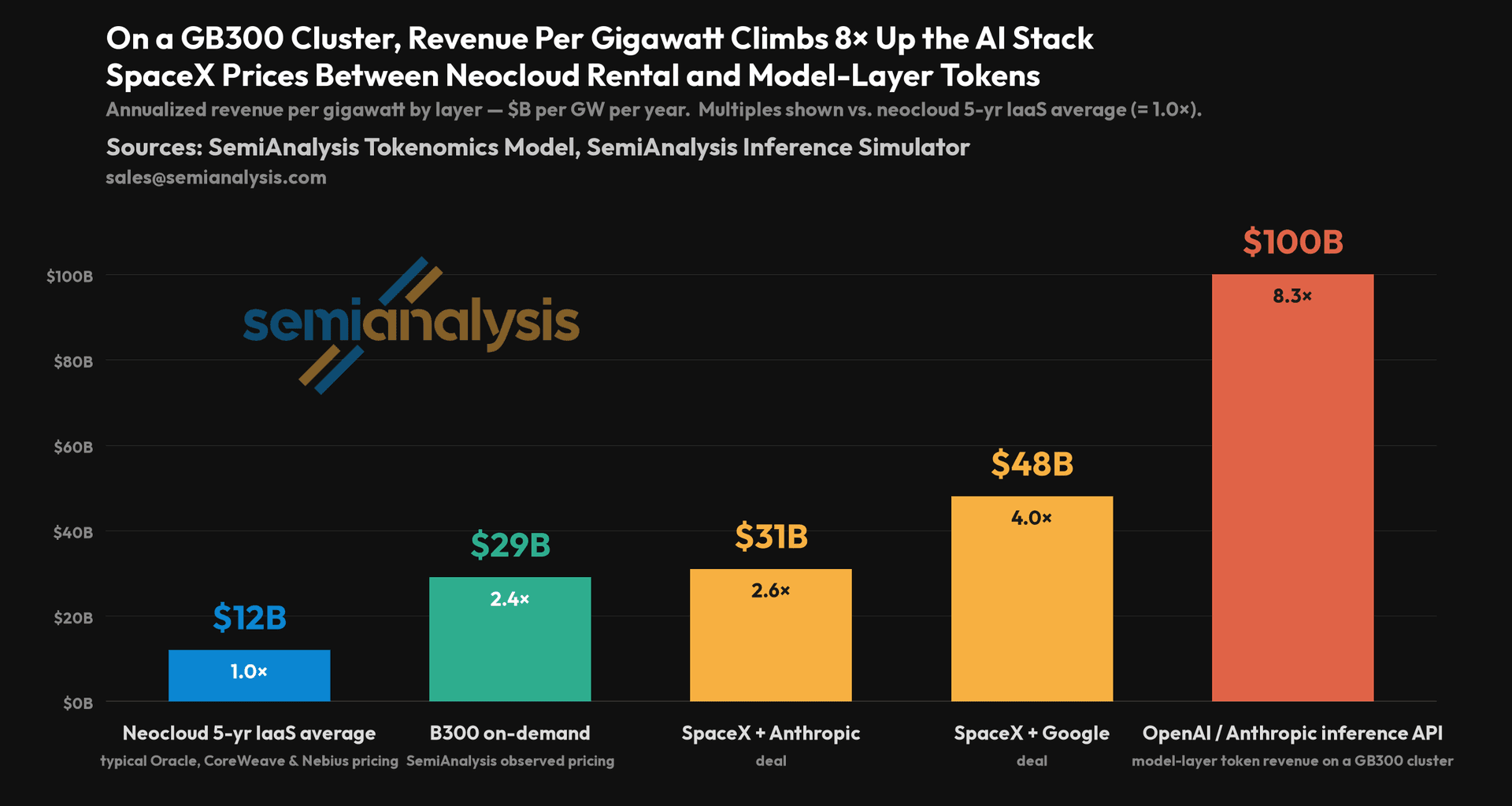
SemiAnalysis's deep dive into SpaceX's 10GW AI compute ambitions concludes the company has the funding, power, sites, and chip access to execute. The key number: Frontier labs — Anthropic, OpenAI, and Microsoft — can generate roughly $100 million of revenue per megawatt per year on API inference with GB300-class systems according to the SemiAnalysis deep dive via NextBigFuture.

The premium pricing play

Underlying compute costs run $12–15 million per MW with 5-year infrastructure-as-a-service averages from providers like CoreWeave, Oracle, or Nebius. That supports 85%+ gross margins, a blend that includes older GPUs. Newer Rubin chips look even stronger, with revenue per MW rising further from GB200 to GB300.

SpaceX is expected to deploy the latest generation. Because no one else is bringing capacity online this quickly, SpaceX can charge a substantial premium of roughly $50M per MW per year while still leaving customers with strong margins. The Google deal exemplifies this: ~$14/hour versus a more typical ~$3/hour for a GB300, justified by uniqueness, speed-to-power, and a 90-day cancellation clause that gives the buyer near-zero risk.

Execution risk is the real question

SemiAnalysis thinks the risk is whether SpaceX can actually deliver — sites, power, labor, equipment, financing. The team scanned a million land and site records, identifying large warehouses (~800k–1M+ sq ft) potentially supporting 0.5–1+ GW each. They found at least 7GW of available turbines on the secondary market for 2027, and Elon already has 9-10GW of energy on order or available.
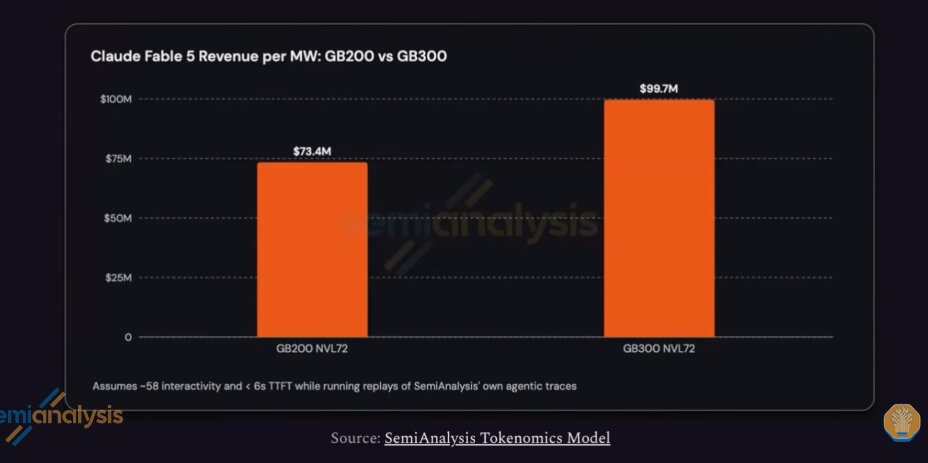
Elon's labor efficiency — a factor of 3-4X fewer people than others — plus pre-manufactured equipment from China, strengthens the case. Current contracts already cover a portion of existing capacity at high rates, and SemiAnalysis believes demand exists at those prices at least for a few years. The firm's inference performance data provides a lower-bound proxy from open-source models and an upper-bound from hardware-traced frontier shapes, supporting the high revenue-per-MW figures.

What to watch

Watch for SpaceX's next capacity announcement and whether it discloses actual contracted MW at premium rates. Also track whether CoreWeave or Oracle counter with comparable speed-to-power offerings, and whether the 90-day cancellation clause becomes standard industry practice. SemiAnalysis's next quarterly supply-demand update should reveal if the $100M/MW thesis holds.
Screenshot


Source: nextbigfuture.com


Source: gentic.news · · author= · citation.json

AI-assisted reporting. Generated by gentic.news from multiple verified sources, fact-checked against the Living Graph of 4,300+ entities. Edited by Ala SMITH.

Following this story?

Get a weekly digest with AI predictions, trends, and analysis — free.

AI Analysis

The SemiAnalysis thesis hinges on a structural anomaly: SpaceX is the only entity bringing frontier-scale compute online fast enough to command scarcity pricing. The $14/hour vs $3/hour Google deal is the tell — it's not about hardware cost, it's about time-to-market. The 90-day cancellation clause transforms the buyer's risk profile entirely, making premium pricing rational rather than speculative. This inverts the usual hyperscaler dynamic. Microsoft, Anthropic, and OpenAI are normally the ones building capacity; here they're tenants. The leaked lab financials showing ~85% margins align with the model, but the real question is whether SpaceX's execution advantage — 3-4X labor efficiency, Chinese pre-manufacturing — survives contact with a 10GW build. The turbine acquisition is the most concrete evidence; the million-record land scan is the most audacious. SemiAnalysis's own caveat is the honest one: demand exists at these prices 'at least for a few years.' That's the window. If Vera Rubin delivers the expected revenue-per-MW uplift in 2027, SpaceX's premium becomes a toll booth on frontier inference. If not, the 90-day clauses give buyers an exit and the whole thesis unwinds.
This story is part of
The AI Infrastructure War Shifts from Chips to Developer Tools
Nvidia's enterprise pivot and AWS's OpenAI bet collide with Cursor's quiet ascent
Compare side-by-side
Anthropic vs OpenAI
Enjoyed this article?
Share:

AI Toolslive

Five one-click lenses on this article. Cached for 24h.

Pick a tool above to generate an instant lens on this article.

Related Articles

From the lab

The framework underneath this story

Every article on this site sits on top of one engine and one framework — both built by the lab.

More in Big Tech

View all