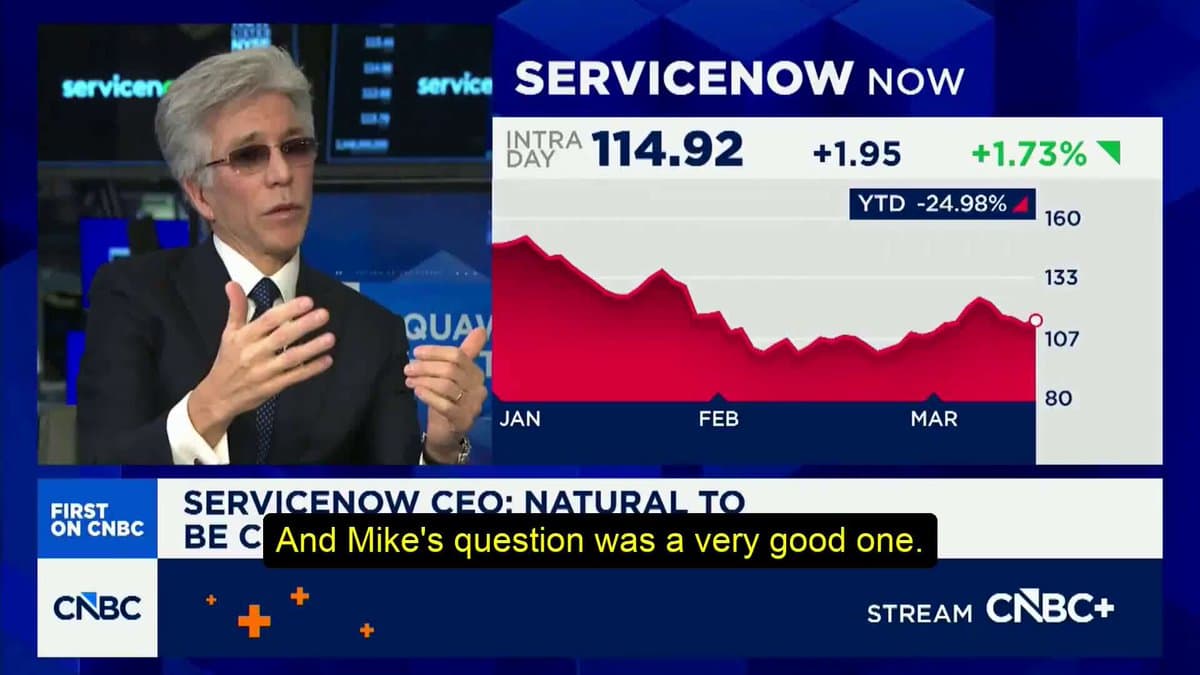
Enterprise software giant ServiceNow is demonstrating the transformative power of artificial intelligence in business operations, with CEO Bill McDermott revealing the company is achieving over 20% revenue growth without increasing its workforce. This remarkable achievement comes from the strategic deployment of AI agents directly into ServiceNow's internal workflows, showcasing a real-world example of how AI can drive productivity at enterprise scale.
The AI Efficiency Breakthrough
According to McDermott's statements, ServiceNow has managed to decouple revenue growth from headcount growth through systematic AI integration. While many companies are experimenting with AI tools, ServiceNow appears to have implemented AI agents at a level that fundamentally changes operational efficiency. The "zero headcount growth" metric is particularly significant in today's economic climate, where businesses face pressure to control costs while continuing to expand.
This development suggests ServiceNow isn't just using AI for isolated tasks but has embedded intelligent agents throughout its business processes. The result is a workforce that becomes more productive without requiring additional human resources—a concept that could redefine how enterprises approach scaling in the AI era.
The Integration Challenge: "AI Needs a Clear Shot on Goal"
McDermott's statement that "AI needs a clear shot on goal" reveals a crucial insight about enterprise AI implementation. He explains that AI "can't go in & out of hundreds of multiple systems," highlighting the integration challenges that prevent many organizations from realizing AI's full potential.
This observation points to a fundamental truth about enterprise technology: disconnected systems create friction that limits AI effectiveness. When AI agents must navigate complex, fragmented technology landscapes, their efficiency diminishes. ServiceNow's approach appears to involve creating unified workflows where AI can operate seamlessly across previously siloed functions.
ServiceNow's Strategic Position
The CEO's comment "That's where we come in" positions ServiceNow as a solution to this integration problem. As a platform that specializes in workflow automation and digital transformation, ServiceNow seems to be leveraging its own technology to create the cohesive environment AI needs to thrive.
This creates a powerful proof point for ServiceNow's value proposition: the company isn't just selling AI capabilities but demonstrating their effectiveness within its own operations. This internal validation could strengthen their position in the competitive enterprise software market, particularly as businesses seek proven AI implementation strategies.
Implications for the Enterprise Software Market
ServiceNow's achievement has significant implications for the broader enterprise technology landscape. First, it demonstrates that AI-driven productivity gains are not just theoretical but achievable at scale. Second, it suggests that companies with integrated platforms may have a distinct advantage in the AI era over those with fragmented technology stacks.
This development could accelerate the trend toward platform consolidation in enterprise software. As businesses recognize that AI performs best in unified environments, they may increasingly favor comprehensive platforms over best-of-breed point solutions. ServiceNow's success with internal AI deployment could make their platform more attractive to organizations seeking similar efficiency gains.
The Future of Work and Productivity
The ServiceNow example raises important questions about the future relationship between workforce size and business growth. If companies can achieve significant revenue increases without proportional headcount growth, this could represent a fundamental shift in how organizations scale.
However, this doesn't necessarily mean widespread job elimination. Instead, it suggests a future where existing employees become dramatically more productive through AI augmentation. The focus may shift from hiring more people to empowering current staff with intelligent tools that handle routine tasks, allowing humans to focus on higher-value work.
Challenges and Considerations
While ServiceNow's achievement is impressive, it's important to recognize that not all organizations can replicate this success immediately. ServiceNow benefits from being both an AI implementer and a platform provider, giving them unique advantages in integration and deployment.
Other companies may face significant challenges in creating the unified systems that enable AI effectiveness. Legacy systems, organizational silos, and data fragmentation could prevent many organizations from giving AI that "clear shot on goal" McDermott describes.
Conclusion
ServiceNow's demonstration of 20%+ revenue growth with zero headcount increase represents a milestone in enterprise AI adoption. It provides concrete evidence that strategically deployed AI agents can dramatically boost productivity and change the traditional relationship between workforce size and business growth.
As McDermott's comments suggest, the key to unlocking this potential lies in creating integrated environments where AI can operate efficiently across systems. This insight may guide enterprise AI strategy for years to come, emphasizing the importance of platform cohesion alongside AI capabilities.
For businesses watching ServiceNow's success, the message is clear: the future belongs to organizations that can effectively integrate AI into their workflows, creating seamless environments where intelligent agents and human workers collaborate to achieve unprecedented efficiency.
Source: Statements from ServiceNow CEO Bill McDermott as reported by @rohanpaul_ai on X/Twitter