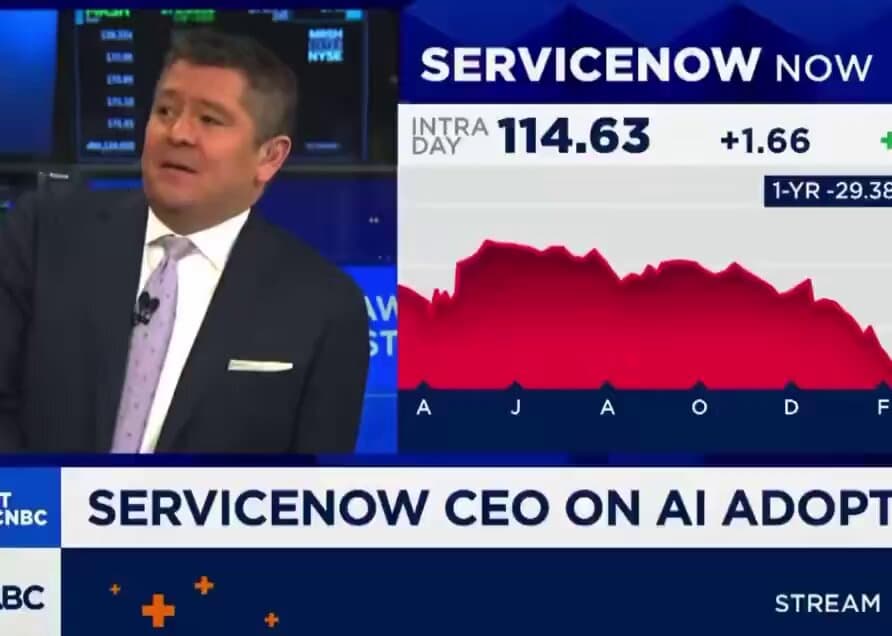
ServiceNow CEO Bill McDermott has issued a stark warning about the labor market impact of AI agents, suggesting unemployment could rise to the "mid 30%" range within the next few years. In comments reported from a recent interview, McDermott noted that graduate unemployment is already at 9% and described it as "very natural to be concerned about jobs."
The Warning
McDermott's central claim is that "so much is going to be done by agents"—referring to AI agents capable of automating complex workflows. He emphasized the speed of this transition, stating that "it's coming faster than people anticipate" and that policymakers are "away" or unprepared for the scale of disruption.
The ServiceNow CEO didn't specify which roles or industries would be most affected, but his company's focus on enterprise workflow automation suggests he's particularly concerned about white-collar and knowledge work. ServiceNow has been aggressively integrating AI agents into its platform, recently launching Now Assist for IT, Customer Service, and HR workflows.
Context and Timing
McDermott's comments come as ServiceNow positions itself as a leader in enterprise AI automation. The company reported 31% year-over-year subscription revenue growth in Q1 2024, with CEO compensation reaching $16.7 million in 2023. His warning about unemployment contrasts with ServiceNow's business strategy of selling automation solutions that could displace human workers.
Other tech executives have made similar warnings about AI's labor market impact. OpenAI CEO Sam Altman has testified before Congress about AI's potential to eliminate jobs, while Tesla CEO Elon Musk has predicted AI will eventually make all jobs optional. However, McDermott's specific "mid 30%" unemployment projection is among the most dire from a sitting CEO of a major public company.
The Current Landscape
The U.S. unemployment rate currently stands at 3.9% (April 2024), making McDermott's projection of mid-30% unemployment a dramatic departure from current conditions. Even during the Great Depression, U.S. unemployment peaked at around 25%. Graduate unemployment at 9%—if accurate—would represent significant underemployment among recent college graduates.
McDermott's comments don't specify whether this unemployment projection is global or U.S.-specific, nor does he provide the methodology behind his estimate. The warning appears to be based on his observation of AI agent capabilities rather than formal economic modeling.
ServiceNow's AI Strategy
ServiceNow has been investing heavily in AI agent technology. Their Now Assist agents can automate IT service management, customer service interactions, and HR processes. The company has partnerships with NVIDIA and recently acquired UltimateSuite to enhance its process mining capabilities—technology that identifies automation opportunities in business workflows.
McDermott's warning about unemployment acceleration comes as his company sells precisely the technology that could cause such displacement. This creates a tension between ServiceNow's commercial interests and the societal impacts of its products—a dynamic common in the automation industry.