Researchers from Stanford University and the University of Munich have developed a groundbreaking method that addresses a fundamental weakness in how large language models (LLMs) learn from their own outputs. The new approach, detailed in the paper "Tool Verification for Test-Time Reinforcement Learning," introduces an external verification step using code checkers to prevent AI models from reinforcing incorrect patterns during self-training.
The Self-Training Problem
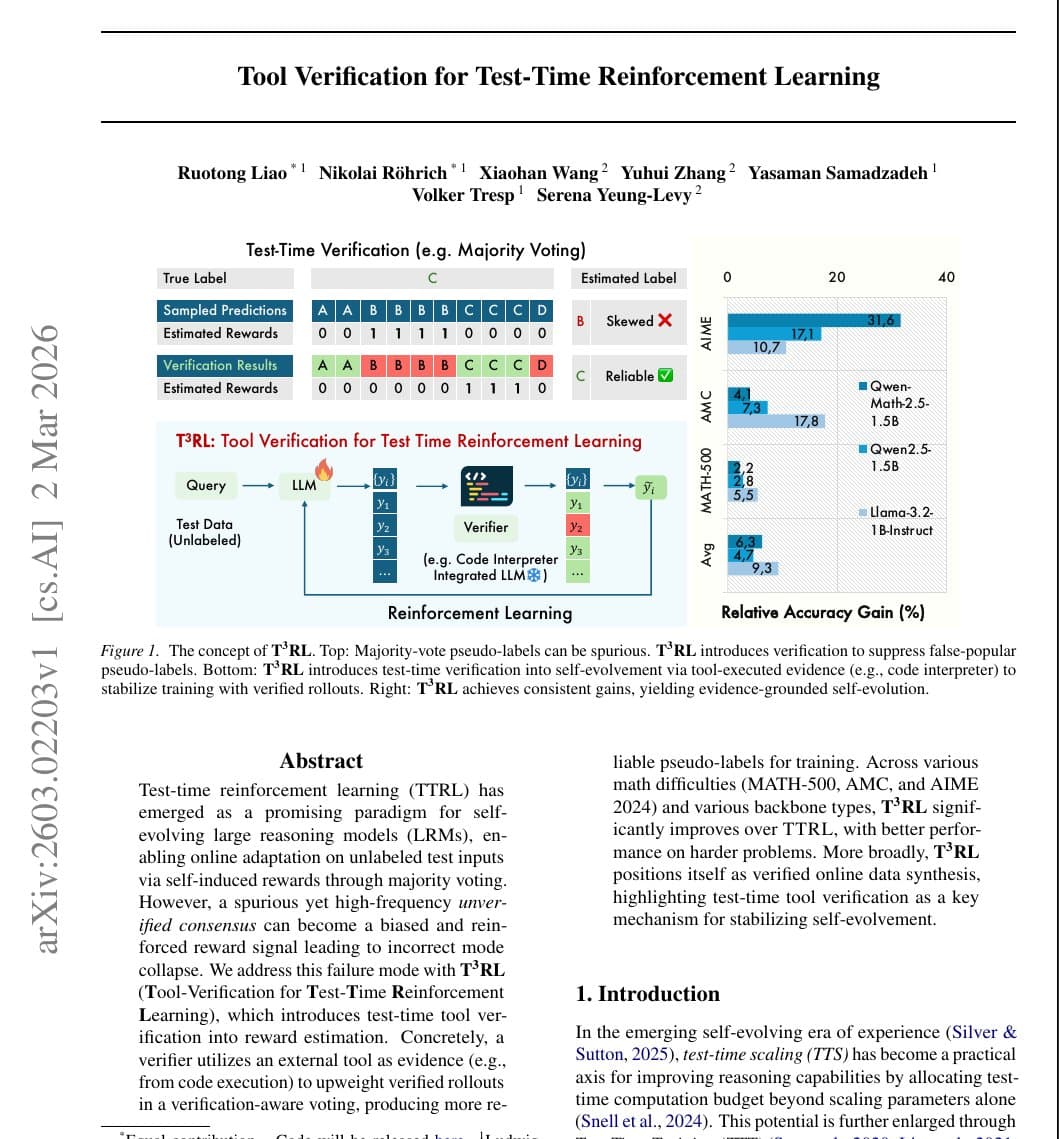
Current LLMs often employ a technique where they generate multiple answers to a problem and assume the most frequently occurring response is correct. This approach, while efficient, creates a significant vulnerability: if a model develops a consistent bias toward an incorrect answer, it will reinforce that error through repetition. This "blind spot" can cause AI systems to spiral into cycles of confident mistakes, particularly when training on unlabeled data without human supervision.
"Standard LLMs try to improve on the fly by generating many answers and assuming the most popular one is correct, but this causes huge problems if the model is consistently biased toward a wrong answer," explains the research team. This problem becomes especially pronounced in domains requiring precise reasoning, such as mathematics, where a single logical error can propagate through subsequent learning cycles.
The Verification Solution
The researchers' innovative solution introduces an external verification step where a secondary AI writes a quick programming script to double-check the mathematical logic of generated answers. When this external code runner confirms an answer is factually accurate, that specific solution receives significant weighting in the final popularity vote. This ensures the model learns from verified truth rather than mere repetition.
This tool-assisted learning setup creates what the researchers describe as a "reliable way to let artificial intelligence safely train itself on unlabeled data without spiraling into a cycle of confident mistakes." The verification system acts as a quality control mechanism, filtering out incorrect responses before they can influence the model's learning process.
Impressive Performance Gains
The research team tested their tool verification system on several challenging mathematical reasoning tests using popular open models including Qwen and Llama. The results were striking: the verification system dramatically boosted accuracy across all tested scenarios, achieving up to a 31.6% relative improvement on the most difficult mathematical challenges.
These performance gains demonstrate the method's effectiveness in correcting the self-reinforcement problem that plagues conventional LLM training approaches. By ensuring that only verified correct answers influence the learning process, the system prevents the accumulation and propagation of errors that typically occur when models learn from their own unverified outputs.
Broader Implications for AI Development
The implications of this research extend far beyond mathematical reasoning tasks. The tool verification framework represents a paradigm shift in how we approach unsupervised and self-supervised learning for AI systems. By incorporating external verification mechanisms, developers can create more robust learning systems that maintain accuracy even when operating without extensive human-labeled training data.
This approach could prove particularly valuable in domains where obtaining labeled data is expensive or impractical, such as scientific research, medical diagnosis, or complex engineering problems. The ability to safely leverage unlabeled data while maintaining accuracy could accelerate AI development across numerous fields.
Future Directions and Applications
While the current implementation focuses on mathematical verification through code execution, the underlying principle of external verification could be adapted to various domains. Future implementations might incorporate different types of verification tools depending on the application—fact-checking databases for historical or scientific claims, simulation environments for physical reasoning tasks, or specialized validators for legal or financial analysis.
The research team's approach also opens new possibilities for creating more transparent and accountable AI systems. By maintaining a verification trail of which answers were confirmed as correct, developers can better understand and audit their models' learning processes, potentially addressing concerns about AI explainability and reliability.
As AI systems continue to advance toward greater autonomy in learning and problem-solving, methods like tool verification will become increasingly important for ensuring these systems develop accurate, reliable knowledge rather than reinforcing their own misconceptions. The Stanford and Munich researchers have provided a crucial framework for building AI that can safely teach itself while avoiding the pitfalls of self-reinforcing errors.
Source: Research paper "Tool Verification for Test-Time Reinforcement Learning" (arXiv:2603.02203) and coverage by Rohan Paul.