Every AI chip on earth — every GPU, TPU, and custom ASIC — depends on a single thin-film material. 98% of global supply comes from one Japanese chemical company. Zero production-ready alternatives exist. The supplier is fully booked through 2027, raising prices, with lead times exceeding six months.
NVIDIA is so concerned they're paying half the capital expenditure to expand the supplier's fabs themselves.
This is the most consequential supply chain bottleneck in the AI industry that nobody is talking about.
Key Takeaways
- A single Japanese chemical company supplies 98% of the thin-film material used in every AI chip on earth.
- NVIDIA is paying half the capex to expand supplier fabs as lead times stretch past 6 months.
The Material
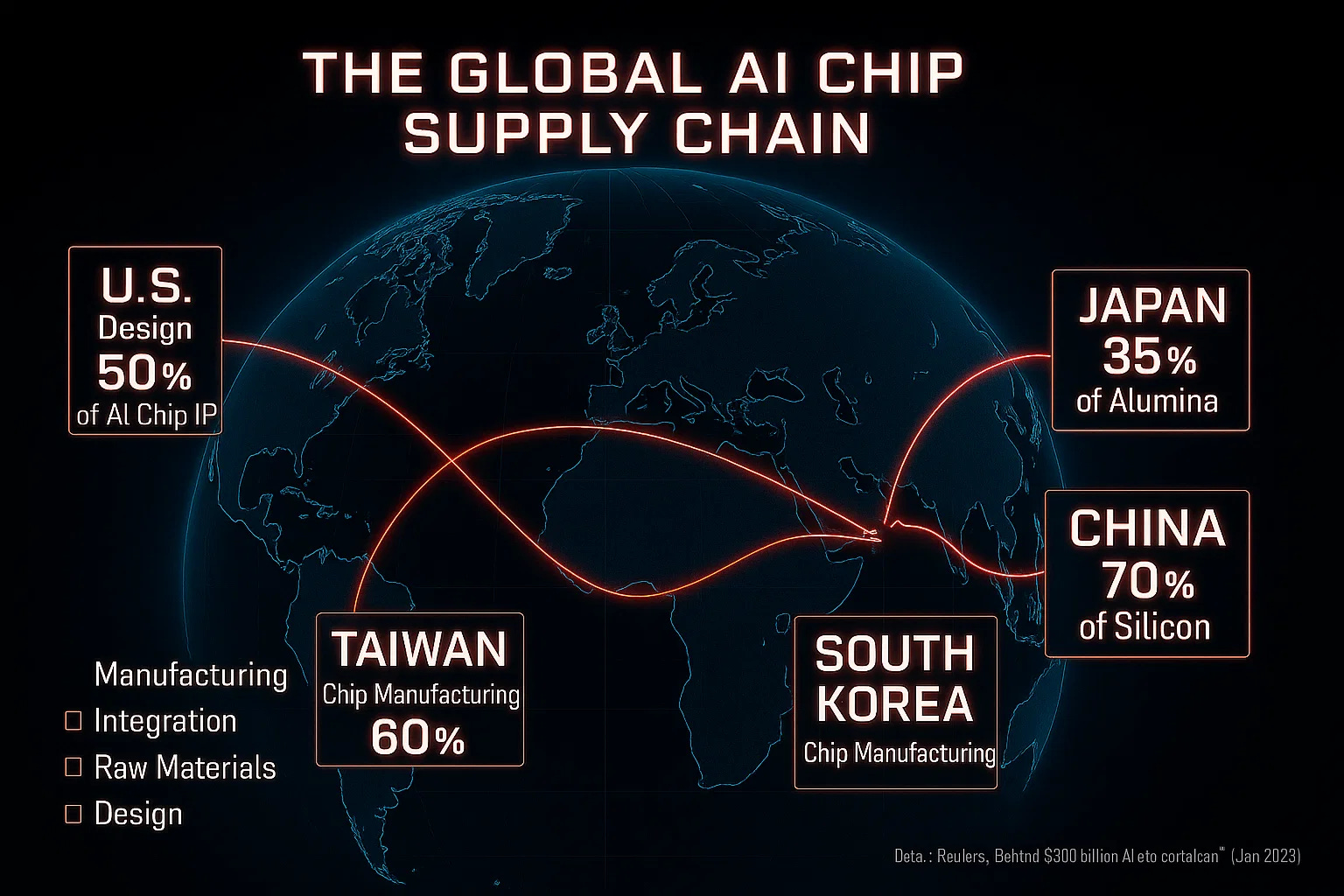
The material in question is a specialized thin-film chemical used in the semiconductor manufacturing process. It is critical for producing the advanced interconnects and dielectric layers that enable the extreme performance of modern AI accelerators. Without it, chip yields plummet and performance degrades catastrophically.
While the exact chemical composition is proprietary, industry sources describe it as a high-purity, polymer-based film that withstands the thermal and electrical stresses of 3nm and 2nm node processes. It is not a commodity chemical — it requires decades of expertise to produce at scale with the purity levels required by TSMC, Samsung, and Intel.
The Supplier
The single supplier is a Japanese chemical company that has held a near-monopoly for over a decade. The company's identity is an open secret among semiconductor supply chain analysts, though it has not been publicly named in mainstream coverage.
This company has invested heavily in production capacity, but demand from AI chipmakers has outstripped supply. The supplier is fully booked through 2027, meaning no new customers can secure volume commitments. Existing customers face allocation limits and price increases.
NVIDIA's Response
NVIDIA has taken the unprecedented step of directly financing supplier expansion. The company is paying half the capital expenditure to build new production lines at the supplier's fabs. This is a rare move for a fabless chip designer — NVIDIA typically focuses on design and software, not manufacturing infrastructure.
This signals that NVIDIA views the material as a strategic bottleneck that could limit its ability to ship GPUs. If the supplier cannot ramp production fast enough, NVIDIA's revenue growth could be constrained regardless of demand.
Market Implications
The implications are stark:
- Every AI chip — from NVIDIA H100/B200, AMD MI300X, Google TPU v5p, to Amazon Trainium2 — uses this material.
- No production-ready alternatives exist. Developing a substitute requires years of qualification and validation.
- The supplier's pricing power is absolute. They can raise prices without losing market share.
- Lead times of 6+ months mean chipmakers must forecast demand far in advance, increasing risk of shortages or overcapacity.
- The bottleneck affects all AI chipmakers equally, but those with less financial muscle (AMD, Intel, startups) face greater risk of allocation shortfalls.
What This Means in Practice

For AI chip buyers (hyperscalers, enterprises, governments): expect GPU supply constraints to persist through 2027 regardless of TSMC capacity. The bottleneck is not just packaging or wafer starts — it's this thin-film material. Procurement teams should factor this into their GPU acquisition timelines and negotiate multi-year commitments now.
For AI chip startups: securing access to this material may be harder than securing fab capacity. The supplier has no incentive to allocate to small customers when NVIDIA is co-funding expansion.
The Timeline
- 2024-2025: Supplier fully booked. Prices rising. Lead times 6+ months.
- 2026-2027: New capacity from NVIDIA-funded expansion comes online, but still tight.
- 2028+: Potential alternatives emerge if development efforts succeed.
What Could Change
Several factors could alleviate the bottleneck:
Alternative suppliers: Other chemical companies are developing competing materials, but qualification with foundries takes 2-3 years.
Process innovation: Chipmakers could redesign manufacturing processes to use less material or substitute different chemistries.
Recycling/reclamation: Improved material recovery in fabs could reduce net demand.
Demand normalization: If AI chip demand growth slows, the supply-demand balance could ease.
None of these are likely before 2028.
Frequently Asked Questions
What exactly is this thin-film material?
It is a specialized, high-purity chemical film used in semiconductor manufacturing for advanced interconnects and dielectric layers. It is critical for the extreme performance and reliability requirements of AI accelerators manufactured at 3nm and 2nm process nodes.
Why is only one company producing it?
The material requires decades of expertise in ultra-high-purity chemical synthesis and semiconductor-grade quality control. The barrier to entry is extremely high — new entrants must invest hundreds of millions in R&D and then pass years of qualification testing with foundries like TSMC.
How does this affect AI chip availability?
Even if TSMC has enough wafer capacity, without this material they cannot produce AI chips at scale. This creates a secondary bottleneck beyond packaging and advanced lithography. Chipmakers may have to allocate production, potentially delaying GPU shipments.
What can AI companies do to mitigate this risk?
Companies can secure long-term supply agreements with the supplier, co-invest in capacity expansion (as NVIDIA is doing), or fund development of alternative materials. They should also design chips to be compatible with multiple material suppliers once alternatives become available.