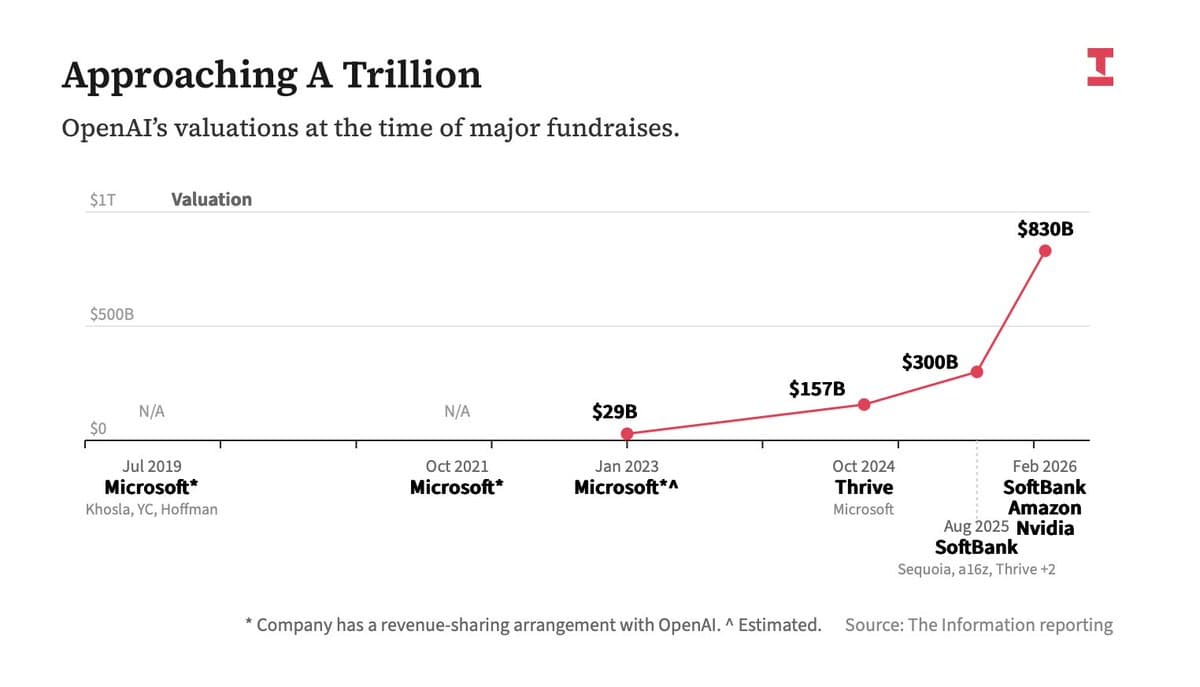
As OpenAI reportedly prepares for a potential initial public offering within the next six months, early conversations with institutional investors reveal growing skepticism about whether the artificial intelligence pioneer's business model can support its staggering ~$850 billion valuation. The company that revolutionized the AI landscape with ChatGPT now faces the challenging transition from technological innovator to sustainable public company.
The Valuation Conundrum
According to investor discussions reported by industry observers, OpenAI's current valuation represents approximately 28 times its projected 2026 revenue—a multiple that more than doubles that of Nvidia, the current darling of the AI hardware market. This premium valuation reflects immense optimism about OpenAI's market position and future growth potential, but also creates significant pressure for the company to deliver extraordinary financial performance.
Investors are particularly concerned about the disconnect between OpenAI's valuation and its path to profitability. The company is reportedly burning cash at a substantial rate and isn't expected to reach profitability until at least 2030, creating a challenging narrative for public market investors accustomed to more immediate returns.
The Profitability Timeline Problem
The extended timeline to profitability represents one of the most significant hurdles for OpenAI's potential IPO. While technology companies have historically gone public before reaching sustained profitability, the current market environment has shown less tolerance for companies with distant profitability horizons, especially at OpenAI's scale.
Sources indicate that OpenAI needs to dramatically reduce costs while simultaneously increasing revenue to justify its valuation and meet investor expectations. This dual challenge comes at a time when the company faces intensifying competition across its product lines, from foundational models to enterprise solutions and consumer applications.
Competitive Pressures Mount
The competitive landscape presents another major concern for potential investors. Anthropic, OpenAI's closest competitor in the frontier AI space, has been gaining significant traction with its Claude models and enterprise offerings. This competition threatens to erode OpenAI's first-mover advantage and could pressure both pricing and market share.
Beyond Anthropic, OpenAI faces challenges from multiple directions:
- Big Tech competitors like Google, Microsoft (despite their partnership), and Amazon are investing billions in their own AI capabilities
- Open-source alternatives continue to improve, offering cost-effective solutions for many use cases
- Specialized AI companies are targeting specific verticals with tailored solutions
The Path Forward
For OpenAI to successfully navigate the public markets, several key developments will need to occur:
Demonstrable progress toward profitability: Investors will need to see clear evidence of improving unit economics and a credible path to positive cash flow
Diversified revenue streams: Over-reliance on any single product or partnership (such as with Microsoft) could concern investors looking for sustainable, diversified growth
Sustainable competitive advantages: OpenAI must demonstrate that its technological lead translates into durable business advantages that can withstand competitive pressures
Clear governance structure: As a company that began as a non-profit research organization, OpenAI's unique corporate structure and governance will likely face intense scrutiny from public market investors
Market Context and Implications
The timing of OpenAI's potential IPO comes during a period of heightened scrutiny for high-growth technology companies. The recent performance of other AI-related IPOs and the mixed reception for companies with extended paths to profitability suggest that OpenAI may face a more challenging market environment than it might have encountered just a few years ago.
Success or failure in OpenAI's public market debut could have significant implications for the broader AI industry. A successful IPO at or near the rumored valuation would validate current investment levels in AI infrastructure and applications, while a disappointing performance could trigger more cautious investment approaches across the sector.
The Broader AI Investment Landscape
OpenAI's valuation and potential IPO represent a critical test case for how public markets value pure-play AI companies at scale. The outcome will likely influence:
- Valuation methodologies for other AI companies considering public offerings
- Investment timelines for venture capital and private equity firms backing AI startups
- Corporate development strategies for larger technology companies evaluating AI acquisitions
- Regulatory approaches to AI company governance and financial reporting
Source: Analysis based on investor discussions reported by @kimmonismus regarding OpenAI's potential IPO timeline and valuation concerns.