A new front has opened in the AI development tools war, and the economics are staggering. According to a recent Forbes report, Cursor—the AI-powered code editor that has gained significant traction among developers—is being heavily subsidized by Anthropic, its Claude AI model provider. The numbers reveal a subsidy strategy so aggressive it suggests a fundamental rethinking of how software will be created in the coming years.
The Subsidy Reality: $200 Plans, $5,000 Costs
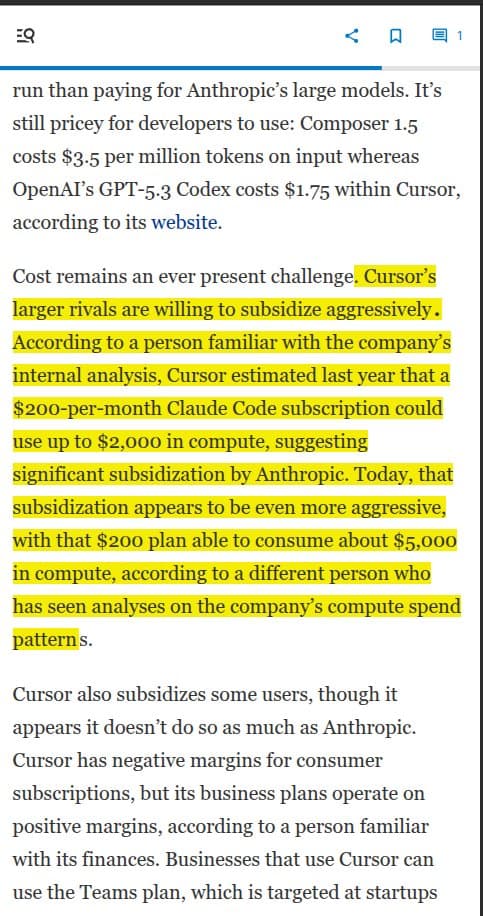
The most striking revelation from the Forbes investigation concerns the actual economics behind Cursor's subscription model. According to sources familiar with Cursor's internal analysis, the company estimated last year that a $200-per-month Claude Code subscription could consume approximately $2,000 in compute resources. This already represented a significant 10:1 subsidy ratio, with Anthropic effectively absorbing $1,800 in costs per user monthly.
Today, that subsidization appears to have intensified dramatically. According to a different source who has seen analyses of the company's compute spend patterns, that same $200 plan can now consume about $5,000 in compute. This represents a 25:1 subsidy ratio, with Anthropic potentially absorbing $4,800 in costs for every $200 subscription.
Beyond Editors: The Rise of Autonomous Coding Agents
The financial story is compelling, but it serves as a proxy for a more profound technological shift. As noted in the Forbes coverage, software development is moving "from human typing to autonomous agents that handle entire features on their own." Cursor represents more than just another code editor with AI features—it's becoming a platform where developers increasingly act as supervisors and architects rather than manual implementers.
This evolution mirrors broader trends in AI-assisted development, where tools are progressing from simple code completion to feature-level implementation. The implications are substantial: if AI can reliably handle entire features autonomously, the role of the developer shifts toward higher-level design, specification, and quality assurance.
The Strategic Battle for Developer Mindshare
The aggressive subsidization strategy reveals how critical the developer tools market has become for AI companies. As the Forbes article notes, "AI labs are willing to lose huge amounts of money to win over developers and capture market." This isn't merely about selling subscriptions—it's about establishing the foundational tools and workflows that will shape how the next generation of software is built.
Developer tools have historically served as gateway products to broader platform ecosystems. By capturing developers early in their careers or during their adoption of AI-assisted workflows, companies like Anthropic (through Cursor) position themselves to influence toolchains, model preferences, and ultimately, the infrastructure choices of entire organizations.
The Economic Implications of AI-First Development
The subsidy model raises important questions about sustainability and market structure. If leading AI companies are willing to operate at massive losses to capture developer tools market share, it could create significant barriers to entry for smaller players. This could lead to a consolidation where only the best-funded AI labs can compete in the development tools space.
However, this strategy also accelerates adoption and innovation. By making powerful AI coding assistants accessible at relatively low cost, more developers can experiment with and integrate these tools into their workflows. This could lead to faster identification of use cases, refinement of capabilities, and ultimately, more sophisticated AI development tools.
The Future of Software Development Roles
As autonomous coding capabilities improve, the nature of software development work will inevitably change. Developers may spend less time writing boilerplate code or implementing routine features and more time on system architecture, complex problem-solving, and ensuring that AI-generated code meets quality and security standards.
This transition could make software development more accessible while simultaneously raising the bar for what constitutes expert-level skill. The ability to effectively prompt, guide, and validate AI coding agents may become as important as traditional programming proficiency.
What Comes After Subsidies?
The current subsidy-heavy approach raises questions about long-term business models. Will prices increase as capabilities mature? Will we see tiered pricing based on compute consumption? Or will the value of capturing developer ecosystems justify continued subsidies indefinitely?
One possibility is that the tools themselves become loss leaders for more profitable enterprise offerings, consulting services, or platform fees. Another is that as AI models become more efficient, the compute costs will decrease, making the current subsidy levels unnecessary.
Conclusion: A Pivotal Moment for Development Tools
The revelations about Cursor's economics highlight a pivotal moment in the evolution of software development tools. We're witnessing not just incremental improvements to existing editors but a fundamental reimagining of how software is created. The aggressive subsidies indicate that major AI players see this transition as strategically critical enough to invest heavily—even at significant short-term losses.
As developers increasingly adopt these tools, we'll see accelerated innovation in what's possible with AI-assisted coding. The real test will come as these tools mature beyond their subsidized phase and must demonstrate sustainable value in a competitive marketplace. For now, developers have an unprecedented opportunity to leverage powerful AI capabilities at a fraction of their true cost, potentially accelerating the very transformation that makes traditional code editors less central to the development process.
Source: Forbes article "Cursor goes to war for AI coding dominance" by Anna Tong, March 5, 2026