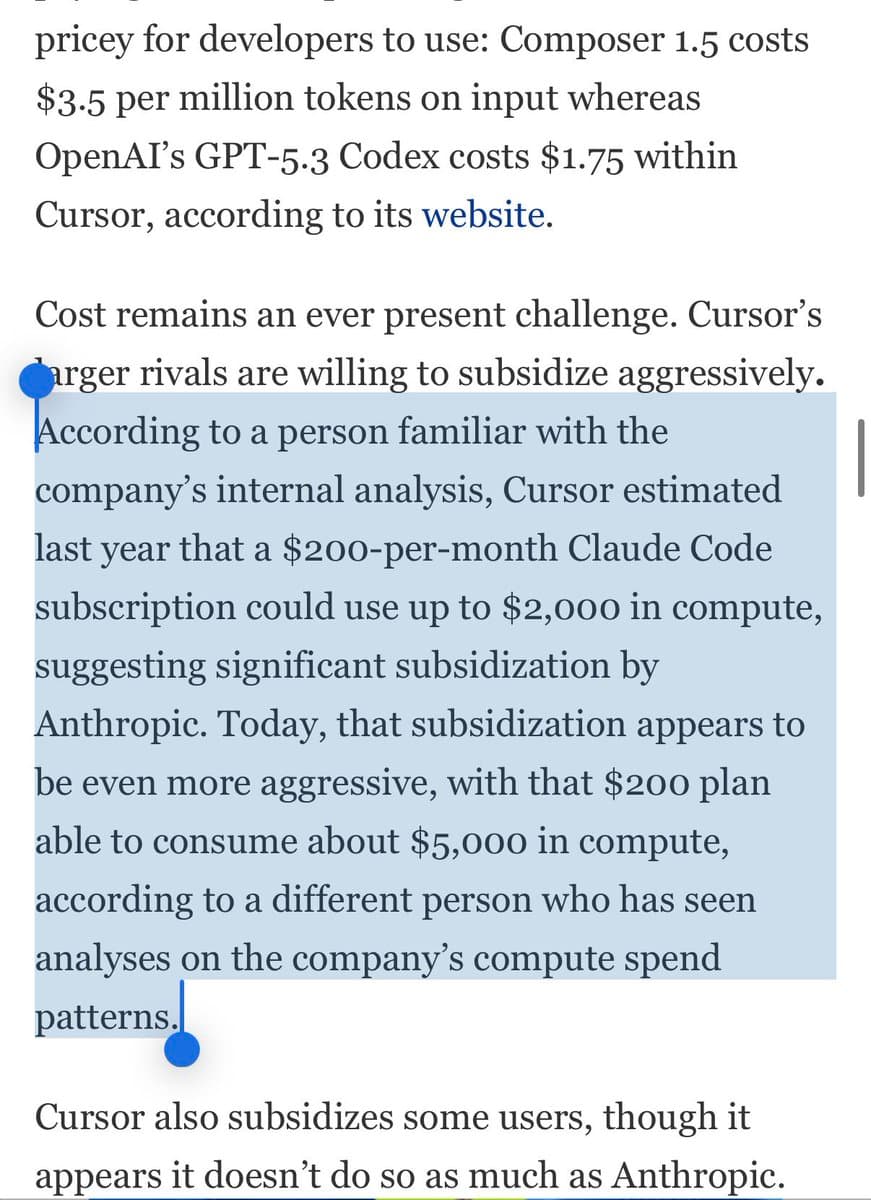
New revelations about the economics behind AI coding assistants have exposed just how aggressively companies are competing in this rapidly evolving space. According to internal research from Cursor, Anthropic is subsidizing its Claude Code subscriptions at rates that dramatically outpace what customers actually pay—with compute costs potentially reaching $5,000 for a $200 monthly plan.
The Subsidy Revelation
The findings, originally reported by @kimmonismus on X, suggest that Anthropic's subsidization strategy has become increasingly aggressive over time. Last year, Cursor's internal analysis estimated that a $200-per-month Claude Code subscription could use up to $2,000 in compute resources. Today, that same $200 plan appears capable of consuming approximately $5,000 in compute—representing a 150% increase in the subsidy gap.
This massive discrepancy between revenue and costs reveals the extraordinary lengths to which AI companies are willing to go to capture market share in the competitive coding assistant landscape. With GitHub Copilot, Amazon CodeWhisperer, and numerous other players vying for developer attention, price has become a critical battleground.
The Competitive Landscape
The coding assistant market has exploded in recent years, with tools promising to revolutionize software development through AI-powered code generation, debugging, and documentation. GitHub Copilot, launched in 2021, quickly became the market leader with its integration into Visual Studio Code and strong performance. However, Anthropic's Claude Code represents a formidable challenger, leveraging the company's Constitutional AI approach and strong performance on coding benchmarks.
What makes Anthropic's subsidy strategy particularly noteworthy is the company's reputation for responsible AI development and its focus on building safe, reliable systems. The aggressive pricing suggests that even companies with strong ethical frameworks are willing to engage in fierce commercial competition when it comes to market positioning.
The Economics of AI Compute
Understanding why compute costs are so high requires examining the technical infrastructure behind modern AI systems. Large language models like Claude require significant computational resources for both inference (generating responses) and training. Each query to Claude Code involves running billions of parameters through specialized hardware, typically NVIDIA GPUs, which consume substantial electricity and require expensive infrastructure.
According to industry estimates, running inference on state-of-the-art models can cost between $0.01 and $0.10 per 1,000 tokens, depending on the model size and optimization. For heavy users who generate thousands of lines of code daily, these costs quickly accumulate. The $5,000 compute estimate for a $200 subscription suggests either extremely heavy usage patterns or particularly expensive model architectures—or both.
Strategic Implications
Anthropic's subsidy strategy carries several important implications for the AI industry:
Market Capture Over Immediate Profitability: Like many tech companies before it, Anthropic appears focused on establishing market dominance before optimizing for profitability. This approach mirrors strategies employed by companies like Amazon in their early days, where growth took precedence over immediate returns.
Barrier to Entry: The scale of subsidies creates significant barriers for smaller competitors who cannot afford to sustain similar losses. This could lead to market consolidation around well-funded players like Anthropic, Microsoft (GitHub Copilot), and Amazon.
Future Pricing Uncertainty: Once market positions are established, companies may need to adjust pricing to achieve sustainability. This raises questions about whether current low prices are temporary or represent a new normal in AI services.
Innovation Pressure: The subsidy war may accelerate innovation as companies seek more efficient architectures and optimization techniques to reduce compute costs while maintaining performance.
The Sustainability Question
The most pressing question raised by these revelations is sustainability. How long can Anthropic and other AI companies maintain such aggressive subsidies? With venture capital funding becoming more selective and investors increasingly focused on path-to-profitability, the era of unlimited subsidies may be approaching its end.
Several factors could influence the sustainability timeline:
- Hardware Improvements: Advances in specialized AI chips from companies like NVIDIA, AMD, and custom silicon developers could dramatically reduce compute costs over time.
- Model Efficiency: Techniques like model distillation, quantization, and architectural improvements could make models cheaper to run without sacrificing performance.
- Alternative Revenue Streams: Companies might develop additional services or enterprise offerings that cross-subsidize consumer-facing products.
- Strategic Partnerships: Deep-pocketed partners (like Amazon's investment in Anthropic) could extend the runway for subsidy strategies.
Industry Reactions and Responses
The coding assistant market has responded to competitive pressures in various ways. GitHub Copilot has maintained its pricing while expanding features and integrations. Amazon CodeWhisperer has leveraged AWS integration as a differentiator. Smaller players have focused on niche capabilities or specialized workflows.
Cursor's decision to conduct and share this internal analysis suggests that companies are closely monitoring each other's economic strategies. This level of competitive intelligence gathering indicates just how high the stakes have become in the AI coding assistant space.
The Developer Perspective
For developers, the subsidy war represents both opportunity and uncertainty. On one hand, access to powerful AI coding assistance at relatively low prices accelerates development and lowers barriers to entry. On the other hand, there's legitimate concern about what happens when subsidies end or prices increase significantly.
Many developers have begun incorporating multiple AI assistants into their workflows, hedging against potential price increases or service changes from any single provider. This diversification strategy reflects growing awareness of the volatile economics underlying these tools.
Looking Ahead
The revelations about Anthropic's subsidy strategy highlight a critical phase in the evolution of AI services. As the technology moves from novelty to necessity, companies are making bold bets on market positioning. The coming years will likely see:
- Consolidation: Smaller players may be acquired or exit the market as subsidy wars intensify.
- Specialization: Companies may focus on specific programming languages, frameworks, or development environments where they can compete more effectively.
- Integration: AI coding assistants will become more deeply embedded into broader development platforms and workflows.
- Pricing Evolution: Subscription models may evolve to include usage-based components or tiered offerings that better align costs with value.
Conclusion
The internal research from Cursor revealing Anthropic's aggressive subsidy strategy provides a rare window into the economic realities of the AI revolution. While developers currently benefit from access to powerful tools at seemingly low prices, the sustainability of this model remains uncertain.
What's clear is that the competition for dominance in AI coding assistants has entered an intense phase, with companies willing to invest significantly in customer acquisition and market positioning. As the technology continues to evolve and business models mature, both developers and companies will need to navigate the transition from subsidized growth to sustainable value creation.
The ultimate winners may not be those who subsidize most aggressively, but those who can deliver the most value while developing economically viable approaches to one of the most transformative technologies of our time.