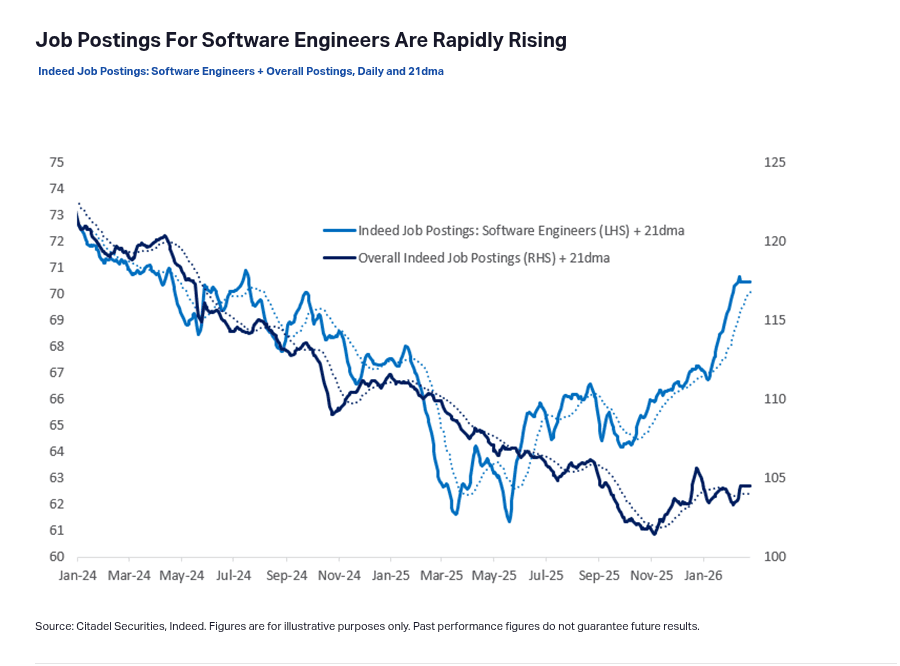
In a surprising twist that challenges conventional wisdom about artificial intelligence and employment, financial giant Citadel Securities has published data showing a dramatic increase in software engineering job postings even as AI coding tools become more sophisticated. This counterintuitive trend represents what economists call the Jevons paradox—a phenomenon where technological improvements that increase efficiency actually lead to greater overall consumption of a resource, not less.
The Data That Defies Expectations
According to Citadel Securities' research, job postings for software engineers have seen a "massive spike" despite widespread deployment of AI coding assistants like GitHub Copilot, Amazon CodeWhisperer, and various large language models capable of generating functional code. This data comes from their comprehensive analysis of global labor markets and technological adoption patterns.
Traditionally, automation technologies have been expected to reduce demand for human labor in affected fields. The narrative around AI in software development has largely followed this pattern, with predictions that AI would gradually replace junior developers and reduce overall employment in the sector. Yet the opposite appears to be happening.
Understanding the Jevons Paradox in Software
The Jevons paradox, named after 19th-century economist William Stanley Jevons, originally described how more efficient steam engines actually increased coal consumption rather than decreasing it. The same principle now applies to software development: as AI makes coding more efficient and less expensive, companies are responding by dramatically increasing their software ambitions.
"When software is cheaper to build, companies naturally want to build a lot more of it," explains the Citadel Securities analysis. "Businesses are now putting software into industries and tools where it was simply too expensive before."
This phenomenon creates a virtuous cycle: AI tools lower the barrier to software creation, which expands the total addressable market for software solutions, which in turn creates more complex problems requiring human oversight and strategic thinking—areas where software engineers remain essential.
The Expansion of Software's Domain
Several factors are driving this expansion of software development:
1. Industry Digitization Acceleration
Previously analog or minimally digital industries—from agriculture and construction to manufacturing and logistics—are now undergoing rapid digitization. The reduced cost of software development makes it economically viable to create custom solutions for these sectors.
2. Increased Complexity Demands
As basic coding tasks become automated, companies are tackling more ambitious projects that require sophisticated architecture, integration with legacy systems, and complex problem-solving—areas where human engineers excel.
3. Democratization of Technology
Smaller companies and startups that previously couldn't afford extensive development teams can now leverage AI-assisted tools to build minimum viable products, creating new market entrants and increasing overall demand for technical talent.
4. Maintenance and Evolution
The software landscape isn't static. Existing systems require maintenance, updates, security patches, and evolution to meet changing requirements—tasks that often require human judgment and contextual understanding.
The Changing Nature of Software Engineering Work
While the number of software engineering positions is increasing, the nature of the work is evolving. AI isn't replacing software engineers but rather changing their role:
- From coders to architects: Engineers are spending less time writing routine code and more time designing systems, making architectural decisions, and solving complex integration problems.
- AI oversight and training: New roles are emerging focused on training, fine-tuning, and overseeing AI coding assistants to ensure they produce secure, efficient, and appropriate code.
- Domain specialization: As software expands into new industries, engineers with domain-specific knowledge (in healthcare, finance, manufacturing, etc.) are becoming increasingly valuable.
- Ethical and security considerations: The proliferation of AI-generated code creates new challenges around security vulnerabilities, intellectual property, and ethical considerations that require human oversight.
Implications for Education and Training
This trend has significant implications for how we educate and train software engineers:
- Curriculum evolution: Computer science programs need to emphasize system design, architecture, and problem-solving over syntax memorization.
- AI literacy: Future engineers must understand how to effectively collaborate with AI tools rather than compete against them.
- Domain knowledge: Cross-disciplinary education combining technical skills with industry-specific knowledge will become increasingly valuable.
- Continuous learning: The rapid evolution of AI tools requires engineers to adopt lifelong learning approaches to stay current.
Global Implications and the Intelligence Crisis
Citadel Securities' analysis connects this trend to what they term a "global intelligence crisis"—a shortage of technical talent capable of leveraging these new tools effectively. As software expands into every sector of the economy, the demand for skilled engineers who can bridge technical and business domains is creating intense competition for talent worldwide.
This has several consequences:
- Geographic redistribution: Tech talent is becoming less concentrated in traditional hubs as remote work and global hiring increase.
- Compression of experience curves: Junior developers with AI assistance can tackle problems that previously required senior-level expertise, potentially accelerating career progression.
- Wage dynamics: While entry-level positions might see wage pressure from AI tools, specialized senior roles commanding premium compensation.
Looking Ahead: The Future of Software Development
The current trend suggests we're entering a new era of software development characterized by:
- Exponential growth in software solutions across all industries
- Human-AI collaboration as the dominant development paradigm
- Increased strategic importance of software engineering within organizations
- Continued demand growth for skilled engineers despite automation advances
As Citadel Securities notes in their analysis, "When AI makes coding cheaper, companies actually may need a lot more software engineers, not fewer." This insight fundamentally reshapes how we think about the relationship between automation and employment in knowledge work.
Conclusion
The data from Citadel Securities provides compelling evidence that the software engineering profession is not disappearing but rather expanding and evolving in response to AI advancements. Rather than viewing AI as a replacement for human developers, organizations are discovering that AI tools amplify human capabilities, enabling more ambitious projects and expanding software's role in the economy.
This represents a significant shift in how we understand technological disruption. Instead of a simple substitution narrative where machines replace humans, we're seeing a more complex pattern of complementarity where AI tools increase productivity, which in turn increases demand for the human skills needed to direct and apply that productivity.
For policymakers, educators, and professionals, the implications are clear: the future belongs not to those who fear AI's impact on jobs, but to those who understand how to harness AI to expand human potential and tackle previously impossible challenges. The Jevons paradox in software development suggests we're at the beginning of a new wave of digital transformation—one that will create more opportunities for skilled engineers than ever before.
Source: Analysis based on Citadel Securities research published at citadelsecurities.com/news-and-insights/2026-global-intelligence-crisis/