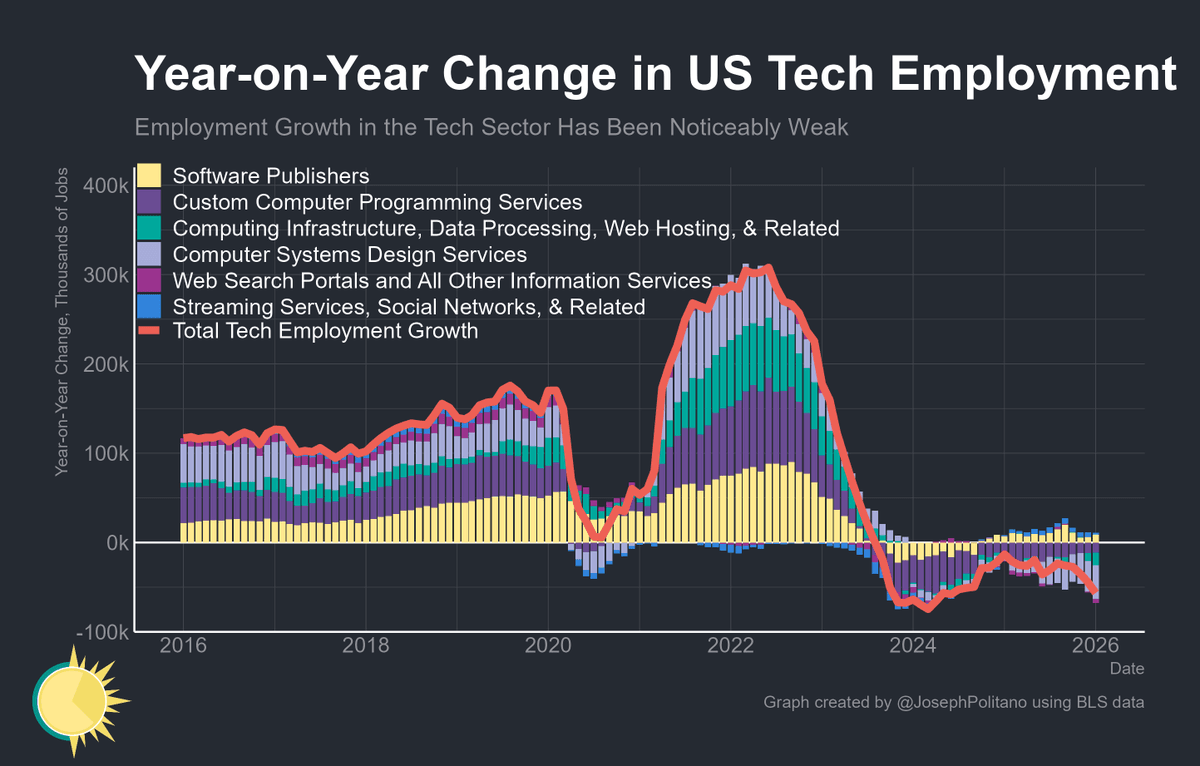
February's jobs report delivered a sobering reality check to the US economy, revealing a net loss of 92,000 jobs when economists had predicted a gain of 55,000. While economic fluctuations are normal, what's particularly striking about this downturn is its concentration in the technology sector and the emerging evidence that artificial intelligence is playing a significant role in this transformation.
The Numbers Tell a Story
The February jobs data represents more than just a statistical anomaly. The magnitude of job losses—particularly in technology-related fields—has drawn comparisons to two of the most significant economic downturns in recent memory: the 2008 financial crisis and the dot-com bust of the early 2000s. Both periods saw massive restructuring in the tech industry, but the current situation differs in one crucial aspect: the accelerating adoption of AI technologies.
According to analysis of the jobs report, the types of positions being eliminated aren't just cyclical casualties but appear to reflect structural changes in how companies approach technology work. Roles in software development, data analysis, content creation, and customer support—all areas where AI has made significant inroads—are showing particular vulnerability.
The AI Factor in Job Displacement
While economic factors like inflation, interest rates, and market corrections certainly contribute to job losses, multiple indicators suggest AI is becoming a meaningful factor in employment decisions. Companies across sectors are increasingly implementing AI solutions that can perform tasks previously handled by human workers, from coding assistance and content generation to data processing and customer service.
This transition isn't happening in isolation. The timing coincides with remarkable advances in generative AI capabilities, with tools like ChatGPT, GitHub Copilot, and various enterprise AI platforms reaching levels of sophistication that make them viable alternatives to certain human-performed tasks. The economic pressure to improve efficiency and reduce costs has created a perfect storm for AI adoption at the expense of some traditional tech roles.
Historical Context: Different Causes, Similar Effects
The dot-com bust of 2000-2002 saw the collapse of overvalued internet companies and widespread tech job losses as speculative bubbles burst. The 2008 financial crisis triggered broader economic turmoil that inevitably impacted tech employment. Today's situation differs in that the underlying technology—AI—isn't collapsing but rather accelerating, creating what economists call "creative destruction" where new technologies displace older ways of working.
What makes the current moment particularly challenging is that AI's impact extends beyond traditional tech companies to virtually every sector of the economy. Financial services, healthcare, manufacturing, and retail are all implementing AI solutions that affect their technology workforce needs.
The Silver Lining: AI Job Creation
While the displacement effect is real, it's crucial to recognize that AI is simultaneously creating new categories of employment. Roles in AI development, implementation, ethics, training, and maintenance are growing rapidly. The challenge lies in the mismatch between the skills needed for these new positions and those possessed by workers in traditional tech roles.
This transition period creates what labor economists call "structural unemployment"—where jobs exist but workers lack the specific skills to fill them. The speed of AI advancement means this skills gap may widen before it narrows, creating temporary but significant disruption in the labor market.
Implications for Workers and Companies
For technology professionals, this shift necessitates a reevaluation of career paths and skill development. Specialized technical skills combined with AI literacy—understanding how to work alongside AI systems rather than competing with them—will likely become increasingly valuable. Soft skills like creativity, complex problem-solving, and emotional intelligence, which remain challenging for AI to replicate, may gain importance.
Companies face their own challenges in navigating this transition. While AI implementation offers efficiency gains, it also requires significant investment in retraining, ethical frameworks, and organizational restructuring. The most successful organizations will likely be those that view AI as a tool to augment human capabilities rather than simply replace them.
Policy Considerations and Future Outlook
The scale of job displacement suggested by the February data raises important questions about policy responses. Potential measures include enhanced retraining programs, educational reforms to prepare future workers for an AI-integrated economy, and social safety nets to support workers during transitions.
Looking ahead, the relationship between AI and employment will likely follow a pattern seen with previous technological revolutions: initial disruption followed by new opportunities, but with a potentially faster transition timeline due to AI's rapid advancement. The February jobs report may represent an early indicator of this acceleration.
Navigating the Transition
As AI continues to evolve, both workers and organizations must adopt proactive strategies. Continuous learning, adaptability, and a focus on uniquely human capabilities will be essential for career resilience. Companies that balance efficiency gains with responsible workforce transitions may find themselves better positioned for long-term success.
The February employment data serves as a wake-up call about the tangible impacts of AI on the workforce. While the full extent of AI's influence on employment remains to be seen, the evidence suggests we've entered a new phase of technological transformation with significant implications for the future of work.
Source: Analysis based on February 2024 jobs report data and economic indicators highlighting AI's growing impact on employment trends.