In the rapidly evolving field of artificial intelligence, researchers continually seek sophisticated techniques to enhance large language model performance—from complex prompt engineering to fine-tuning and architectural innovations. Yet a startling new discovery suggests that one of the most effective methods might be astonishingly simple: just ask twice.
Recent research has revealed that repeating the exact same prompt verbatim can dramatically improve LLM accuracy on certain tasks, with one model's performance jumping from 21% to 97% accuracy on a name-search task. This improvement occurs without longer outputs, slower response times, fine-tuning, or elaborate prompt engineering—challenging fundamental assumptions about how we interact with AI systems.
The Discovery: When Asking Twice Makes All the Difference
The finding, highlighted by researcher Kimmo Kärkkäinen and detailed in the paper "Repetition Improves Language Model Embeddings," demonstrates what the authors term the "repetition effect." When users submit identical prompts in succession, models produce significantly more accurate and reliable outputs across various benchmark tasks.
In one striking example, researchers tested a name-search task where the model needed to identify whether a particular name appeared in a given context. With a single prompt, accuracy languished at just 21%. When the identical prompt was repeated, accuracy soared to 97%—a 76 percentage point improvement with zero additional engineering.
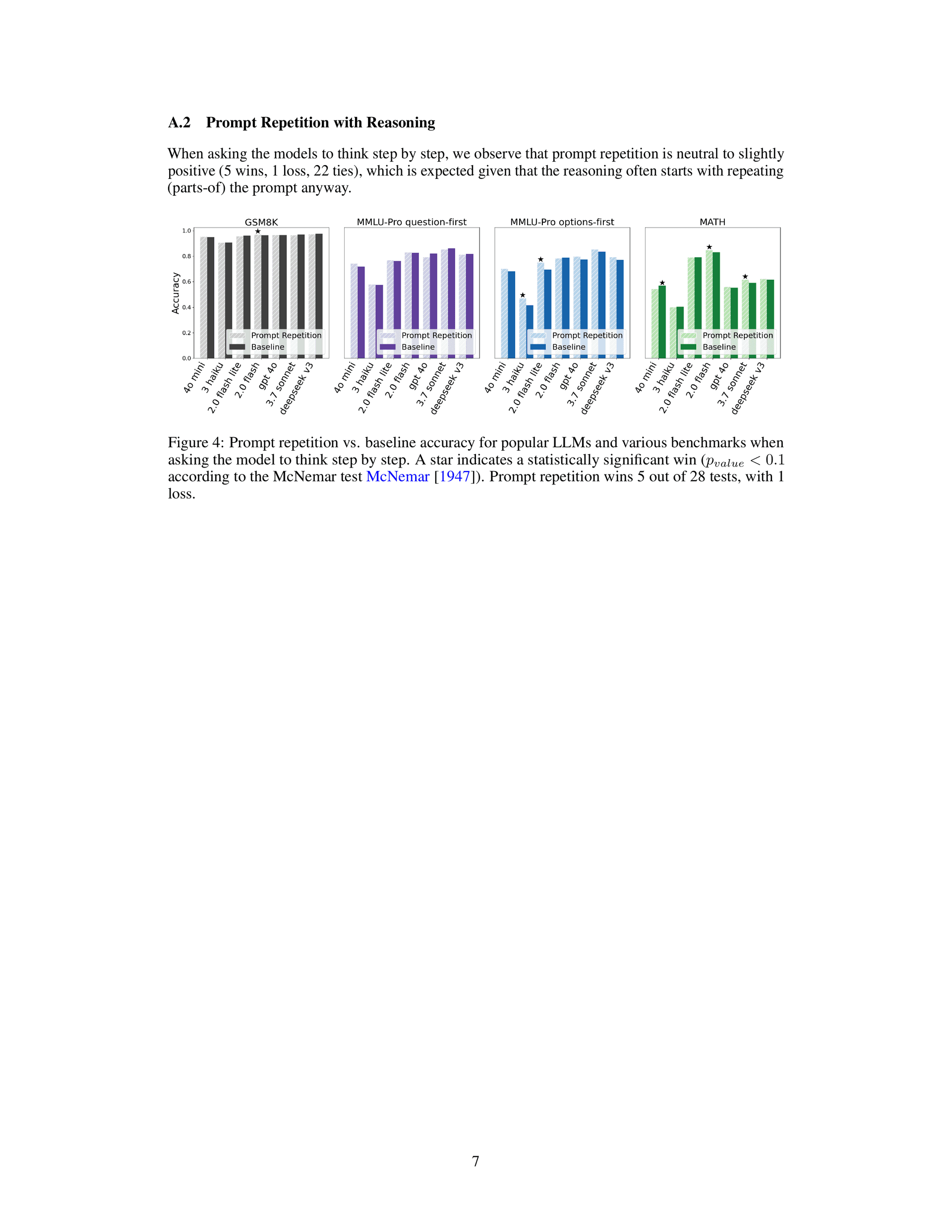
This phenomenon isn't limited to obscure benchmarks. The research shows consistent improvements across multiple model architectures and task types, suggesting a fundamental property of how contemporary LLMs process sequential inputs.
How Repetition Reshapes Model Processing
The mechanism behind this effect appears to relate to how language models allocate computational resources during inference. When presented with a prompt, models generate internal representations (embeddings) that guide their responses. The first presentation of a prompt establishes initial activations, while the repetition allows the model to refine and reinforce these patterns.
Researchers hypothesize several possible explanations:
Attention Reinforcement: Repeated prompts may strengthen attention weights to relevant tokens, helping the model focus on critical information it might initially overlook.
Noise Reduction: The first pass might include more stochastic elements, while repetition allows the model to converge on more deterministic, accurate representations.
Contextual Priming: The initial prompt establishes context that the second iteration can build upon more effectively than if presented in isolation.
Confidence Calibration: Repetition may help models overcome initial uncertainty, particularly for ambiguous or complex queries.
Practical Implications for AI Interaction
This discovery has immediate practical implications for developers, researchers, and everyday users of AI systems:
For Developers: API-based applications could implement automatic prompt repetition for critical queries, potentially improving reliability without increasing costs proportionally (since repeated prompts typically don't double computational requirements).
For Researchers: The finding suggests that benchmark results might be artificially low if they don't account for this repetition effect, potentially necessitating reevaluation of model comparisons.
For Users: Simple interfaces could incorporate a "double-check" function that automatically resubmits queries when confidence is low, similar to how humans might re-read confusing instructions.
Beyond Simple Repetition: Related Phenomena
The repetition effect connects to broader research on how input formatting influences model performance. Studies have shown that:
- Adding phrases like "Let's think step by step" improves reasoning
- Certain whitespace and formatting choices affect output quality
- The position of instructions within prompts changes results
What makes the repetition effect particularly remarkable is its simplicity and consistency—no specialized wording or formatting is required, just literal duplication.
Limitations and Caveats
While promising, the repetition effect isn't a universal solution:
- Improvements vary significantly by task type and model architecture
- Some tasks show minimal or no benefit from repetition
- The effect may diminish with extremely large context windows or specialized models
- Researchers haven't yet determined optimal repetition counts (beyond two) for different scenarios
Additionally, the computational ethics of this approach warrant consideration. If repetition becomes standard practice, it could increase energy consumption for AI systems, though likely less than more complex enhancement methods.
Future Research Directions
The discovery opens numerous research avenues:
Mechanistic Understanding: Detailed analysis of how repetition changes internal model states during processing
Architectural Implications: Whether future models should be designed to achieve similar benefits without explicit repetition
Task Specificity: Mapping which problem types benefit most from repetition techniques
Combination Strategies: How repetition interacts with other prompt optimization methods
Cognitive Parallels: Comparisons to human cognitive processes where repetition improves comprehension and recall
Conclusion: Rethinking AI-Human Interaction
The repetition effect represents one of those rare findings in AI research that is simultaneously simple, profound, and immediately applicable. It reminds us that despite the complexity of modern neural networks, their behavior can sometimes be dramatically improved through elementary interventions.
As AI systems become increasingly integrated into daily life, understanding such basic interaction principles may prove as important as advancing the underlying technology. The fact that merely repeating a request can transform near-failure into near-perfect performance suggests we're still discovering fundamental aspects of how these systems process human language.
This research, detailed in the paper "Repetition Improves Language Model Embeddings," challenges the assumption that better AI interaction necessarily requires more complex engineering. Sometimes, the most powerful technique might be the simplest one of all: asking twice.
Source: Research highlighted by Kimmo Kärkkäinen (@kimmonismus) based on findings from "Repetition Improves Language Model Embeddings"