For four decades, the digital revolution has been built on a foundation of deterministic systems—precise, predictable software functions and APIs that execute flawlessly when triggered but remain inert without explicit human instruction. As noted by AI commentator Rohan Paul, we've essentially created "pristine, infinitely scalable muscles" that only fire when told. The bottleneck has always been human attention span and judgment, forcing us to act as the brains for these powerful but passive digital systems.
From Deterministic to Probabilistic Architecture
The current AI wave represents a fundamental architectural shift. Large Language Models (LLMs) now serve as probabilistic reasoning engines that sit atop rigid software systems, dynamically mapping messy, real-world inputs to precise API calls. This transition eliminates the need for endless if-else logic branches designed to catch every edge case. Instead, developers now write boundary conditions, creating frameworks within which AI systems can operate autonomously.
This represents more than just another technological improvement—it's a complete reimagining of how software interacts with the world. Where traditional applications required users to navigate interfaces and complete tasks step-by-step, AI-powered systems can now receive high-level instructions and execute entire workflows independently.
The New Development Paradigm
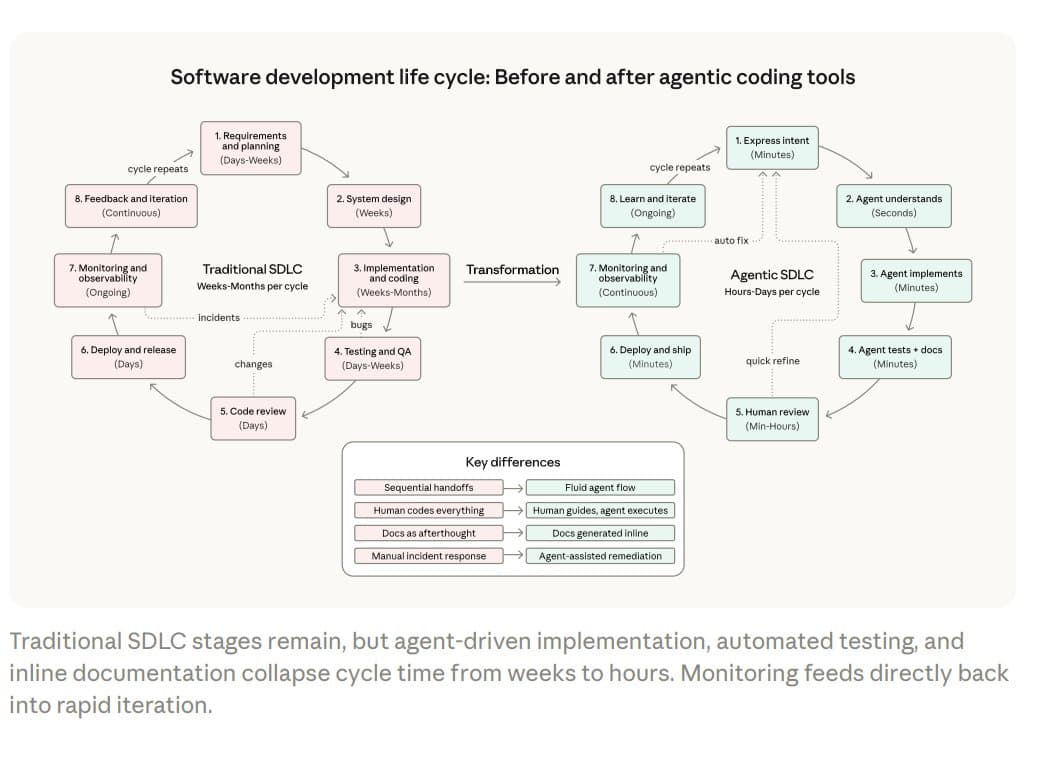
The implications for software development are staggering. Building software traditionally took months as human engineers manually wrote, tested, and documented every line of code. Now, developers can state their goals in plain language while autonomous AI systems handle the implementation details. According to research cited in the source, this shift is already reducing development timelines from months to hours for certain applications.
This doesn't eliminate the need for developers but fundamentally changes their role. Rather than focusing on implementation details, developers now concentrate on defining system boundaries, establishing evaluation frameworks, and ensuring safety protocols. The hardest engineering challenge has become building "strict evaluation frameworks to ensure these probabilistic brains do not hallucinate when triggering irreversible actions."
The Coming Workflow Revolution
Research from Anthropic suggests that by 2028, autonomous AI systems will handle 15% of all daily workflow decisions. This transition will force human workers to evolve into roles focused on compliance, governance, and quality control. The human-machine relationship is being redefined from one of direct control to one of oversight and boundary-setting.
This shift represents what might be called "the great unbundling" of human attention from digital execution. For the first time in computing history, we're separating the cognitive work of understanding intent from the mechanical work of executing tasks. This creates unprecedented scalability in how organizations can leverage their existing digital infrastructure.
Safety and Evaluation Challenges
The probabilistic nature of AI systems introduces new engineering challenges. Unlike deterministic systems that behave predictably given the same inputs, AI systems make probabilistic judgments that require robust evaluation frameworks. The primary engineering focus has shifted toward building safety boundaries that prevent catastrophic failures when AI systems trigger irreversible actions.
This represents a fundamental reorientation of software engineering priorities. Where reliability once meant eliminating bugs and edge cases, it now means creating systems that can safely handle uncertainty and ambiguity while remaining within established boundaries.
Implications for Business and Society
The transition from deterministic to probabilistic systems will reshape industries across the board. Companies that have invested heavily in API infrastructure now find that infrastructure becoming exponentially more valuable when paired with AI reasoning layers. The bottleneck of human attention that limited automation for decades is being systematically removed.
This development also raises important questions about accountability, transparency, and control. As AI systems take on more autonomous decision-making roles, establishing clear governance frameworks becomes essential. The human role transitions from direct operator to system designer and overseer—a shift that will require new skills and organizational structures.
Source: Analysis based on observations by Rohan Paul (@rohanpaul_ai) regarding the architectural shift from deterministic to probabilistic systems in AI development.