A new research framework called Trace2Skill proposes a method for mimicking human skill authoring by analyzing how models execute tasks and converting those patterns into reusable, declarative skills. The approach, detailed in a paper highlighted by the @HuggingPapers account, aims to improve the capabilities of larger foundation models without requiring expensive parameter fine-tuning.
What the Framework Does
Trace2Skill operates on a core observation: when humans learn a complex skill, they often break down successful executions into a set of declarative rules or principles that can be applied to new situations. The framework attempts to automate this process for AI agents.
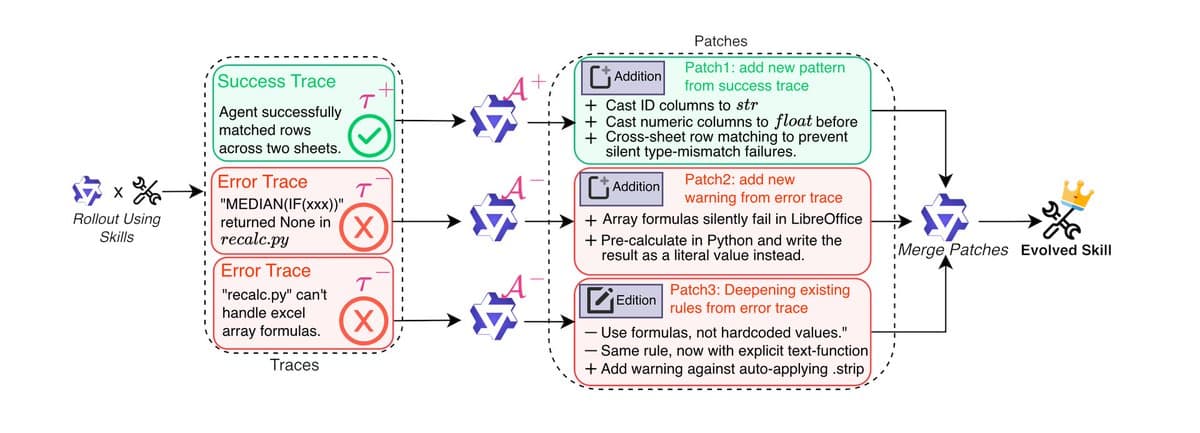
It works by first collecting execution trajectories—step-by-step records of how a model or agent successfully completes a task. These trajectories are then fed into a system of parallel sub-agents, each tasked with analyzing the trace from a different perspective or to extract a different type of pattern.
How It Works: Parallel Analysis and Skill Distillation
The technical innovation lies in the dispatch mechanism and the distillation process. Instead of a single monolithic analysis, the framework employs multiple specialized sub-agents that operate in parallel. This design is intended to capture a more diverse and robust set of insights from a single successful run.
Each sub-agent focuses on a specific aspect of the trajectory, such as:
- State-transition patterns: How the agent moves between different states of the environment or problem.
- Action sequences: The specific chain of actions that led to success.
- Conditional logic: The "if-then" rules implicitly followed during execution.
- Goal decomposition: How the main task was broken into subtasks.
The outputs from these parallel analyses are then synthesized and distilled into a declarative skill. This skill is not a fine-tuned set of model weights, but rather a structured, interpretable representation—such as a set of rules, a program, or a natural language description—that can be understood and executed by other agents or models.
The Key Benefit: Transfer Without Tuning
The primary claimed advantage of Trace2Skill is that these distilled skills are transferable and can be used to improve the performance of other, often larger, models without parameter updates. This is significant because fine-tuning large language models (LLMs) or other foundation models is computationally expensive and can lead to catastrophic forgetting of other capabilities.
By providing a model with a library of declarative skills derived from successful traces, the model can, in theory, refer to these skills during inference to guide its problem-solving, similar to how a human might consult a checklist or a set of best practices. This aligns with a growing research direction focused on improving model reasoning and planning through external, updatable knowledge or procedures, rather than solely through weight adjustment.
Potential Applications and Immediate Questions
The paper suggests applications in complex, multi-step reasoning domains where explicit skill libraries are beneficial, such as:
- Code generation and software engineering tasks, where a successful debugging trace can be turned into a general bug-fixing rule.
- Mathematical reasoning, where the solution to one problem can be abstracted into a proof strategy.
- Robotic task planning, where a physical demonstration can be converted into a reusable procedure.
However, the announcement via tweet is brief and leaves several critical questions for practitioners:
- What is the exact architecture of the sub-agents?
- On which benchmarks was the framework validated, and what were the quantitative results?
- How is the "skill" representation formalized, and how is it integrated into a larger model's inference process?
- What is the overhead of the parallel analysis phase, and does it require multiple successful trajectories to be robust?
gentic.news Analysis
Trace2Skill enters a crowded and active field of research aimed at extracting structured knowledge from neural networks. This trend is a direct response to the opaque, black-box nature of large foundation models. Techniques like model distillation, concept extraction, and mechanistic interpretability all seek to make model capabilities more explicit and transferable. Trace2Skill's specific angle—using parallel sub-agents to analyze execution traces—is a novel twist that draws inspiration from program synthesis and automated planning literature.
The emphasis on declarative skills and parameter-free improvement is particularly timely. As models grow larger, the community is increasingly looking for alternatives to full fine-tuning. Methods like retrieval-augmented generation (RAG), tool use, and prompt tuning are all part of this ecosystem. Trace2Skill can be seen as a form of skill-augmented generation, where the external knowledge base is populated not with documents, but with procedural knowledge extracted from the model's own successful behaviors.
This work also subtly connects to the broader push for more compositional and modular AI systems. The vision of having a model dynamically select and apply pre-defined skills is a step towards a more robust and reliable agentic AI, moving beyond pure next-token prediction. The success of this approach will hinge on the fidelity of the distillation process—can the parallel sub-agents truly capture the causal, generalizable principles from a trace, or will they overfit to superficial patterns? The answers will be in the empirical results, which the research community will eagerly scrutinize upon the paper's full release.
Frequently Asked Questions
What is the main goal of the Trace2Skill framework?
Trace2Skill aims to automate the process of converting successful task executions (traces) into reusable, declarative skills. Its primary goal is to improve the performance of larger AI models by providing them with these extracted skills, without needing to update the model's internal parameters through fine-tuning.
How does Trace2Skill differ from standard model fine-tuning?
Standard fine-tuning adjusts the numerical weights (parameters) of a neural network, which is computationally expensive and can degrade performance on unrelated tasks (catastrophic forgetting). Trace2Skill, in contrast, extracts skills as external, interpretable representations (like rules or programs). A model uses these as a guide during inference, leaving its original parameters unchanged.
What are "declarative skills" in this context?
In Trace2Skill, a declarative skill is a structured, human- or machine-readable representation of a procedure or strategy derived from an execution trace. It is "declarative" because it states what to do or under what conditions, rather than being an implicit, unreadable pattern in a neural network's weights. Examples could include a set of logical rules, a small program, or a detailed natural language instruction set.
What types of tasks is Trace2Skill best suited for?
Based on the described methodology, Trace2Skill is likely best suited for complex, multi-step reasoning and planning tasks where successful solutions can be decomposed into generalizable principles. This includes domains like code generation, mathematical theorem proving, strategic game playing, and robotic manipulation planning, where explicit procedures are valuable.