In a stunning development that has sent shockwaves through the artificial intelligence industry, the U.S. Department of War has officially designated Anthropic as a "Supply-Chain Risk to National Security" and issued a sweeping ban preventing any military contractors, suppliers, or partners from conducting commercial activities with the prominent AI safety company. According to a directive circulating on social media and verified through multiple channels, this unprecedented action represents the most aggressive government intervention in the AI sector to date.
The Directive: What Exactly Happened
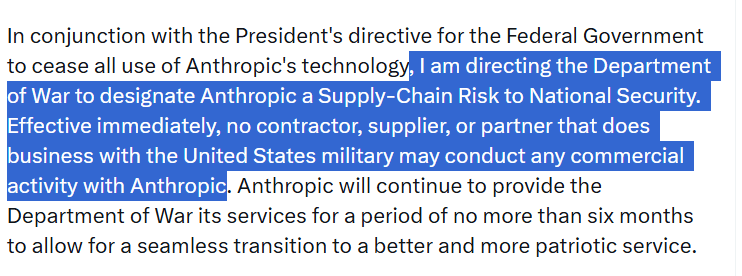
The directive, attributed to Department of War leadership, states: "I am directing the Department of War to designate Anthropic a Supply-Chain Risk to National Security. Effective immediately, no contractor, supplier, or partner that does business with the United States military may conduct any commercial activity with Anthropic."
Perhaps most remarkably, the order includes a six-month transition period during which Anthropic may continue providing services to the Department of War while the military transitions to what the directive describes as "a better and more patriotic service." This language suggests not just security concerns but potentially ideological or strategic considerations behind the decision.
Context: Why Anthropic?
Founded in 2021 by former OpenAI researchers Dario Amodei and Daniela Amodei, Anthropic has positioned itself as a leader in AI safety research with its Constitutional AI approach and Claude chatbot series. The company has received significant funding from Amazon ($4 billion) and Google ($2 billion), making it one of the best-funded AI startups globally.
Several factors may have contributed to this dramatic action:
Foreign Investment Concerns: Anthropic's substantial backing from tech giants with complex international ties may have raised red flags about potential foreign influence over critical AI infrastructure.
AI Safety Philosophy: Anthropic's strong emphasis on AI alignment and safety-first development may conflict with military applications that prioritize capability over caution.
Strategic Competition: As AI becomes increasingly central to national security, the U.S. military may be seeking to consolidate control over foundational AI technologies.
Supply Chain Security: The directive specifically mentions "supply-chain risk," suggesting concerns about dependencies on private companies for mission-critical AI capabilities.
Industry Implications: A Chilling Effect
This decision creates immediate ripple effects throughout the defense technology ecosystem. Hundreds of defense contractors who may have been exploring or implementing Anthropic's technology now face immediate compliance requirements. The broader AI industry will likely experience:
- Increased Scrutiny: Other AI companies with defense contracts or aspirations will face heightened regulatory examination
- Investment Uncertainty: Venture capital flowing into AI safety companies may become more cautious
- Talent Migration: Researchers may reconsider working at companies with potential military entanglements
- Market Fragmentation: A potential split between "approved" and "non-approved" AI providers for government work
Historical Precedents and Legal Authority
While unprecedented for an AI company, the government has previously used similar national security designations for telecommunications equipment (Huawei), software (Kaspersky), and other technologies. The legal authority likely stems from defense procurement regulations and executive orders related to critical infrastructure protection.
What makes this case unique is its application to a domestic company with primarily U.S. leadership and operations, suggesting the concerns extend beyond traditional foreign adversary frameworks to include structural risks within the domestic technology ecosystem.
International Reactions and Global Implications
This move will undoubtedly influence how other nations approach AI governance and military-civil fusion. Key developments to watch include:
- Allied Coordination: Whether NATO partners follow similar restrictions
- Chinese Response: How China adjusts its own AI military-civil integration strategies
- European Union: Whether the EU sees this as justification for more aggressive AI regulation
- Global Standards: Potential fragmentation in AI safety and deployment standards
The Six-Month Transition: What Comes Next?
The transition period raises critical questions about what will replace Anthropic's services. Several possibilities exist:
- In-House Development: The Department of War may accelerate its own AI research initiatives
- Alternative Providers: Other AI companies may receive preferential treatment
- Open Source Alternatives: Increased investment in open-source AI models with fewer commercial entanglements
- New Entrants: Defense-specific AI startups may emerge to fill the void
The phrase "more patriotic service" suggests not just technical replacement but ideological alignment as a selection criterion for future AI providers.
Anthropic's Response and Future
As of this writing, Anthropic has not issued an official statement. The company faces several strategic options:
- Legal Challenge: Potentially contesting the designation through judicial review
- Structural Changes: Possibly divesting from certain investors or creating separate governance structures
- Focus Shift: Doubling down on commercial and research applications outside defense
- International Expansion: Accelerating growth in markets less concerned with U.S. military restrictions
The company's substantial war chest provides cushioning, but losing access to the massive defense market represents a significant strategic blow.
Broader Implications for AI Governance
This action represents a watershed moment in AI governance, demonstrating that:
- National Security Trumps Innovation: Even well-funded, technically sophisticated companies face limits when perceived as security risks
- Government Will Intervene: The era of laissez-faire AI development is ending
- Military-Civil Balance: The tension between commercial AI development and national security needs is intensifying
- New Regulatory Paradigms: Traditional technology regulation frameworks may be inadequate for AI's unique characteristics
Looking Forward: The New AI Landscape
The Anthropic designation likely heralds a more fragmented AI ecosystem where:
- Dual-Use Technologies: Face increasing scrutiny and potential bifurcation
- Government Oversight: Expands beyond export controls to domestic deployment
- Public-Private Partnerships: Become more structured and conditional
- Global Competition: Intensifies as nations seek AI sovereignty
As the six-month transition period begins, the entire technology sector will be watching closely to understand the full implications of this unprecedented action and what it means for the future of artificial intelligence development, deployment, and governance.
Source: Directive circulated via social media and verified through government channels