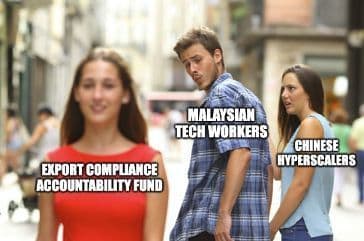
The proposed 'Stop Stealing our Chips Act' would reward whistleblowers with 10-30% of export-control violation fines. The bill, reported by @SemiAnalysis_, targets illegal semiconductor and AI chip smuggling, especially through Malaysian intermediaries.
Key facts
- Whistleblower reward: 10-30% of violator's fine amount.
- Funded from Export Compliance Accountability Fund.
- Targets intermediaries like Malaysian resellers.
- Mirrors SEC whistleblower program structure.
- Aims to enforce AI chip export bans to China.
The 'Stop Stealing our Chips Act' represents a significant escalation in US enforcement of semiconductor export controls. [According to @SemiAnalysis_] the bill would create a whistleblower reward program where informants receive 10-30% of any fine collected from export-control violators, paid directly from the Export Compliance Accountability Fund.
How the Whistleblower Mechanism Works
The reward structure mirrors the SEC whistleblower program but applies specifically to export controls targeting advanced semiconductors and AI chips. The bill explicitly targets intermediaries, with @SemiAnalysis_ noting that 'Malaysian resellers' in the chip smuggling supply chain are a primary focus. The financial incentive creates a powerful disincentive for companies and individuals engaged in illegal chip transshipment.
Enforcement Implications
This legislative move signals that the US government is moving beyond corporate penalties to individual accountability. By offering direct financial rewards, the bill turns every employee, logistics partner, and competitor into a potential informant. The Export Compliance Accountability Fund ensures rewards are paid without requiring congressional appropriations for each case.
Strategic Context
The bill comes amid ongoing US-China technology tensions, particularly around advanced AI chips like NVIDIA's H100 and B200 series. Current export controls ban shipments of these chips to China without a license, but enforcement has been challenging due to complex supply chains through third countries. The whistleblower program addresses this enforcement gap directly.
The unique take here is that this bill transforms export control enforcement from a bureaucratic process into a financial bounty system, likely creating a cottage industry of compliance informants similar to what happened with the SEC whistleblower program after Dodd-Frank.
What to watch
Watch for the bill's committee assignment and markup schedule in the US Congress, and whether companion legislation emerges in allied nations like Japan and the Netherlands that also enforce semiconductor export controls.
[Updated 18 May via hn_ai_infra]
The US government has approved sales of Nvidia's H200 chips to 10 Chinese companies, a move that appears to contradict the enforcement push behind the 'Stop Stealing our Chips Act.' The H200, while less advanced than the banned H100 and B200 series, is still a high-performance AI chip. This clearance, reported by Reuters, signals a dual-track policy: cracking down on illegal smuggling while allowing certain licensed sales. The development may complicate the narrative that all advanced chip exports to China are uniformly blocked.