Vellum AI Launches as Persistent Desktop Agent with Dedicated Email and Accounts

Vellum AI Launches as Persistent Desktop Agent with Dedicated Email and Accounts

Vellum AI operates as a persistent desktop agent with its own email and accounts, executing tasks autonomously. The tool claims enterprise-grade security while running continuously on user systems.

5h ago·2 min read·8 views·via @hasantoxr
Share:

What Happened

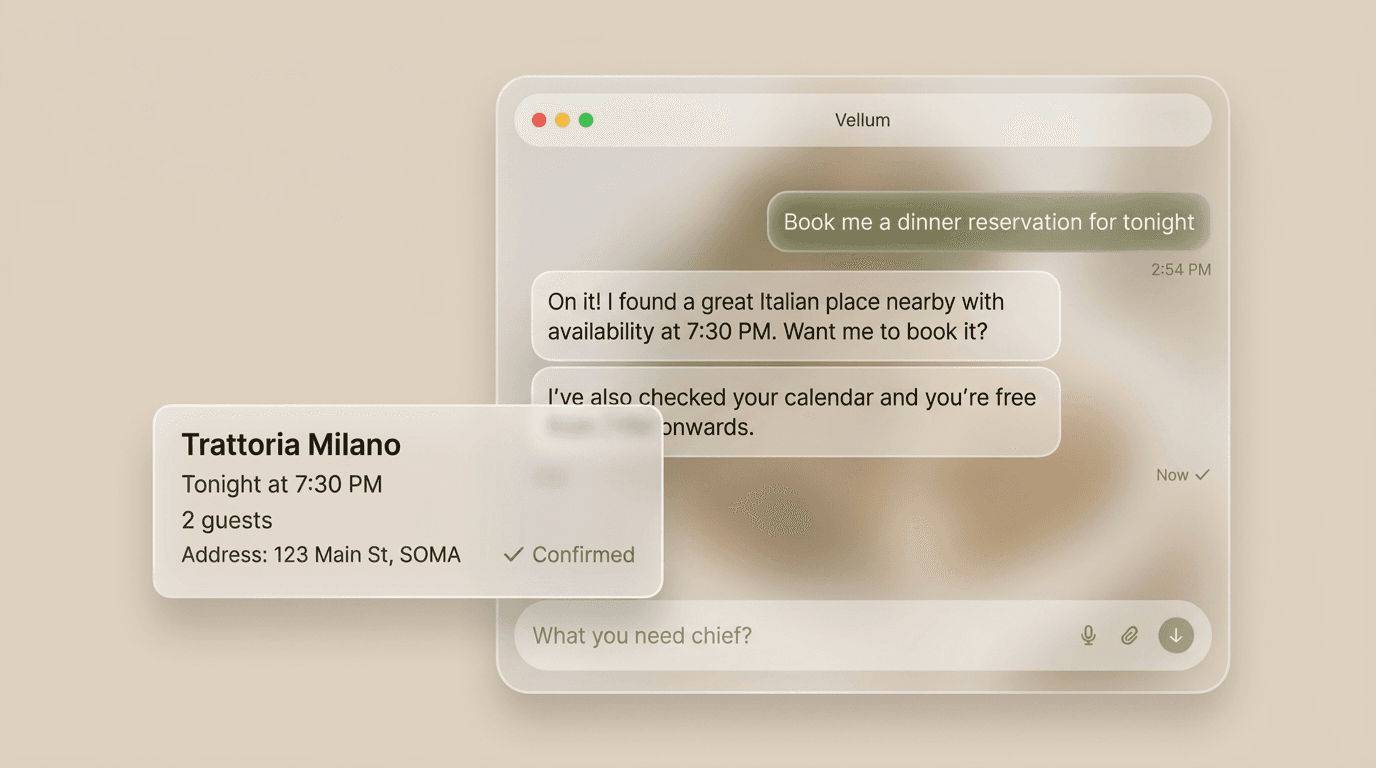
A new AI agent called Vellum has launched, positioning itself as a persistent desktop assistant that operates with its own email address, user accounts, and the ability to execute tasks autonomously—including while the user is offline or asleep. According to user reports, the agent runs directly on the user's desktop system rather than as a cloud-only service.

The key claimed differentiator is that Vellum maintains its own identity within applications and services (email, accounts) rather than merely acting through the user's existing credentials. This allows it to operate independently and handle workflows without constant user intervention.

Context

The development follows growing interest in persistent AI agents that can manage workflows beyond simple chatbot interactions. Unlike tools that require manual triggering or operate solely through APIs, Vellum appears designed to maintain continuous operation with delegated access to tools and accounts.

The security claim—"it's actually secure"—suggests the implementation includes local execution with encrypted credential storage and perhaps audit trails, addressing common concerns about granting AI systems access to sensitive accounts.

No technical specifications, architecture details, pricing, or benchmark comparisons were provided in the source material. The announcement appears to be an initial product launch announcement rather than a research publication.

AI Analysis

The Vellum announcement points toward a concrete implementation of the persistent agent paradigm that has been discussed theoretically in AI research circles. Rather than treating AI as a tool you invoke, it treats AI as a semi-autonomous colleague with delegated access and responsibility. This represents a significant shift in human-AI interaction design. From a security perspective, the claim that it's "actually secure" is critical but unsubstantiated in the source. Practitioners should look for technical details on how credentials are stored (likely locally encrypted), what audit trails exist, and whether actions are reversible. The architecture likely involves a local orchestrator that manages API calls and maintains session persistence, rather than a purely cloud-based agent that loses context between sessions. If Vellum delivers on its promise, it could move AI assistance from reactive task completion to proactive workflow management. However, the lack of technical details in the source means engineers should approach with healthy skepticism until architecture diagrams, security audits, and performance benchmarks are published.
Original sourcex.com

Trending Now

More in Products & Launches

Browse more AI articles