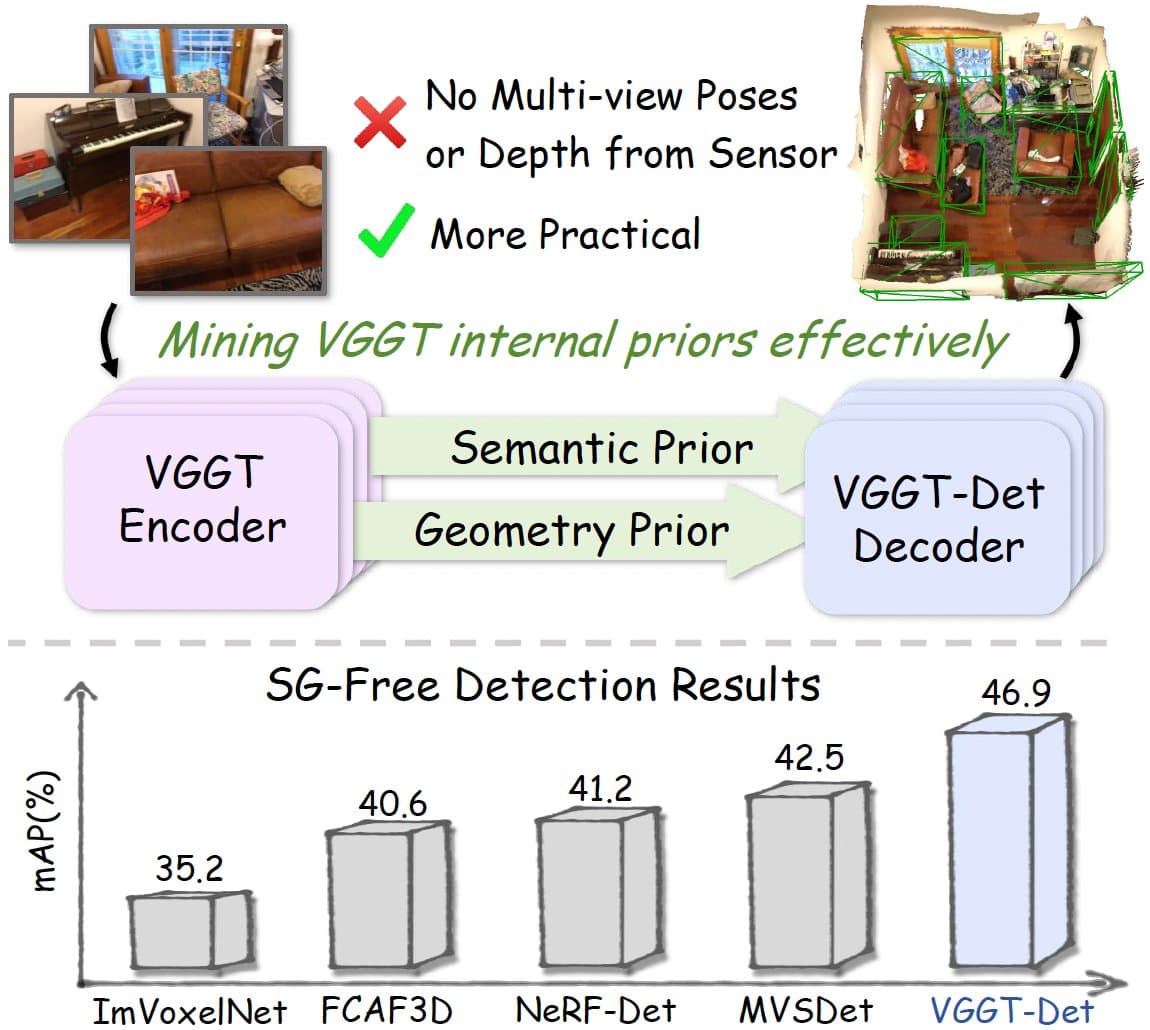
Researchers have unveiled VGGT-Det, a groundbreaking framework that fundamentally changes how artificial intelligence systems perceive three-dimensional spaces. Unlike traditional approaches that rely on precisely calibrated camera parameters, this new method achieves state-of-the-art multi-view indoor 3D object detection without requiring camera pose calibration—a development that could democratize 3D vision applications across industries.
The Problem with Traditional 3D Detection
For years, 3D object detection from multiple camera views has depended on knowing exactly where each camera is positioned and how it's oriented in space. This requirement for calibrated camera poses has been a significant bottleneck in real-world applications. In controlled environments like research labs, precise calibration is achievable, but in dynamic settings—from smart homes to retail stores to industrial facilities—maintaining perfect calibration is impractical and expensive.
Traditional methods typically follow a two-step process: first establishing camera geometry through calibration, then using this geometric information to reconstruct 3D scenes. When calibration drifts or cameras move unexpectedly, these systems fail dramatically. VGGT-Det represents a paradigm shift by learning to understand 3D space directly from visual data, bypassing the calibration requirement entirely.
How VGGT-Det Works: Mining Internal Priors
The core innovation of VGGT-Det lies in its ability to mine what researchers call "VGGT internal priors"—essentially learning geometric relationships directly from visual data. The framework employs two key mechanisms:
Attention-Guided Query Generation: Instead of relying on external camera parameters, the system generates queries about potential object locations using attention mechanisms that analyze relationships between different views. These queries represent hypotheses about where objects might exist in 3D space.
Query-Driven Feature Aggregation: Once queries are generated, the system aggregates features from multiple camera views specifically around these hypothesized locations. This creates rich, multi-view representations that allow the model to verify and refine its 3D understanding.
What makes this approach particularly elegant is that it learns to perform what amounts to implicit camera calibration through the training process. By seeing enough examples of multi-view scenes, the model internalizes how different perspectives relate to each other in 3D space.
Technical Architecture and Performance
According to the research paper, VGGT-Det employs a transformer-based architecture that processes features from multiple camera views simultaneously. The attention mechanisms operate across both spatial dimensions and different camera perspectives, allowing the model to establish correspondences between views without explicit geometric constraints.
Experimental results show VGGT-Det outperforming prior state-of-the-art methods on standard indoor 3D detection benchmarks. The system demonstrates particular strength in handling challenging scenarios where camera positions might shift slightly or where calibration would traditionally be difficult to maintain. The performance gap widens in more complex environments with occlusions and varying lighting conditions.
Real-World Applications and Implications
The practical implications of geometry-free 3D detection are substantial. Consider these potential applications:
Smart Home and Office Environments: Security systems could track objects and people in 3D without requiring professionally installed, perfectly calibrated camera arrays. Home robots could navigate and interact with their environment more naturally.
Retail Analytics: Stores could deploy camera systems that automatically understand shelf inventory, customer movement patterns, and product interactions in three dimensions without expensive installation and maintenance of calibrated systems.
Industrial Monitoring: Manufacturing facilities could implement quality control and safety monitoring with cameras that can be moved or adjusted without requiring recalibration by specialists.
Augmented and Virtual Reality: AR systems could better understand physical environments without requiring users to perform calibration procedures, making the technology more accessible and user-friendly.
The Broader Trend: Learning Geometry from Data
VGGT-Det represents part of a broader movement in computer vision toward learning geometric understanding directly from data rather than relying on explicit mathematical models. This data-driven approach to geometry has been gaining momentum across multiple areas of computer vision, from depth estimation to scene reconstruction.
What sets VGGT-Det apart is its specific application to the challenging problem of multi-view 3D object detection and its demonstrated superiority over traditional geometry-dependent methods. The success of this approach suggests that for many 3D vision tasks, learning implicit geometric representations may be more robust and practical than relying on explicit geometric models.
Challenges and Future Directions
While VGGT-Det represents a significant advance, challenges remain. The current framework focuses on indoor environments, where camera views tend to be relatively constrained and lighting conditions more controlled. Extending this approach to outdoor environments with greater scale variation and more extreme lighting conditions presents additional hurdles.
Future research directions likely include:
- Scaling the approach to handle larger numbers of camera views
- Extending to dynamic scenes with moving cameras
- Incorporating temporal information for video understanding
- Combining with other sensor modalities like LiDAR or radar
- Improving efficiency for real-time applications
Conclusion: Toward More Accessible 3D Vision
VGGT-Det marks an important step toward making sophisticated 3D computer vision more accessible and practical. By eliminating the requirement for camera calibration, the technology lowers barriers to deployment across numerous applications. As the research community continues to develop geometry-free approaches, we may be approaching a future where 3D understanding becomes as straightforward to implement as 2D computer vision is today.
The work demonstrates that sometimes the most elegant solutions come not from more sophisticated explicit models, but from allowing neural networks to discover implicit patterns in data—even patterns as fundamental as the geometry of our three-dimensional world.
Source: HuggingPapers on X/Twitter