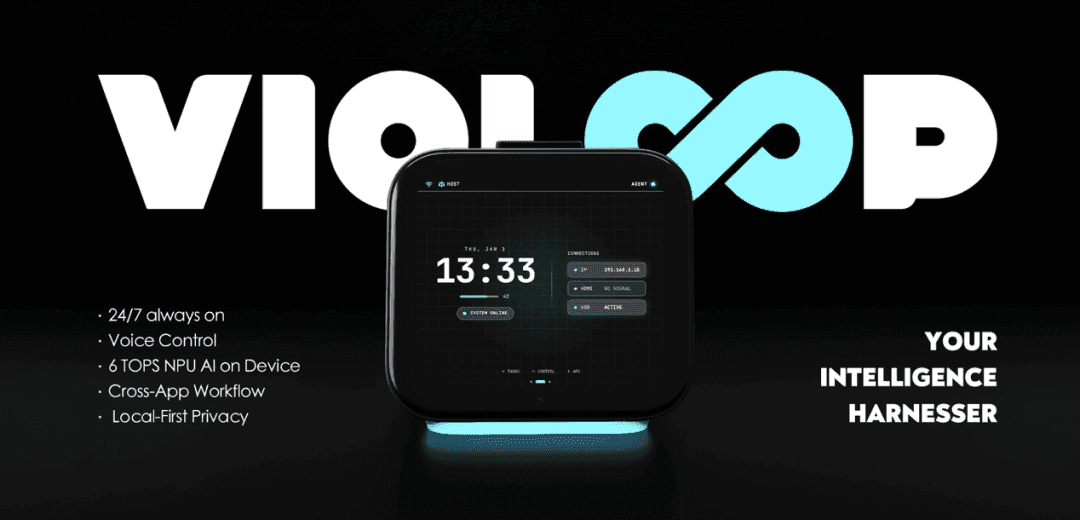
In a significant departure from the software-centric trajectory of most artificial intelligence development, hardware startup Violoop has announced securing multi-million dollar funding to build what it claims will be the world's first physical-level AI Operator. This ambitious project, as reported by Pandaily, seeks to fundamentally redefine how users interact with AI systems by embedding intelligence directly into a dedicated desktop hardware device, moving beyond the confines of screens and purely digital interfaces.
The Vision: From Digital Assistant to Physical Operator
The core concept behind Violoop's technology is the creation of a hardware-driven AI entity that operates at a "physical level." While details from the funding announcement remain guarded, the implication is a move toward an AI that doesn't just process information or generate text but can interact with and potentially orchestrate other physical devices and workflows on a user's desk. This represents a tangible shift from AI as a cloud-based service or software application to AI as an integrated, standalone piece of office hardware.
This development arrives at a critical juncture in AI's evolution. Recent analyses, including a March 2026 report, highlight that compute scarcity is making advanced AI expensive, forcing a strategic prioritization of high-value tasks. A dedicated hardware operator could be one answer to this challenge—optimizing specific, high-utility physical interactions rather than attempting generalized, resource-intensive automation.
Context: The Hardware Renaissance in AI
Violoop's venture underscores a growing recognition that the future of AI may not be purely algorithmic. The industry is grappling with the physical and economic constraints of scaling. The prevailing model of delivering ever-larger AI models via software-as-a-service (SaaS) is facing pressures, as noted in late February 2026 when rapid AI advancement was identified as a threat to traditional software models. A hardware-first approach could offer a more efficient, specialized, and potentially more private pathway for certain AI functions.
Furthermore, the push into physical interaction aligns with broader trends in human-computer interaction. As AI begins to meaningfully impact official productivity statistics—resolving the long-standing "productivity paradox" as of early March 2026—the focus is shifting from what AI can compute to how seamlessly it can be woven into human workflows. A physical operator on the desk could serve as a bridge, turning AI's cognitive output into actionable control over a user's immediate physical environment.
Potential Implications and Challenges
The implications of a successful physical AI operator are vast. In professional settings, it could streamline complex, multi-device tasks, acting as a central hub that manages everything from peripheral devices to environmental controls based on contextual AI understanding. It promises a more intuitive and embodied form of interaction, moving beyond voice and text to potentially include tactile feedback, spatial awareness, and direct device control.
However, the path is fraught with challenges. Hardware development carries significant costs and risks compared to software iteration. The device must offer a compelling, unique value proposition that cannot be replicated by a smartphone app or computer program. It must also navigate the complex ecosystem of existing devices and protocols. Success will depend not just on advanced AI but on elegant industrial design, robust engineering, and solving real user pain points in a way that feels indispensable.
The Competitive Landscape and Future Outlook
By staking a claim in physical AI hardware, Violoop is entering a nascent but potentially competitive space. It positions itself not against other large language models, but as a new category of product: the AI-native physical interface. Its success could catalyze a wider movement toward specialized AI hardware, influencing how we think about the interface between human intention, artificial intelligence, and the physical world.
The funding announcement signals investor confidence in this hardware-driven vision for the next phase of AI integration. As the technology matures, it will be fascinating to observe whether Violoop's physical operator can carve out a essential role on the knowledge worker's desk, transforming our conception of the desktop from a collection of tools into an intelligently orchestrated, AI-powered workspace.
Source: Pandaily - Violoop Secures Millions in Funding to Build the World’s First Physical-Level AI Operator