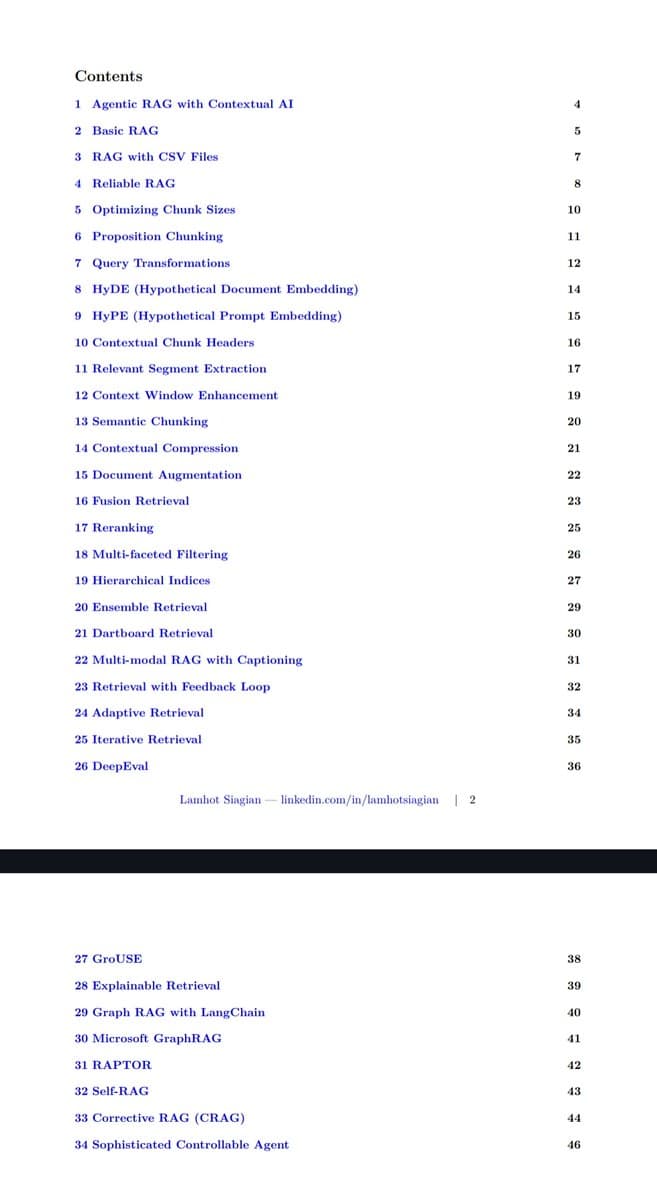
VMLOps, a technical account focused on machine learning operations and infrastructure, has published a structured catalog documenting 34 distinct techniques for improving Retrieval-Augmented Generation (RAG) systems. The catalog, shared via a social media post, serves as a consolidated reference for engineers and researchers building production RAG applications.
What's in the Catalog?
The catalog organizes techniques across the core components of a RAG pipeline: retrieval, generation, and hybrid approaches. While the source post does not detail every single method, the existence of a 34-technique taxonomy indicates a move toward systematizing what has often been an ad-hoc, trial-and-error field. The goal is to provide a structured menu of options for practitioners facing specific performance challenges, such as improving answer accuracy, reducing hallucination, or optimizing latency.
The Need for Systematization in RAG
RAG has rapidly become the dominant architecture for building LLM-powered applications that require factual grounding, from chatbots to enterprise search. However, its implementation involves numerous design choices—from how to chunk and index documents to how to re-rank retrieved passages and integrate them into the prompt. Without a shared vocabulary or framework, teams often reinvent solutions. This catalog represents an effort to map the expanding solution space, helping teams select and compare techniques based on their specific needs (e.g., precision vs. recall, computational cost vs. accuracy).
A Resource for Practitioners
For engineers, such a catalog is immediately practical. It can inform architecture reviews, guide A/B testing strategies, and serve as a checklist during system optimization. Instead of scouring disparate papers and blog posts, a practitioner can reference a single structured document to explore techniques like query expansion, hybrid search (combining dense and sparse retrieval), adaptive retrieval, or various post-retrieval refinement methods.
Accessing the Resource
The catalog is available via the link shared in the VMLOps post. As it is presented as a living resource, it may be updated as new techniques emerge and existing ones evolve.
gentic.news Analysis
This catalog publication is a clear signal of RAG's maturation from a research concept to a mainstream engineering discipline. As we covered in our analysis of Palo Alto Networks' Cortex XSIAM 2.0, which heavily utilizes RAG for security operations, enterprises are now demanding robust, production-grade implementations. The proliferation of techniques—now numbering 34—reflects both intense innovation and the complexity of real-world deployment. Standardization efforts like this are crucial for reducing fragmentation and enabling best practices to coalesce.
The timing aligns with increased industry focus on evaluation frameworks for RAG systems, such as NVIDIA's recently released NeMo Retriever microservices, which aim to provide standardized components. VMLOps, through resources like this catalog, is positioning itself as a key curator of practical MLOps knowledge, bridging the gap between academic research and operational reality. For teams building with RAG, this resource should accelerate development cycles by providing a structured way to diagnose issues and select appropriate interventions, moving beyond generic "improve your RAG" advice.
Frequently Asked Questions
What is Retrieval-Augmented Generation (RAG)?
Retrieval-Augmented Generation is an architecture for large language model applications that combines a retrieval system (which fetches relevant information from a knowledge base) with a generative model (which produces a final answer). This allows the LLM to ground its responses in factual, up-to-date, or proprietary data, reducing hallucinations and improving accuracy.
Why are there so many different RAG techniques?
RAG involves multiple interconnected subsystems: document processing, embedding, indexing, retrieval, re-ranking, and prompt construction. Each stage has multiple possible implementations with different trade-offs between accuracy, speed, cost, and complexity. The 34 techniques cataloged by VMLOps represent the combinatorial space of optimizations across this pipeline.
Who is VMLOps?
VMLOps is a technical account and community resource focused on machine learning operations, infrastructure, and production best practices. They share insights, tools, and references aimed at helping teams deploy and scale ML systems effectively.
How can I use this catalog in my project?
Use the catalog as a reference during the design and optimization phases of your RAG system. If you are facing a specific issue—like poor retrieval recall or the model ignoring retrieved context—browse the relevant section of the catalog to identify techniques that have been developed to address that problem. It can serve as a starting point for research and experimentation.