A new, freely accessible resource has emerged for engineers preparing for the rapidly evolving AI/ML job market. The account @_vmlops has published a GitHub repository containing over 300 questions and answers designed to cover the technical breadth required for modern AI engineering roles.
What's in the Repository?
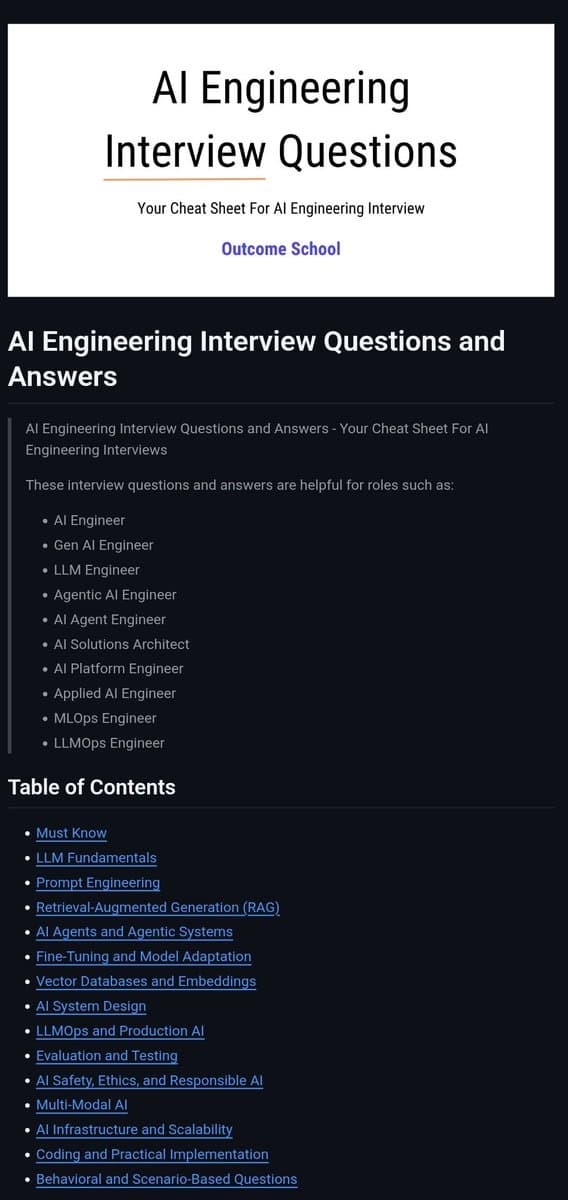
The repository is structured as a study guide, organizing questions into key technical domains that have become central to AI product development. According to the announcement, the content spans:
- LLM Fundamentals: Core concepts behind large language models.
- RAG Pipelines: Architectures for retrieval-augmented generation.
- AI Agents & MCP: Frameworks for autonomous agents and the Model Context Protocol.
- Fine-tuning: Practical methods like LoRA, QLoRA, and RLHF.
- Vector DBs & Embeddings: Data infrastructure for semantic search.
- LLMOps & Production AI: Operational practices for deploying and maintaining AI systems.
- AI Safety & Ethics: Considerations for responsible development.
- System Design Questions: High-level architectural problems.
The guide is positioned as relevant for roles including AI Engineer, LLMOps Engineer, MLOps Engineer, and AI Solutions Architect.
Access and Context
The repository is available on GitHub at the link provided in the announcement. It represents a crowd-sourced or curated compilation aimed at demystifying the interview process for a field where the required knowledge set expands monthly.
This release taps into a consistent market need: the gap between academic ML knowledge and the applied, toolchain-heavy skills demanded by industry. As companies shift from research prototypes to production systems, interview loops have increasingly emphasized practical knowledge of deployment stacks, cost optimization, and evaluation frameworks alongside core model understanding.
gentic.news Analysis
This release by VMLOps is a direct response to a well-documented and growing pain point in the AI industry: the extreme velocity of the toolchain and the consequent widening of the "production knowledge gap." It follows a clear trend of the job market seeking hybrid profiles that blend traditional machine learning expertise with software engineering rigor and specific operational knowledge of the modern LLM stack.
The repository's focus on RAG pipelines, AI agents, and LLMOps is particularly telling. This aligns with our previous coverage on the rise of retrieval-augmented generation as the dominant pattern for grounding LLMs in enterprise data and the subsequent emergence of a dedicated LLMOps tooling category. It also connects to the growing discussion around the Model Context Protocol (MCP), an open protocol pioneered by Anthropic to standardize how AI applications connect to external data sources and tools, which is becoming a relevant topic for architects designing agentic systems.
By including system design questions, the guide acknowledges that senior AI engineering roles now require architects who can reason about trade-offs between different serving infrastructures (e.g., vLLM vs. TGI), caching strategies for embeddings, and cost-performance profiles of various model APIs—topics that were largely irrelevant just two years ago.
The existence of this free resource also subtly highlights the competitive and fast-paced nature of the field. When the required knowledge evolves this quickly, standardized, paid certification paths struggle to keep up, creating space for community-driven, real-time resources like this one to fill the gap for job seekers.
Frequently Asked Questions
Where can I find the VMLOps interview questions GitHub repo?
You can access the free repository by visiting the GitHub link provided in the original announcement from the @_vmlops account. The URL is included in their social media post.
What job roles is this AI/ML interview guide designed for?
The repository is designed to cover technical questions for roles such as AI Engineer, LLMOps Engineer, MLOps Engineer, and AI Solutions Architect. It focuses on the applied, production-oriented knowledge required for these positions beyond core machine learning theory.
Does this guide cover questions about Large Language Models (LLMs)?
Yes, a significant portion of the 300+ Q&As is dedicated to LLM fundamentals, including their architecture, training, limitations, and the practical frameworks built around them, such as RAG pipelines and fine-tuning techniques like LoRA and QLoRA.
Is this resource useful for learning about AI system design?
Absolutely. The guide explicitly includes a section on system design questions, which are critical for senior and architect-level interviews. These questions typically involve designing scalable, reliable, and cost-effective systems for serving AI models, managing data pipelines, and integrating AI components into larger applications.