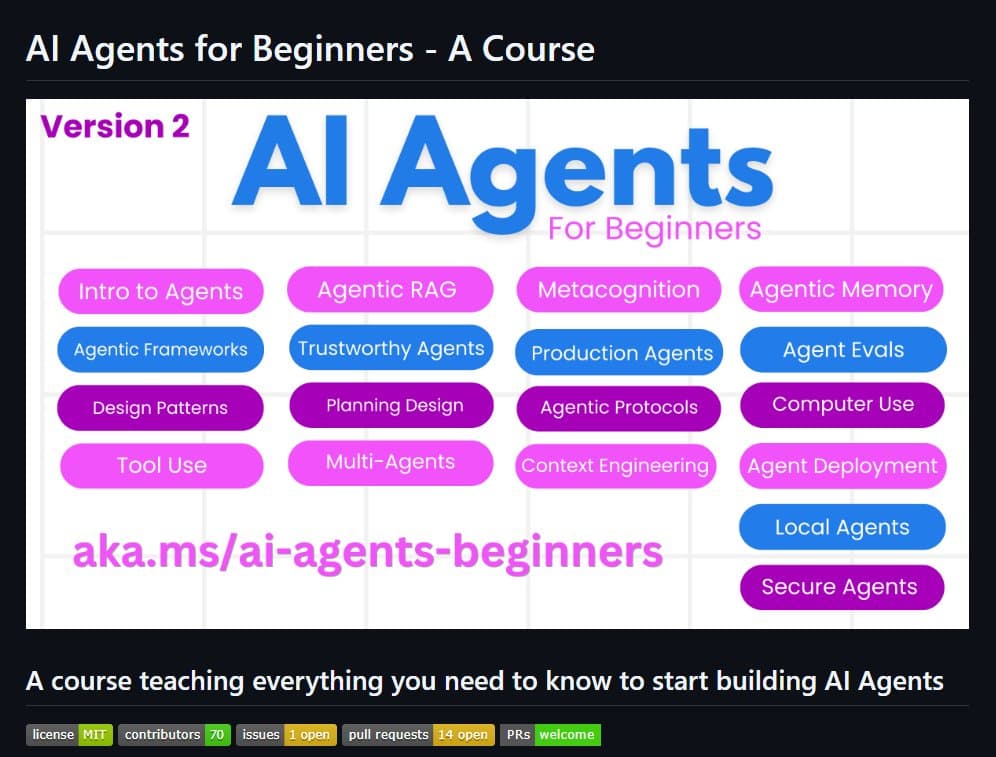
Microsoft has released a new, freely available educational resource for AI developers: a comprehensive course focused on building practical AI agents. Announced via social media, the course is positioned as a "goldmine" for developers seeking to move from conceptual understanding to hands-on implementation.
The course, titled "AI Agent Course," is hosted on GitHub and structured as a series of modules. It explicitly avoids theoretical deep-dives in favor of practical, project-based learning aimed at production-ready outcomes.
What's in the Course?
The curriculum is broken down into core modules that map to the current stack required for modern AI agent development:
- Agent Design Patterns: Foundational architectures and best practices for structuring agentic systems.
- RAG + Tools: Integration of Retrieval-Augmented Generation (RAG) for knowledge grounding and the creation of custom tools (functions) that agents can call to interact with external systems and data.
- Multi-Agent Systems: Orchestration of multiple specialized agents to work together on complex tasks, a key paradigm for sophisticated applications.
- Production-Ready Concepts: Guidance on moving from a prototype to a deployable system, likely covering aspects like evaluation, monitoring, security, and scalability.
The repository is designed to be a self-contained learning path. Developers can clone the repo and work through the modules, which presumably include code samples, Jupyter notebooks, and documentation.
Technical Context & Availability
The course is hosted on GitHub under the Microsoft organization (microsoft/ai-agent-course), making it openly accessible. This aligns with Microsoft's broader strategy of empowering developers on its Azure AI and OpenAI service platforms. By educating developers on agent design, Microsoft indirectly fosters the ecosystem that builds on its AI infrastructure.
While the source tweet does not list specific technologies, it is highly probable the course utilizes Microsoft's own Semantic Kernel (an open-source AI orchestration SDK) and the Azure AI Studio/OpenAI API for core LLM functionality. The hands-on nature suggests working code will be a primary component.
Why This Matters for Developers
For engineers, the value is direct: a structured, vendor-created curriculum that cuts through the noise. The AI agent landscape is fragmented, with rapid innovation but sparse, consolidated educational material that bridges the gap from tutorials to production. This course acts as an official playbook.
It also signals Microsoft's bet on AI agents as the next primary application layer. By training developers on its recommended patterns, Microsoft is shaping standards and increasing adoption of its tools, similar to how Google's TensorFlow tutorials once educated a generation of ML engineers.
gentic.news Analysis
This release is a tactical move in the ongoing platform wars for AI developer mindshare. It follows a pattern of major AI infrastructure providers releasing educational content to lock in developers. Google has its Generative AI learning paths, Anthropic offers its Claude documentation and cookbooks, and OpenAI has its platform documentation and cookbooks. Microsoft's move is distinct in its focus on a single, complex topic (agents) with an end-to-end, production-oriented lens.
This aligns with a trend we've covered extensively: the industrialization of AI agent tooling. In late 2025, we reported on the rise of frameworks like CrewAI, AutoGen, and LangGraph (LangChain), noting the market need for robust orchestration. Microsoft's own Semantic Kernel has been a key player, but adoption has required developers to piece together concepts. This course serves as the missing official curriculum for that stack.
Furthermore, it connects to Microsoft's integration strategy. The course likely demonstrates how to build agents that seamlessly use Azure AI Services (for vision, speech, etc.) and ground knowledge in Azure AI Search (for RAG). This creates a natural on-ramp to the Azure ecosystem. For developers, the benefit is a coherent learning path; for Microsoft, it's a powerful funnel.
Looking at the competitive landscape, this puts subtle pressure on other agent framework providers. While open-source projects like CrewAI offer excellent functionality, they lack the backing of a full-stack, production-cloud integrated tutorial series. Microsoft is leveraging its platform advantage to provide a one-stop-shop for learning and deployment.
Frequently Asked Questions
Where can I find the Microsoft AI Agent Course?
The course is hosted on GitHub at the repository microsoft/ai-agent-course. You can clone or fork the repository to access all modules, code, and documentation directly.
What do I need to know before starting this course?
You should have a foundational understanding of Python programming and a basic familiarity with large language models (LLMs) and APIs. Experience with a cloud platform (like Azure) and concepts like API endpoints will be helpful for the production modules, but the course is designed to be an end-to-end guide.
Is this course specific to Azure or OpenAI?
While the course is created by Microsoft and will naturally integrate best with its Azure AI and OpenAI services (which Microsoft hosts), the core concepts of agent design patterns, RAG, and multi-agent systems are framework-agnostic. The principles taught will be applicable across different LLM providers and cloud platforms.
How does this compare to other AI agent learning resources?
Most existing resources are either high-level theoretical papers, fragmented blog posts, or documentation for a specific framework (like LangChain or CrewAI). Microsoft's course is unique in providing a structured, comprehensive, and production-focused curriculum from a major platform provider, tying together design, implementation, and deployment considerations in one place.