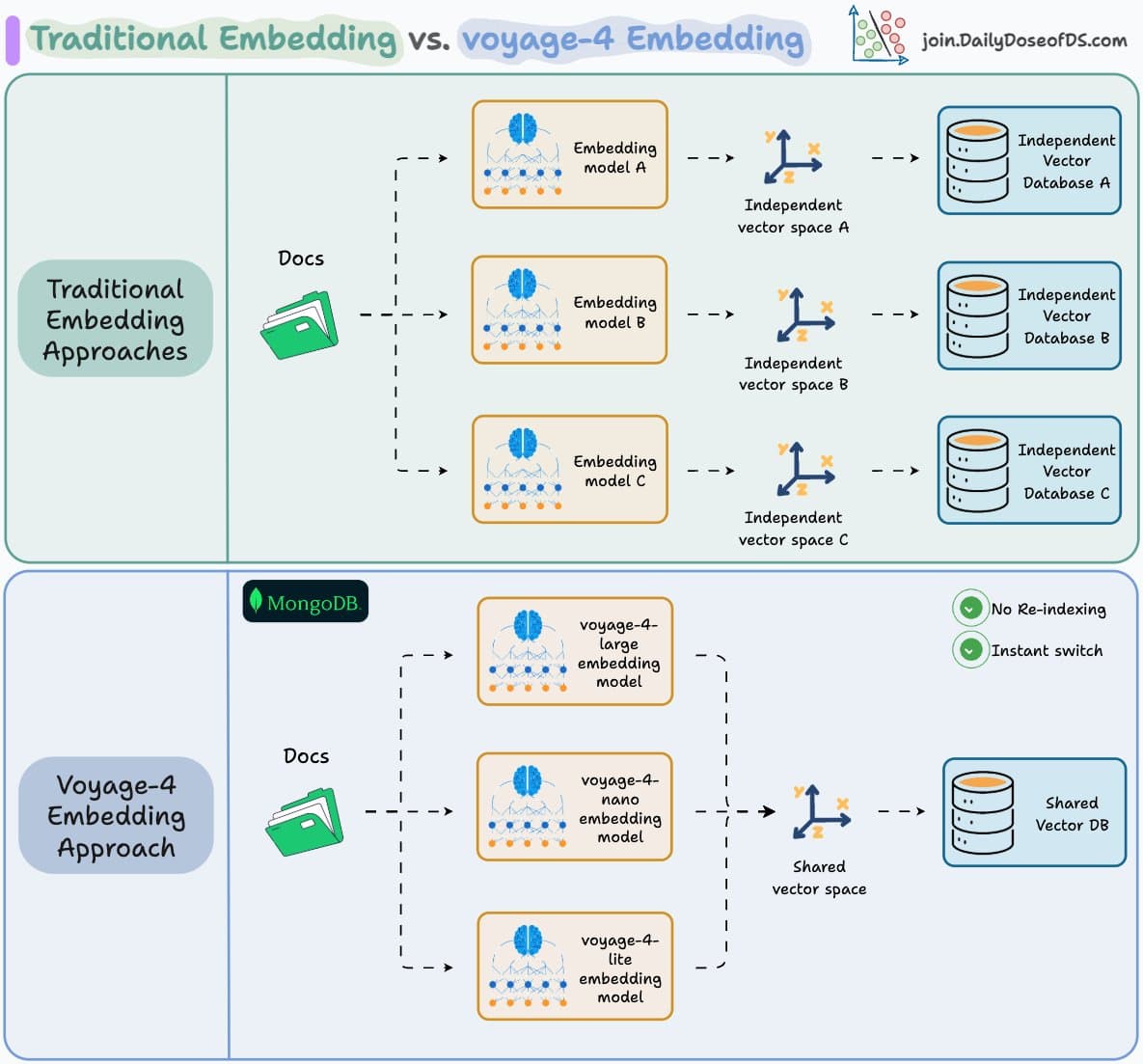
A common but rarely discussed problem in Retrieval-Augmented Generation (RAG) systems has quietly plagued AI developers for years: the embedding model lock-in trap. When teams build RAG pipelines with large, high-quality embedding models, they often find themselves trapped months later when scaling demands require switching to more cost-effective alternatives. Voyage AI's recently announced Voyage 4 model family appears to offer an elegant solution to this fundamental architectural challenge.
The Silent RAG Trap
As AI developer Akshay Pachaar explains in his analysis, most RAG pipelines face a critical design limitation that becomes apparent only in production. Teams typically begin by selecting embedding models optimized for retrieval quality—often larger, more sophisticated models that produce highly accurate embeddings. These models work beautifully during initial development and launch phases.
However, six months to a year later, when application traffic grows and embedding costs begin to soar, teams discover they're trapped. Switching to a more cost-effective or latency-optimized model requires completely rebuilding their vector database. The reason is simple but devastating: different embedding models produce vectors in different mathematical spaces.
This incompatibility means that embeddings generated by Model A cannot be meaningfully compared with embeddings from Model B. To switch models, teams must:
- Re-embed every document in their knowledge base
- Recompute every chunk of text
- Regenerate millions or billions of vectors
- Potentially redesign their entire retrieval architecture
Faced with this monumental task, most teams simply absorb the escalating costs rather than undertake the massive re-engineering effort. This creates what Pachaar describes as "an unspoken rule" in RAG development: you choose between quality and cost early on, and you live with that decision permanently.
Voyage AI's Architectural Solution
Voyage AI's Voyage 4 series addresses this problem through a clever architectural approach. All models within the family—from the high-quality voyage-4-large to the cost-optimized voyage-4-lite—share the same vector space. This compatibility enables what was previously impossible: indexing documents with a quality-optimized model while querying with a cost-optimized one.
The practical implications are significant. Development teams can now:
- Build their initial vector database using voyage-4-large for maximum retrieval accuracy
- Scale their query operations using voyage-4-lite for reduced latency and cost
- Switch between models seamlessly without touching their existing indexes
- Future-proof their systems against evolving cost and performance requirements
Notably, Voyage AI has also open-sourced voyage-4-nano on Hugging Face, making the smallest model in the family accessible to developers who prefer open-weights solutions.
The Broader Implications for AI Infrastructure
This development represents more than just another model release—it signals a maturation in how we think about AI infrastructure. The embedding model lock-in problem has been a hidden tax on AI innovation, forcing teams to make irreversible decisions about their technical architecture.
Voyage AI's approach suggests that model families designed with interoperability in mind could become a new standard. Rather than treating each embedding model as an isolated system, future developments might prioritize cross-model compatibility as a core feature.
This has particular relevance for enterprise AI deployments, where systems often need to evolve over years rather than months. The ability to switch embedding strategies without rebuilding entire knowledge bases could save organizations millions in engineering costs and prevent technical debt from accumulating around foundational AI components.
Looking Forward: The Future of Embedding Interoperability
While Voyage AI's solution addresses a specific problem, it raises broader questions about embedding standardization. Could we see industry-wide efforts to create compatible embedding spaces across different providers? Might we develop translation layers that allow embeddings from different models to be mapped to common spaces?
The open-sourcing of voyage-4-nano also suggests a potential path toward community-driven standards. As more developers experiment with and build upon compatible model families, we may see ecosystem effects that benefit the entire AI development community.
For now, Voyage AI's approach offers a practical solution to a real-world problem that has quietly hindered RAG adoption and scalability. By acknowledging and addressing the embedding lock-in trap, they've taken an important step toward more flexible, sustainable AI infrastructure.
Source: Analysis by Akshay Pachaar based on Voyage AI's Voyage 4 model family announcement.