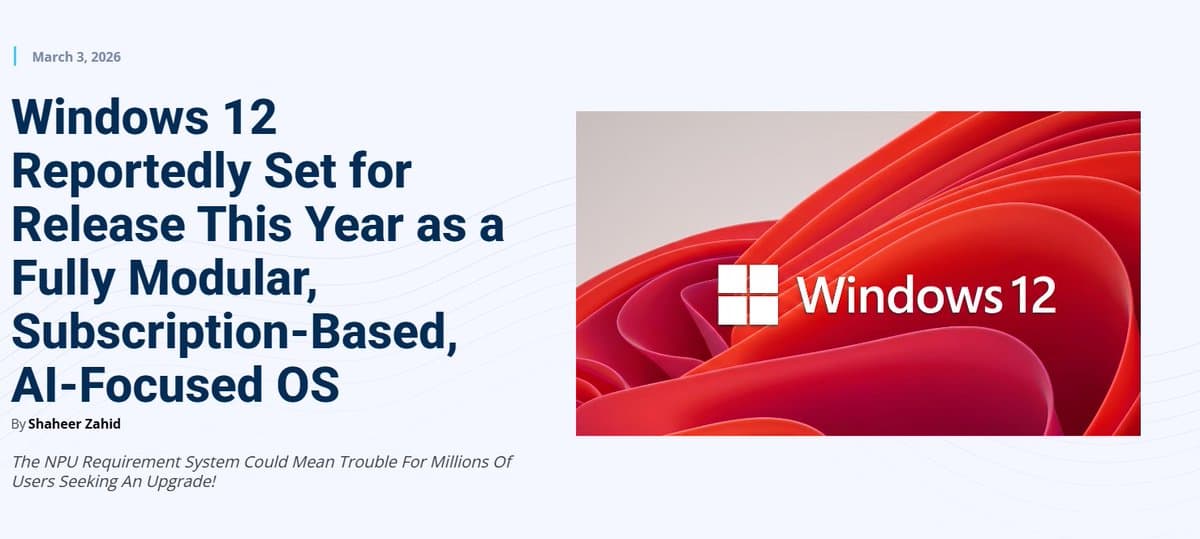
Recent leaks from industry insiders, including prominent tech commentator @kimmonismus, have revealed what appears to be Microsoft's blueprint for Windows 12—an operating system fundamentally redesigned around artificial intelligence. According to these reports, the upcoming Windows iteration will feature "heavy AI integration through Copilot" as its central design philosophy, potentially marking the most significant shift in Microsoft's operating system strategy since Windows 10.
The AI-Centric Vision
The leaked information suggests Windows 12 won't be a simple incremental update but rather a complete reimagining of the Windows experience with AI at its core. Microsoft's Copilot—currently available as a sidebar assistant in Windows 11—is expected to become deeply embedded throughout the operating system, potentially controlling system functions, automating workflows, and providing contextual assistance across all applications.
This represents a strategic pivot for Microsoft, which has been aggressively pursuing AI integration across its product suite following its multi-billion dollar investment in OpenAI. Windows 12 appears to be the culmination of this strategy at the operating system level, potentially creating what Microsoft envisions as the world's first truly AI-native PC experience.
The Subscription Model Controversy
Perhaps the most controversial aspect of the leak is the suggestion that "advanced AI features" may be "locked behind a subscription model." This would represent a significant departure from Microsoft's traditional licensing approach, where users pay once for the operating system or receive it bundled with hardware.
Industry analysts suggest this could follow the model of Microsoft 365, where basic functionality remains free but premium features require ongoing payments. Potential subscription-only features might include advanced Copilot capabilities, specialized AI tools for creative or professional work, or enterprise-grade automation features.
This approach raises important questions about digital equity and accessibility. Will users in developing markets or with limited budgets be locked out of core computing advancements? How will this affect the perception of Windows as a universal platform?
Visual and Interface Innovations
Alongside the AI focus, the leaks describe significant visual changes, including "transparent UI elements" and a "floating taskbar." These aesthetic updates suggest Microsoft is pursuing a more modern, minimalist interface that potentially reduces visual clutter while emphasizing AI interactions.
The transparent elements could represent a return to the aesthetic experimentation of Windows Vista and 7, but with contemporary hardware acceleration. The floating taskbar—potentially detachable or repositionable—might offer greater customization and screen real estate management, particularly as foldable and multi-screen devices become more common.
Competitive Landscape and Market Implications
Microsoft's apparent strategy places Windows in direct competition with other AI-integrated platforms, particularly Google's ChromeOS with its Gemini integration and Apple's rumored AI enhancements for macOS. However, Windows' dominant market position in the PC space gives Microsoft unique leverage to push AI adoption at scale.
The subscription model, if confirmed, could fundamentally alter the economics of personal computing. It might accelerate the trend toward "PC as a service" models, where users pay monthly for hardware, software, and AI capabilities bundled together—an approach already emerging in enterprise markets.
Privacy and Control Concerns
Deep AI integration inevitably raises privacy questions. A Copilot that can control system functions and access data across applications would require extensive permissions and data access. Microsoft will need to address concerns about what data is processed locally versus in the cloud, and how users maintain control over their AI interactions.
The European Union's Digital Markets Act and other global regulations may also influence how Microsoft implements these AI features, particularly regarding user choice and interoperability with third-party AI services.
The Unasked-For Update Dilemma
The leak's framing—"the update that you weren't asked for"—touches on a growing tension in software development: the balance between innovation and user autonomy. As operating systems become increasingly service-oriented, users have less control over when and how their computing environment changes.
This approach has drawn criticism in recent Windows updates, with some users feeling forced into UI changes or feature implementations they didn't request. Windows 12's AI-first design could amplify these concerns if users perceive the AI integration as intrusive or mandatory rather than optional.
Looking Ahead
While Microsoft hasn't officially confirmed Windows 12's development timeline or features, the consistent leaks from multiple sources suggest an announcement could come in 2024 or 2025. The company's Build developer conference or a dedicated Windows event would be the likely venue for such a reveal.
The success of Windows 12 will depend not just on technological implementation but on user acceptance. Microsoft will need to demonstrate that AI integration genuinely enhances productivity and creativity rather than simply adding another layer of complexity or cost.
As the boundaries between operating systems and AI platforms blur, Windows 12 could represent either a visionary leap forward in personal computing or a case study in how not to implement AI at scale. The coming months will reveal which path Microsoft has chosen.