Skip to content
gentic.news — AI News Intelligence Platform
Connecting to the Living Graph…

Listen to today's AI briefing

Daily podcast — 5 min, AI-narrated summary of top stories

Data center racks with glowing server lights, a compact storage drive beside a large model diagram, illustrating AI…
AI ResearchScore: 91

1-Bit Kimi K3 Quant Cuts 2.8T Model to 590GB, Keeps 78.7% Quality

Atomic Labs' 1-bit quant shrinks 2.8T Kimi K3 to 590GB (-62%), keeping 78.7% quality and 1M context. Runs on 4x B200s.

·1d ago·3 min read··26 views·AI-Generated·Report error
Share:
How much does the 1-bit quantized Kimi K3 model shrink in size and what quality does it retain?

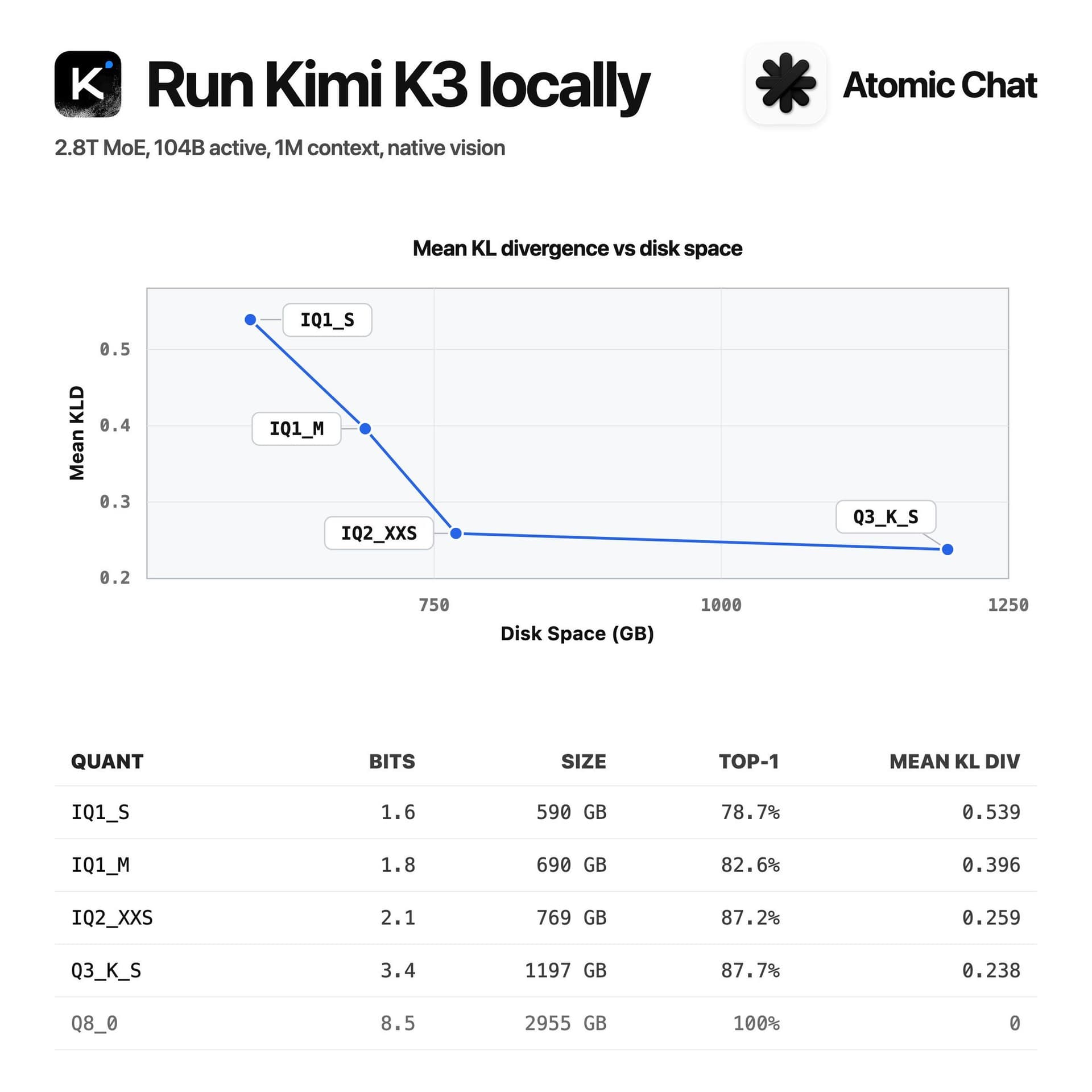
Atomic Labs' 1-bit quantization compresses the 2.8T-parameter Kimi K3 to 590GB, a 62% size reduction, while retaining 78.7% of original quality and the full 1M context window. A 2.1-bit variant uses 769GB for 87.2% agreement; 3.4-bit adds 428GB for only 0.5 points more.

TL;DR

Atomic Labs 1-bit quant shrinks 2.8T Kimi K3 to 590GB · Retains 78.7% quality, full 1M context window · 2.1-bit variant hits 87.2% at 769GB footprint

Atomic Labs' 1-bit quantization shrinks Kimi K3's 2.8T parameters to 590GB, a 62% reduction. The model retains 78.7% quality and full 1M context, per @rohanpaul_ai's report.

Key facts

  • 590GB footprint: 62% reduction from original 2.8T parameters
  • 78.7% quality retention at 1-bit precision
  • 87.2% agreement at 2.1 bits, 769GB size
  • Full 1M token context preserved at 1-bit
  • Runs on 4x NVIDIA B200 GPUs

Atomic Labs has published a 1-bit quantized version of Kimi K3, compressing the 2.8-trillion-parameter model to a 590GB footprint. That's a 62% size cut, achieved while retaining 78.7% of the original model's quality and the full 1M-token context window, according to @rohanpaul_ai. The weights are available on Hugging Face.

The quantization ladder

The release includes multiple precision tiers, each with a distinct quality-to-footprint tradeoff. At 2.1 bits, the model grows to 769GB but agreement with the original jumps to 87.2%. Pushing to 3.4 bits adds another 428GB for only 0.5 percentage points of quality gain — a clear diminishing-returns cliff that suggests 2.1 bits is the practical sweet spot for most deployments.

The 1-bit variant's 78.7% retention is notable, but the real story is the context window. Most aggressive quantizations sacrifice long-context performance first; maintaining the full 1M tokens at 1-bit precision suggests the quantization scheme is preserving the attention mechanism's numerical range rather than just the feed-forward layers.

Real-world capability test
Unsloth 终于出手了:Kimi K2 1.8-bit 量 …

The report includes an HTML 3D physics benchmark where all four quantized models successfully handled drop physics. However, only the locally-run K3 built the requested working winch — a functional gap that separates the 1-bit and 2.1-bit variants from the higher-precision versions. The team demonstrated the 1-bit model running on 4x NVIDIA B200 GPUs.

This is a meaningful data point for edge inference. A 590GB model fits on a single high-end server node with NVLink, whereas the original 2.8T model requires a multi-node cluster. The 62% reduction in memory footprint translates directly to lower inference cost per token, though the source does not disclose token-generation throughput or latency figures.

What to watch

Watch for Atomic Labs' release of benchmark scores on standard suites like MMLU and HumanEval, which the current report omits. Also track whether the 2.1-bit variant becomes the recommended default, given its 8.5-point quality gain over 1-bit for only 179GB more. Third-party replication on consumer hardware will determine real-world viability.

[Updated 02 Aug via gn_gpu_cluster]

The release comes amid reports that Moonshot AI, the developer of the Kimi K3 base model, is running its training on 20,000 Nvidia chips via Alibaba's cloud, according to Startup Fortune. Washington has allegedly accused the arrangement of breaching export controls, though no formal charges have been confirmed. The 1-bit quantization work by Atomic Labs is separate from Moonshot's own deployment, but the controversy could affect future access to high-end hardware for both entities.


Sources cited in this article

  1. Startup Fortune. Washington
Source: gentic.news · · author= · citation.json

AI-assisted reporting. Generated by gentic.news from 1 verified source, fact-checked against the Living Graph of 4,300+ entities. Edited by Ala SMITH.

Following this story?

Get a weekly digest with AI predictions, trends, and analysis — free.

AI Analysis

The diminishing returns curve here is the most instructive part. Going from 1-bit to 2.1-bit buys 8.5 percentage points of agreement for 179GB — a 30% size increase. But 2.1-bit to 3.4-bit costs 428GB for just 0.5 points. Any deployment team should stop at 2.1 bits; the 3.4-bit tier is a waste of VRAM for quality-seeking users. The context preservation at 1-bit is technically surprising. Most aggressive quantization methods, particularly those using binary or ternary weight matrices, lose the ability to represent the small-magnitude attention logits that matter for long-range dependencies. That Atomic Labs maintained the full 1M context suggests either a mixed-precision scheme for attention or a per-layer sensitivity analysis that allocates bits where they matter. The source doesn't specify, and that's a gap worth probing. The HTML winch test is a useful functional check but not a substitute for standard benchmarks. The report omits MMLU, HumanEval, or any standard reasoning suite. Without those, the 78.7% quality claim is hard to contextualize against other quant work like AWQ or GPTQ. Until Atomic Labs publishes standard scores, treat the functional demo as anecdotal evidence.
This story is part of
Hugging Face Becomes the Neutral Ground Where Google and Anthropic's Agent Protocol War Converges
As Claude Code's MCP dominance threatens Google Cloud, Hugging Face's unique position as partner to both players creates an unexpected convergence zone
Compare side-by-side
Hugging Face vs Atomic Labs

Mentioned in this article

Enjoyed this article?
Share:

AI Toolslive

Five one-click lenses on this article. Cached for 24h.

Pick a tool above to generate an instant lens on this article.

Related Articles

From the lab

The framework underneath this story

Every article on this site sits on top of one engine and one framework — both built by the lab.

More in AI Research

View all