What Happened
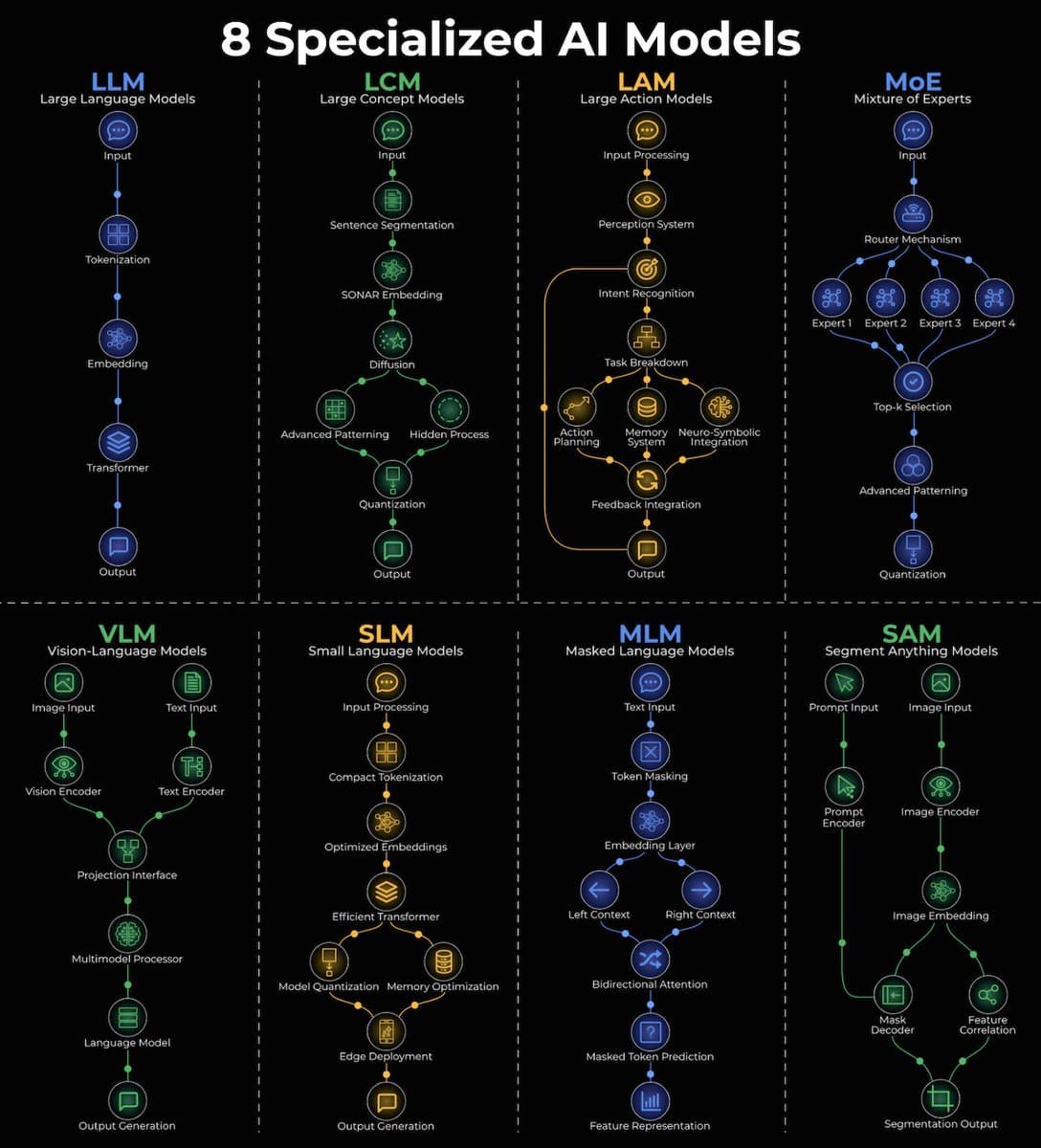
A visual explainer has been published that maps eight fundamental AI model architectures. The guide, created by Akshay Pachaar, aims to provide clarity on the diverse family of specialized models that exist beyond the current focus on Large Language Models (LLMs).
The visual explanation covers:
- Transformer architecture (the foundation of modern LLMs)
- Convolutional Neural Networks (CNNs)
- Recurrent Neural Networks (RNNs)
- Long Short-Term Memory networks (LSTMs)
- Generative Adversarial Networks (GANs)
- Variational Autoencoders (VAEs)
- U-Net architecture
- Diffusion models
Context
While LLMs dominate current AI discourse, these eight architectures represent the foundational building blocks of modern AI systems. Each architecture has specific strengths and applications:
- Transformers excel at sequence processing and form the backbone of models like GPT-4 and Claude
- CNNs remain essential for computer vision tasks
- RNNs/LSTMs handle sequential data with temporal dependencies
- GANs and VAEs power different approaches to generative AI
- U-Nets are crucial for image segmentation tasks
- Diffusion models have become the standard for high-quality image generation
The visual guide appears to show how these architectures are structured at a high level, helping practitioners understand the relationships and differences between these fundamental approaches.
Why Visual Explanations Matter
Architecture diagrams serve as critical reference points for AI engineers and researchers. They provide:
- Mental models for understanding how different components interact
- Implementation guidance when building or modifying models
- Comparison frameworks for evaluating which architecture suits a particular problem
For engineers working with specialized models (computer vision, audio processing, time-series analysis, etc.), understanding these architectures is essential for selecting the right tool for the job and for debugging model performance issues.