What Happened
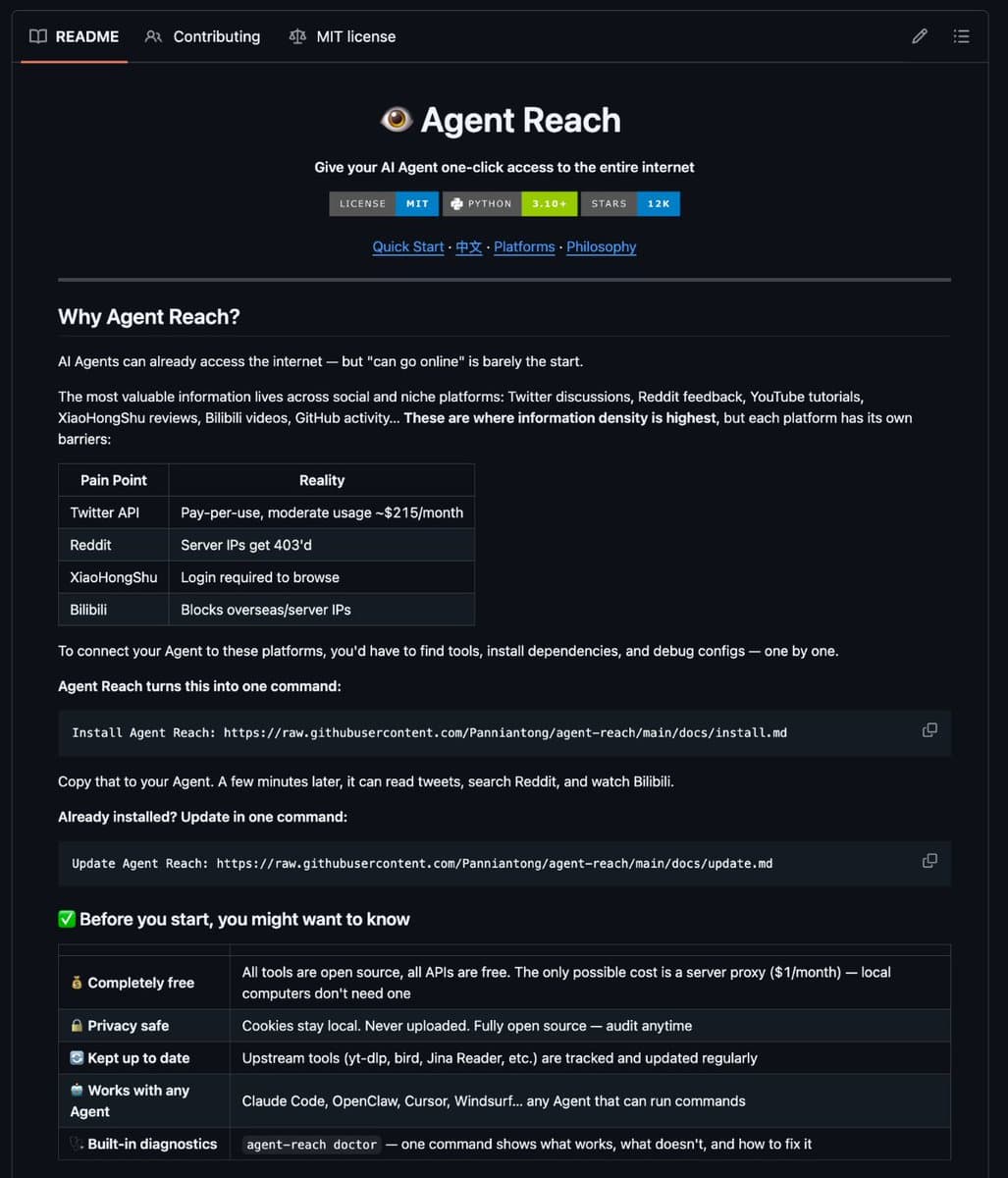
Developer Hasan Töre (@hasantoxr) has released Agent Reach, an open-source Python toolkit designed to give AI coding agents and assistants—like Claude Code, Cursor, Windsurf, or OpenClaw—the ability to read and interact with web content that is typically blocked or requires paid API access.
The core problem Agent Reach addresses is straightforward: AI agents can write code, manage files, and plan projects, but they frequently fail when asked to fetch real-time information from the open web. Twitter/X requires a paid developer API for programmatic access. Reddit often returns 403 errors to automated requests. YouTube subtitles require special extraction. Chinese social platform Xiaohongshu demands a login. Standard web scraping returns raw, unreadable HTML.
Agent Reach bundles pre-configured tools and handlers into a single command-line installable package. It uses cookie-based authentication, custom HTTP headers, and platform-specific parsers to bypass these barriers, presenting returned content as clean, readable text rather than raw HTML or JSON payloads.
What Works Out of the Box
Immediately after installation, an AI agent can:
- Read any webpage and receive clean, extracted text (via
readability-like libraries). - Extract subtitles from YouTube and Bilibili videos and search within them.
- Read Twitter/X posts using a cookie-based login method, circumventing the need for a paid API.
- Read RSS and Atom feeds from any source.
- Search and read public GitHub repositories, issues, and code files.
What Unlocks With Minimal Configuration
With a single extra step—typically adding a free API key or environment variable—the agent gains:
- Full web semantic search via Exa's API.
- Twitter timeline browsing, search, and posting capabilities.
- Full Xiaohongshu access, including reading, searching, and posting.
- Access to private GitHub repos, pull requests, and issue creation.
Architectural Philosophy: Pluggable and Maintained
The "wildest part," as the developer notes, is the modular design. Each platform integration is a single, pluggable Python file. If a better tool emerges or a platform changes its anti-scraping rules, users (or the maintainer) can swap that one file without disrupting the rest of the system. The maintainer commits to updating these modules as platforms evolve, aiming to free users from constantly chasing API changes and blockades.
The tool is built for agents that can execute command-line instructions. It is 100% open source under the permissive MIT License.
gentic.news Analysis
Agent Reach tackles a critical, under-discussed bottleneck in the practical deployment of AI agents: information acquisition. While models have grown more capable at reasoning and tool use, their ability to gather fresh, real-world data has been gated by platform policies, rate limits, and authentication walls. This tool represents a pragmatic, developer-centric approach to that problem, prioritizing working, free access over official—and often costly—API channels.
This release fits into a clear trend we've been tracking: the toolification of AI agents. As covered in our analysis of OpenAI's GPT-4o and its new desktop app, the frontier is shifting from pure model capability to integration and workflow. Agent Reach is a direct response to developers hitting real walls when trying to build agents that can "search the web." It's less about a breakthrough in AI and more about a clever assembly of existing web scraping and parsing libraries (like requests, BeautifulSoup, youtube-transcript-api) into an agent-friendly package.
However, this approach carries significant legal and ethical risk. Using cookie-based authentication to bypass Twitter's API monetization strategy or scraping Xiaohongshu despite login requirements likely violates those platforms' Terms of Service. While the tool is technically impressive and solves a real pain point, its longevity depends on a cat-and-mouse game with platform security teams. The promise of maintainer updates is crucial here, but it's an arms race. For developers building commercial products, reliance on such a tool could introduce substantial operational risk if a key platform successfully blocks its methods.
Ultimately, Agent Reach highlights a market gap. The demand for affordable, reliable web access for AI is immense, but the supply from major platforms is restricted and expensive. Until platform owners offer viable, low-cost pathways for AI agents to access public data, tools like Agent Reach—and the legal gray area they inhabit—will continue to flourish.
Frequently Asked Questions
What is Agent Reach?
Agent Reach is an open-source Python toolkit that provides AI coding agents and assistants with the ability to read content from websites and platforms that are typically difficult to access programmatically, such as Twitter/X, YouTube, Reddit, and Xiaohongshu. It bundles scraping tools and authentication handlers into a single package that returns clean, readable text instead of raw HTML.
How does Agent Reach access Twitter/X without the paid API?
It uses a cookie-based authentication method. Instead of calling the official Twitter API (which requires a paid subscription), the tool mimics a logged-in web browser session by using cookies from a user's account. This allows it to fetch data directly from Twitter's web interface, though this method likely violates Twitter's Terms of Service and can be blocked at any time.
Is Agent Reach legal to use?
Using Agent Reach may violate the Terms of Service of the platforms it accesses, particularly for features that bypass official APIs or authentication gates (like Twitter and Xiaohongshu). While the tool itself is open-source software, using it for web scraping, especially at scale or for commercial purposes, could lead to IP bans, account suspension, or legal action from platform owners. Users should proceed with caution and understand the risks.
Can I use Agent Reach with ChatGPT or Claude's web interface?
No, not directly. Agent Reach is designed for AI agents that can run command-line tools, such as Claude Code, Cursor, Windsurf, or OpenClaw. It is not a plugin for cloud-based chat interfaces like chat.openai.com or claude.ai. You need a local or remote development environment where the agent can execute shell commands and Python scripts.