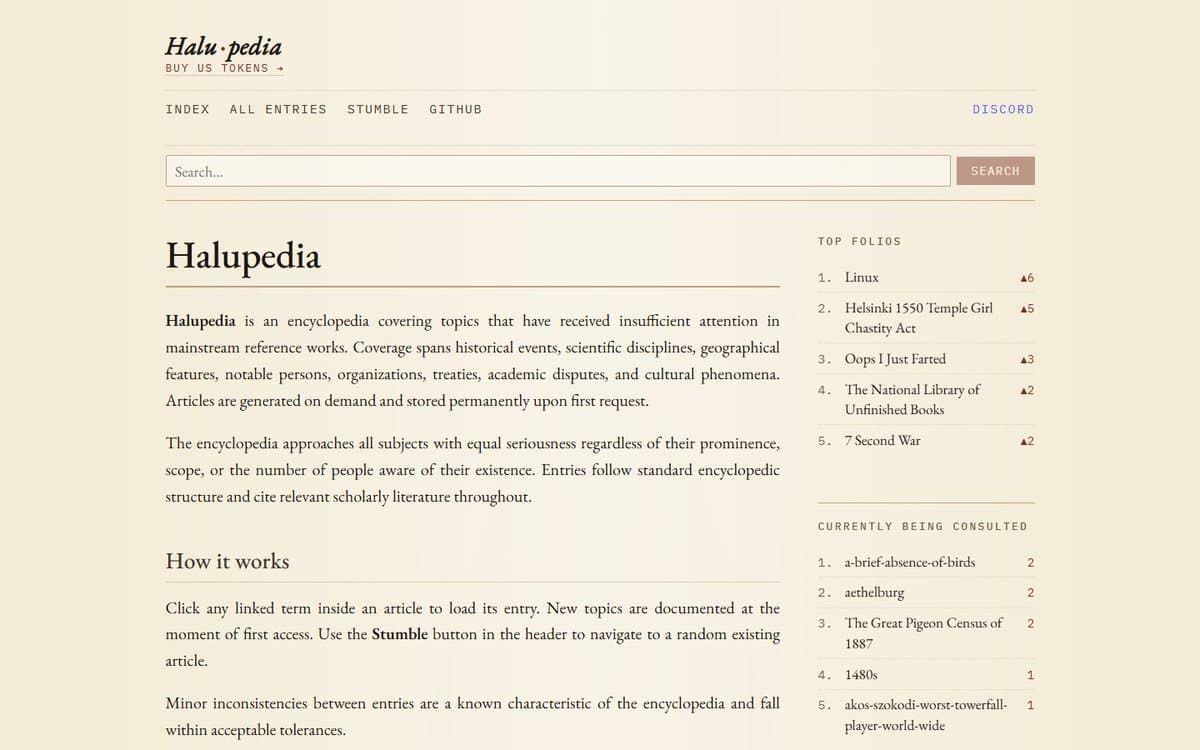
Developer @heynavtoor launched Halupedia, an open-source website that generates every Wikipedia-style article via AI hallucination on the fly. The project, whose backend is a single GitHub repo called vibeserver, creates fake entries like 'The Great Pigeon Census of 1887' the moment a user clicks.
Key facts
- Halupedia generates AI-hallucinated Wikipedia articles on click
- Backend is a single GitHub repo called vibeserver
- Fake entries include 'The Great Pigeon Census of 1887'
- Site claims 'you alone are consulting this folio at present'
- Open-source, can be forked by anyone
Halupedia presents itself as a mirror universe of Wikipedia. The site looks exactly like Wikipedia, with the same fonts, layout, and scholarly citations. It even includes a 'stumble' button for random articles. The only difference: none of the content is real. Every article is generated by an AI model when a user visits the page, and each article page displays how many people are reading it, stating 'you alone are consulting this folio at present.'
One guy, one repo, one rule
The entire backend is a single open-source repo called vibeserver, described by its creator as 'a little webserver making things up just in time.' The site's tagline: 'an encyclopedia of a universe that does not exist until you visit it.' Notable hallucinated entries include 'The Ministry of Slightly Wrong Maps,' 'Chaldic Arithmetic — a branch of mathematics where subtraction is forbidden,' and 'The Society for the Prevention of Unnecessary Tuesdays.'
Why this matters more than a joke
Halupedia is a deliberate stress test of AI-generated content at scale. While companies like Google and OpenAI scramble to detect and filter AI hallucinations from search results and knowledge bases, Halupedia does the opposite: it weaponizes hallucination as a feature, not a bug. The project surfaces a structural tension in the AI ecosystem — the same generative models that power useful chatbots can also produce convincing but entirely fabricated encyclopedias. The open-source release means anyone can fork vibeserver and spin up their own hallucination engine, potentially flooding the web with plausible-sounding nonsense.
Prior art and context
Halupedia follows a lineage of AI-generated nonsense projects, including GPT-4-powered chatbots that have produced fake academic citations and the 'Waluigi effect' where models generate counterfactual personas. However, Halupedia is unique in its commitment to real-time generation and its visual mimicry of Wikipedia's trusted interface. The project has already drawn comparisons to the 'Sokal Squared' hoax, where a fake paper was published in a predatory journal.
What to watch
Watch for forks of vibeserver appearing on GitHub, and whether Halupedia's traffic spikes enough to trigger moderation from search engines or Wikipedia's own anti-plagiarism tools. The project's open-source nature makes it a potential vector for disinformation campaigns if adopted by bad actors.
Key Takeaways
- Halupedia generates fake Wikipedia articles via AI hallucination on click.
- Open-source backend vibeserver lets anyone deploy a similar project.
What to watch

Watch for forks of vibeserver appearing on GitHub, and whether Halupedia's traffic spikes enough to trigger moderation from search engines or Wikipedia's anti-plagiarism tools. The open-source nature makes it a potential vector for disinformation campaigns if adopted by bad actors.