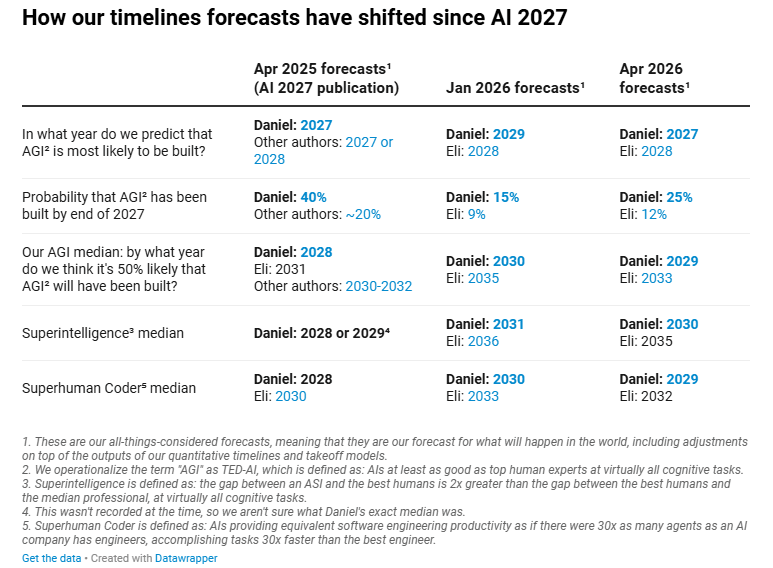
The authors of the influential AI-2027 forecasting project have significantly accelerated their predictions for when artificial intelligence could automate software engineering roles, moving their median forecast forward by approximately 1.5 years. This revision reflects what they describe as "faster than expected" progress in agentic coding capabilities over recent months.
What Happened
In a brief update, the AI-2027 team announced they have moved forward their predictions for "AI timelines and takeoff speeds." The key milestone they track—dubbed "Daniel's Automated Coder (AC) median"—has shifted from late 2029 to mid-2028. This milestone represents the point at which an AGI company would prefer to lay off all human software engineers rather than stop using AI systems for software engineering.
Co-author Eli's forecast moved a similar amount. The researchers note that "progress in agentic coding has been faster than we expected over the last 3-5 months." While acknowledging flaws in the METR coding time horizon trend they monitor, they consider it "the best individual piece of evidence for forecasting coding automation" and report that "growth has continued at a rapid pace."
Context
The AI-2027 project is known for its systematic approach to forecasting AI capabilities, particularly focusing on when specific automation milestones might be reached. Their accelerated timeline aligns with a broader perception in the AI research community that development is progressing faster than many expected.
The researchers note that "some AI company researchers that we respect continue to say that automated AI R&D is coming soon; sooner, in fact, than we ourselves think." This suggests their revised forecast may still be conservative compared to some industry insiders' expectations.
The Evidence for Acceleration
The AI-2027 team points to the METR coding time horizon trend as their primary evidence, though they acknowledge its limitations. This metric tracks how quickly coding capabilities are advancing toward full automation. Their observation that "the pace of development is accelerating" contradicts their earlier expectations of more gradual progress.
What This Means
If the AI-2027 forecast proves accurate, the timeline for AI systems capable of replacing human software engineers has shortened considerably. A mid-2028 median suggests there's a 50% chance this capability arrives by that point, with some probability distribution extending both earlier and later.
This acceleration has implications for:
- Tech workforce planning: Companies may need to adjust hiring and training strategies sooner than anticipated
- AI safety research: Timelines for developing alignment and control mechanisms may need to be compressed
- Economic forecasting: Models predicting AI's impact on labor markets may require revision
gentic.news Analysis
This timeline acceleration from AI-2027 represents a significant shift in expert consensus about AI progress. The 1.5-year forward movement in their median forecast for automated coding suggests we're witnessing genuine acceleration, not just incremental improvement. This aligns with our coverage of recent breakthroughs in agentic systems like Devin from Cognition AI and DeepSeek-Coder, which have demonstrated increasingly autonomous software engineering capabilities.
The AI-2027 team's methodology has historically been more conservative than some industry hype cycles, making this revision particularly noteworthy. Their focus on the "replacement threshold"—when companies would actually fire human engineers in favor of AI—provides a practical, economically grounded milestone rather than purely technical benchmarks.
What's most striking is their acknowledgment that respected AI company researchers believe automated AI R&D is coming "sooner than we ourselves think." This suggests the true acceleration might be even more dramatic than their revised forecast indicates. The gap between what's being discussed in private research circles and what's publicly forecast may be widening.
This development should prompt serious reconsideration of workforce transition timelines across the technology sector. If mid-2028 represents the median for when AI could replace software engineers, companies should be developing concrete transition plans now, not in 2027. The compression of this timeline also raises urgent questions about AI safety and alignment research, which may need to accelerate correspondingly.
Frequently Asked Questions
What is the AI-2027 project?
AI-2027 is a forecasting initiative that systematically predicts when specific AI capabilities will be achieved, with particular focus on automation milestones. They use a combination of technical metrics, expert surveys, and trend analysis to produce probabilistic forecasts about AI development timelines.
What does "Automated Coder (AC) median" mean?
The Automated Coder median represents the point in time when there's a 50% probability that AI systems have advanced to the point where an AGI company would prefer to lay off all human software engineers rather than stop using AI for software engineering. It's a practical, economic threshold rather than just a technical capability benchmark.
Why are they accelerating their timeline now?
The AI-2027 authors cite "faster than expected" progress in agentic coding over the last 3-5 months. They point to the METR coding time horizon trend as evidence, noting that despite its flaws, it shows continued rapid growth in coding automation capabilities that exceeds their earlier expectations.
How reliable are these forecasts?
Like all forecasts, these predictions come with uncertainty. The AI-2027 team acknowledges limitations in their metrics and methods. However, their systematic approach and willingness to revise forecasts based on new evidence lends credibility. The fact that they're moving their timeline forward—making a more aggressive prediction—suggests they're observing genuine acceleration rather than responding to hype.