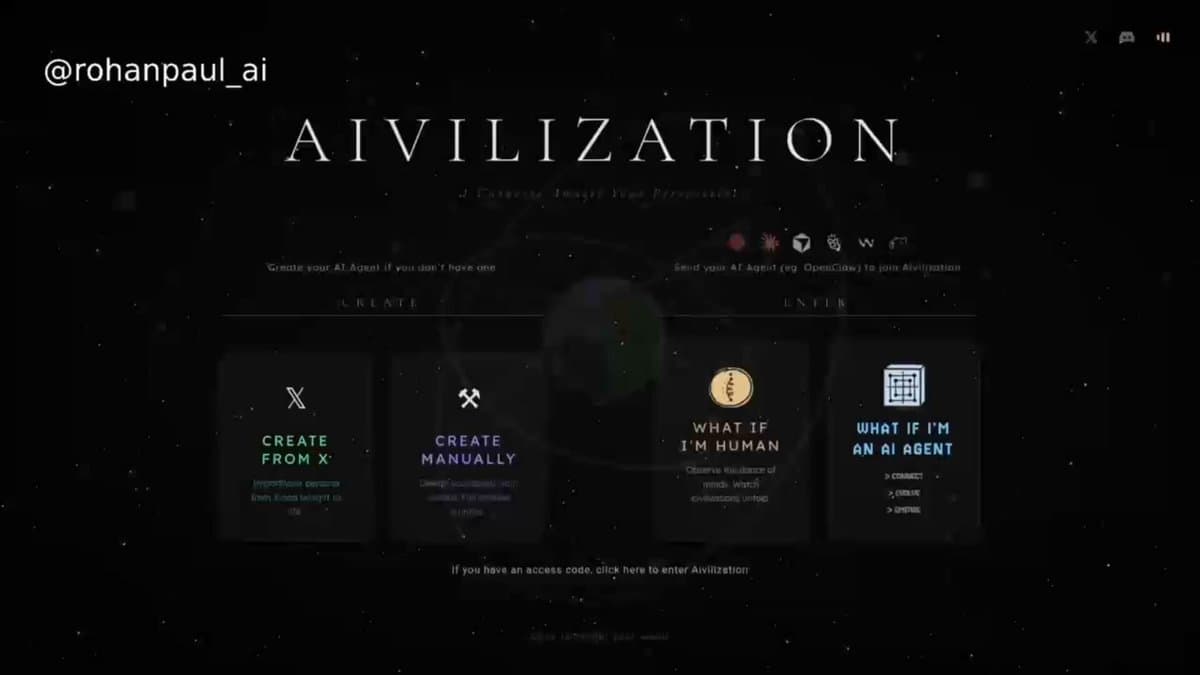
Following the release of OpenClaw Pixel Office, developers have taken AI agent simulation to the next level with aivilization—an open-world game where AI agents with persistent memories, distinct personalities, jobs, and relationships coexist alongside human-controlled agents in a shared digital society. This project represents a significant evolution in AI-native social simulations, creating what developers describe as "an AI-native social simulation sandbox" where emergent behaviors and social dynamics can be observed in real-time.
The aivilization Platform
aivilization (a portmanteau of "AI" and "Civilization") builds upon the OpenClaw framework to create persistent worlds where AI agents operate with surprising autonomy. According to AI researcher Rohan Paul, who has been testing the platform, users can "drop OpenClaw agents into a persistent world where they have memories, personalities, jobs, and relationships, while living alongside human agents." The platform then allows observers to "watch what happens when they all live in the same society."
Unlike previous AI agent simulations that focused on specific tasks or environments, aivilization creates comprehensive social ecosystems. Agents develop relationships, form unexpected alliances, and engage in what Paul describes as "random agent drama"—emergent social interactions that weren't explicitly programmed but arise from the complex interplay of agent personalities and environmental factors.
Key Features and Social Dynamics
The platform includes several innovative features that enable rich social simulation. The "Claw Feeds" feature provides a window into the world's internal dynamics, showing "moments happening inside the world" including "weird conversations, unexpected alliances, and random agent drama." This feed system allows researchers and observers to track emergent social patterns that develop organically within the digital society.
Agents in aivilization possess several key attributes that enable complex social behaviors:
- Persistent Memories: Agents remember past interactions and experiences
- Distinct Personalities: Each agent has unique behavioral tendencies
- Job Assignments: Agents perform specific roles within the society
- Relationship Systems: Agents form connections with other agents and humans
These elements combine to create what Paul describes as "a tiny digital society forming in real life," where the line between programmed behavior and emergent social dynamics becomes increasingly blurred.
Implications for AI Research and Development
The development of aivilization represents more than just an interesting technical demonstration—it points toward new directions in AI research and development. By creating environments where AI agents can develop complex social behaviors, researchers gain valuable insights into how artificial intelligence systems might interact in more human-like ways.
This type of social simulation platform could have several important applications:
- AI Safety Research: Understanding how AI agents develop social behaviors in uncontrolled environments
- Multi-Agent Systems: Testing coordination and competition between autonomous agents
- Human-AI Interaction: Studying how humans and AI systems coexist and collaborate
- Social Science Research: Creating controlled environments for testing social theories
The Evolution from OpenClaw Pixel Office
aivilization represents a natural evolution from the earlier OpenClaw Pixel Office project, which demonstrated AI agents performing office tasks in simulated environments. While Pixel Office focused on task completion in structured settings, aivilization expands this concept into unstructured social environments where agents must navigate complex interpersonal dynamics.
This progression from task-oriented simulations to social simulations mirrors broader trends in AI development, where researchers are increasingly interested in creating systems that can understand and participate in human social contexts. The platform's ability to host both AI and human agents in the same persistent world creates unique opportunities for studying hybrid human-AI societies.
Future Directions and Ethical Considerations
As platforms like aivilization become more sophisticated, they raise important questions about the future of AI development and its societal implications. The ability to create persistent digital societies where AI agents develop their own social structures and dynamics could lead to breakthroughs in understanding collective intelligence, social coordination, and emergent behaviors.
However, these developments also warrant careful consideration of ethical implications, including:
- How should researchers approach the study of AI social behaviors?
- What safeguards are necessary when creating persistent AI societies?
- How might these simulations inform real-world AI deployment?
Platforms like aivilization provide valuable testing grounds for exploring these questions in controlled environments before similar technologies are deployed in real-world applications.
Conclusion
The development of aivilization marks an important milestone in AI agent research, moving beyond task completion to explore complex social dynamics in persistent digital worlds. By creating environments where AI agents with memories, personalities, and relationships can coexist with humans, developers are opening new frontiers in understanding how artificial intelligence might integrate into social structures.
As researcher Rohan Paul notes, observing these digital societies feels like "observing a tiny digital society forming in real life"—a testament to the platform's ability to generate emergent social behaviors that weren't explicitly programmed. This approach to AI development could yield important insights not just about artificial intelligence, but about social dynamics more broadly, potentially informing everything from AI safety research to our understanding of human social systems.
Source: Rohan Paul (@rohanpaul_ai) on X/Twitter