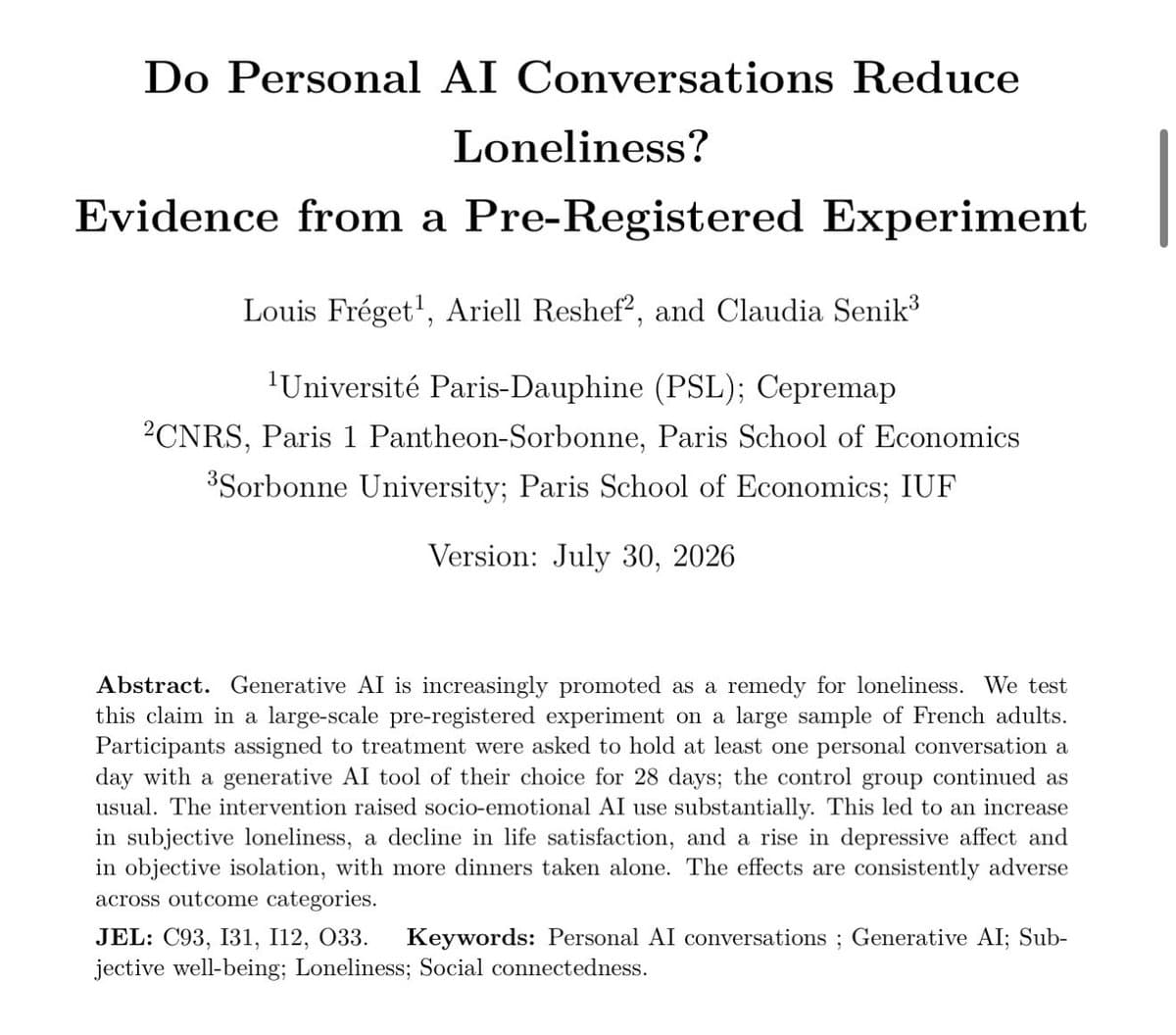
Wharton professor Ethan Mollick highlights a new study showing AI chatbot conversations increase loneliness, contradicting prior experiments. The research landscape remains divided on whether AI companions alleviate or worsen social isolation.
Key facts
- New study: AI conversations increase loneliness
- Prior experiments: significant loneliness reduction
- Other studies: ambiguous results by usage
- Ethan Mollick: Wharton professor highlighting evidence
- Effect depends on chatbot approach
The evidence on AI chatbots and loneliness is far from settled, according to Wharton professor Ethan Mollick. According to @emollick, a new study finds AI conversations increase loneliness, but previous published experiments show significant reduction or ambiguous results depending on usage patterns.
The contradiction is not merely academic. As AI companions like Replika and Character.AI scale to millions of users, the psychosocial effects carry real product and policy implications. The new study's finding that conversations increase loneliness suggests some chatbot designs may fail at their stated purpose of providing companionship.
Key Takeaways
- New study shows AI chatbots increase loneliness, contradicting prior research showing reduction.
- Ethan Mollick highlights unclear evidence depending on chatbot approach.
The Divergent Evidence

Prior experiments have demonstrated the opposite effect. Some published studies found significant loneliness reduction among users who engaged regularly with AI companions, particularly older adults and those with limited social networks. Others produced ambiguous results, with effects varying by usage frequency and depth of engagement.
Mollick's framing suggests the field lacks consensus, with outcomes highly sensitive to the specific chatbot approach. The new study's negative finding may reflect differences in study design, participant demographics, or the chatbot's conversational style.
Why Design Matters
The conflicting findings suggest chatbot design and user engagement patterns drive the loneliness outcome. A chatbot that encourages deep emotional disclosure without reciprocal human connection might paradoxically highlight users' isolation. Conversely, chatbots that facilitate real-world social connection or provide light-touch companionship may reduce loneliness.
Researchers have not yet isolated which specific chatbot features produce positive versus negative social effects. The divergence between studies points to a need for standardized loneliness metrics across AI interaction research.
Open Questions
The source provides limited methodological detail about the new study, including sample size, chatbot type, and measurement instruments. Without these specifics, the finding's generalizability remains uncertain. The scientific community will need replication studies and meta-analyses to resolve the contradiction.
What to watch
Watch for meta-analyses aggregating loneliness studies across AI chatbot designs, and for the new study's full methodology release. Also track whether major AI companion platforms like Replika or Character.AI publish their own user well-being data in response to these conflicting findings.