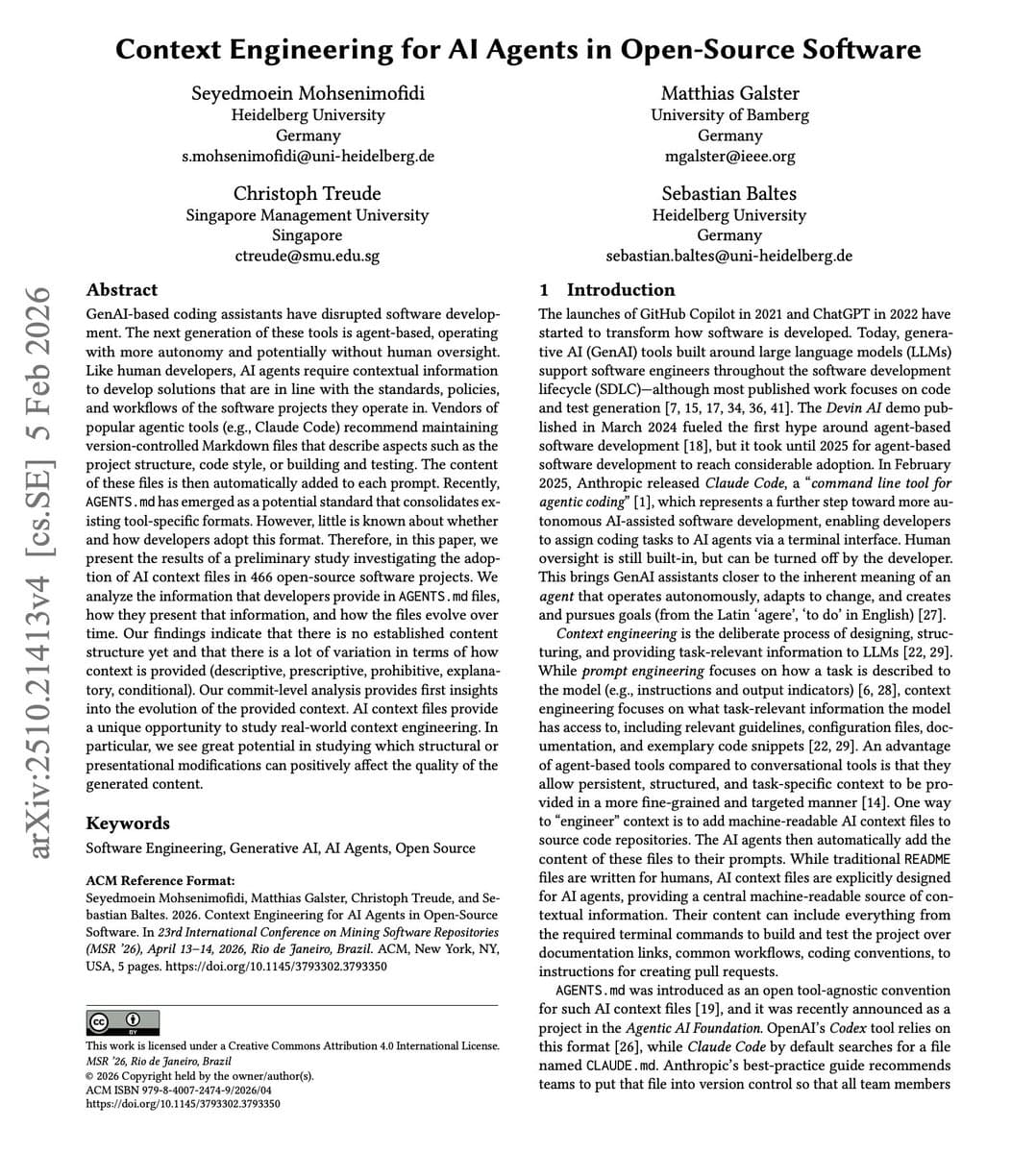
In the rapidly evolving landscape of AI-assisted software development, a surprising pattern has emerged: developers are creating specialized configuration files for AI tools, then largely ignoring them. A first-of-its-kind empirical study examining 10,000 open-source repositories reveals that only 466 projects (approximately 5%) have adopted AI context files like AGENTS.md, CLAUDE.md, or Copilot instructions. Even more telling: of the 155 AGENTS.md files analyzed, half were never modified after their initial creation, and only 6% underwent 10 or more revisions.
The Study's Methodology and Findings
Researchers conducted a comprehensive analysis of public repositories to understand how developers are implementing what might be considered "AI documentation"—configuration files designed to guide AI assistants in understanding project context, conventions, and architecture. The study represents the first systematic look at how this emerging practice is actually playing out in real development environments.
What they discovered was a landscape of inconsistency and abandonment. While some teams have embraced these files as a way to communicate project-specific knowledge to AI tools, the implementation varies dramatically from project to project. The most common content categories identified were:
- Development conventions (coding standards, naming patterns)
- Contribution guidelines (how to submit changes, review processes)
- Architecture overviews (system design, component relationships)
The Standardization Problem
One of the study's most significant findings is the complete lack of standardization in how these files are structured and what they contain. Unlike established documentation formats with community conventions, AI context files show "wide variation in what teams encode," according to the researchers.
This inconsistency creates several practical problems. First, AI tools themselves may struggle to parse and utilize information presented in radically different formats. Second, developers moving between projects face a learning curve for understanding each project's unique AI configuration approach. Third, the absence of best practices means teams are reinventing the wheel rather than building on established patterns.
The Abandonment Phenomenon
The study's most striking statistic—that 50% of AGENTS.md files were never modified after initial creation—points to a deeper issue in how developers are integrating AI tools into their workflows. This "write once and forget" pattern suggests several possibilities:
Initial enthusiasm followed by practical neglect: Teams may create these files as part of experimenting with AI tools but fail to maintain them as development priorities shift.
Unclear value proposition: Developers may not see sufficient return on investment for maintaining these files compared to other documentation or code.
Tool immaturity: Current AI assistants may not effectively utilize or prompt for updates to these context files.
Workflow integration challenges: The process of updating AI context files may not be seamlessly integrated into existing development workflows.
Implications for AI-Assisted Development
The study's findings arrive at a critical juncture in the adoption of AI coding assistants. As tools like GitHub Copilot, Claude Code, and others become increasingly sophisticated, their effectiveness depends heavily on understanding project-specific context. Without well-maintained configuration files, these tools operate with generic knowledge that may not align with a project's specific requirements, architecture, or conventions.
This research suggests that the AI development ecosystem is experiencing growing pains similar to those seen with earlier technologies. Just as version control systems evolved from varied approaches to the near-universal adoption of Git, and just as package management matured from scattered solutions to established systems like npm and pip, AI context management appears to be in its formative, fragmented stage.
The Path Forward
The researchers' work highlights several areas needing attention from both the developer community and tool creators:
Standardization Efforts: The field would benefit from community-driven standards for AI context file structure and content. This could take the form of schema definitions, template libraries, or convention documents similar to how README.md files evolved common patterns.
Tool Integration: AI assistants could better prompt for context updates when they detect knowledge gaps or outdated information. More seamless integration with development workflows might increase maintenance frequency.
Education and Best Practices: As with any emerging practice, education about effective approaches could help teams avoid common pitfalls and realize greater value from their AI context investments.
Research Continuation: This initial study provides a foundation, but ongoing research will be needed to track how practices evolve as AI tools mature and developer experience grows.
Conclusion
The empirical study of AI context files reveals a technology in transition—adopted by a small but growing minority of developers, implemented with great variation, and often abandoned after initial creation. This pattern mirrors the early days of many software development practices that eventually matured into essential, standardized components of the developer toolkit.
As AI-assisted development continues to evolve, the management of project context for AI tools represents both a challenge and an opportunity. The teams that crack the code on effective, maintainable AI context management may gain significant productivity advantages, while the broader ecosystem works toward solutions that make this practice more accessible and valuable for all developers.
Source: Original research paper referenced in Omar Sar's analysis of AI context file adoption in open-source projects.