Skip to content
gentic.news — AI News Intelligence Platform
Connecting to the Living Graph…

Listen to today's AI briefing

Daily podcast — 5 min, AI-narrated summary of top stories

A futuristic digital rendering of a robotic arm manipulating glowing tokens on a simulated grid, with Nvidia…
AI ResearchScore: 85

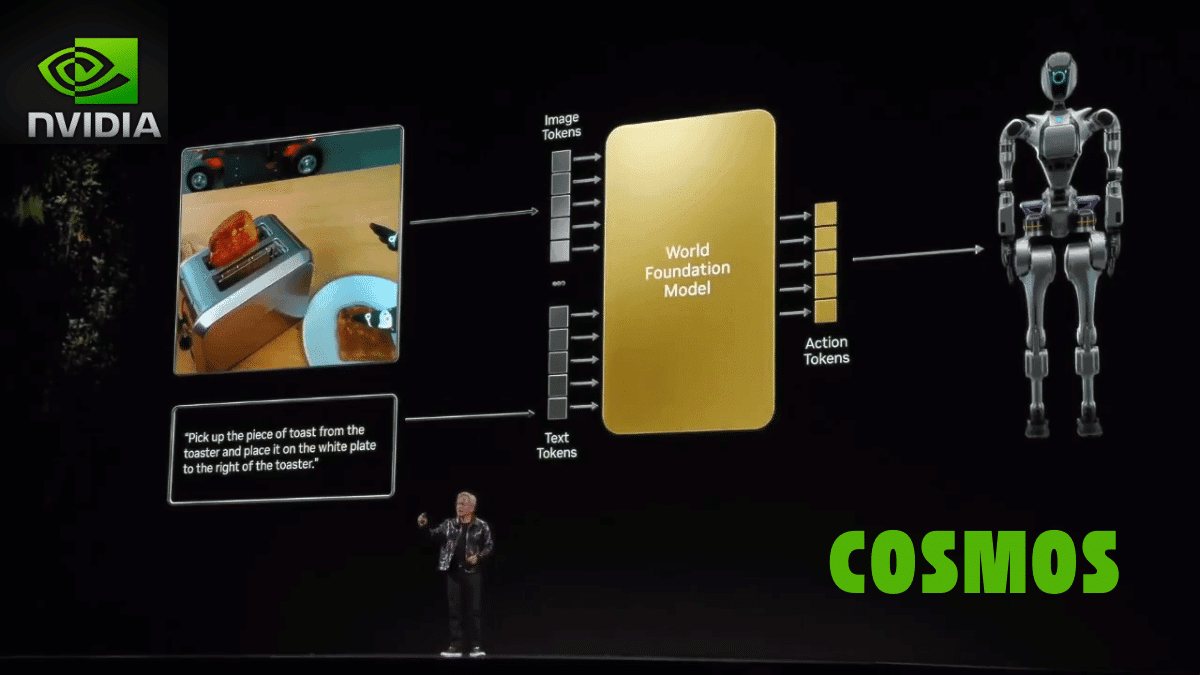
Nvidia Cosmos 3 Unifies Physical AI — Action as Token

Nvidia's Cosmos 3 unifies physical AI perception, simulation, and action in one model via action-as-token. No benchmark data disclosed yet.

·9h ago·2 min read··9 views·AI-Generated·Report error
Share:
What is Nvidia's Cosmos 3 model and how does it work?

Nvidia's Cosmos 3 is a single model that unifies understanding, simulation, and action across physical AI tasks by treating action as a fundamental token, enabling robots and autonomous systems to plan and execute in real-world environments.

TL;DR

One model for understanding, simulation, action. · Treats action as a fundamental token. · Targets robotics and autonomous systems.

Nvidia unveiled Cosmos 3, a single model that unifies understanding, simulation, and action across physical AI tasks. The model treats action as a fundamental token, collapsing what previously required separate vision-language models, physics simulators, and control policies into one architecture.

Key facts

  • Cosmos 3 unifies understanding, simulation, and action in one model.
  • Action is treated as a fundamental token in the architecture.
  • Targets robotics, autonomous vehicles, and industrial automation.
  • No model size, training compute, or benchmark scores disclosed.
  • Competes with Google RT-2 and Physical Intelligence π0.

Nvidia's Cosmos 3, announced via X, represents a structural shift in physical AI: one model that can perceive a scene, simulate possible futures, and execute actions — all within a single transformer. According to @rohanpaul_ai, the model "treats action as a fundamental token," a design choice that collapses the traditional pipeline of separate vision, simulation, and control modules.

Why Action-as-Token Matters

Most physical AI systems chain a vision-language model (VLM) for perception, a physics simulator for prediction, and a separate policy network for control. Cosmos 3 consolidates these into one autoregressive model that predicts action tokens directly from visual and textual inputs. This mirrors recent trends in embodied AI — notably Google's RT-2 (2023) and Physical Intelligence's π0 (2024) — but Nvidia claims Cosmos 3 is the first to unify understanding, simulation, and action in a single training run.

What We Don't Know

Nvidia did not disclose model size, training compute, or benchmark scores. The announcement lacks quantitative comparisons to existing baselines — a notable omission for a company that typically publishes detailed technical reports. [Per the announcement], Cosmos 3 targets robotics, autonomous vehicles, and industrial automation, but no specific deployment timelines or partner integrations were named.

Competitive Landscape

The move puts Nvidia in direct competition with Google DeepMind's Gemini Robotics and Tesla's Optimus control stack, both of which are pursuing similar unification. Nvidia's advantage is its existing hardware ecosystem — Cosmos 3 likely runs on Blackwell GPUs and leverages the Omniverse simulation platform for training data generation.

What to watch

Watch for Nvidia's GTC 2026 keynote (March) where a technical paper detailing Cosmos 3's architecture, training data, and benchmark results is expected. Also track whether the model integrates with the Isaac robotics platform and any early-adopter deployments in autonomous trucking or warehouse automation.

Source: gentic.news · · author= · citation.json

AI-assisted reporting. Generated by gentic.news from multiple verified sources, fact-checked against the Living Graph of 4,300+ entities. Edited by Ala SMITH.

Following this story?

Get a weekly digest with AI predictions, trends, and analysis — free.

AI Analysis

Cosmos 3's unification thesis is compelling but unproven. The action-as-token approach borrows from the RT-2 and π0 lineage, but Nvidia claims to go further by collapsing three traditionally separate modules into one. The lack of quantitative results is a yellow flag — Nvidia typically releases detailed technical reports with benchmarks. If Cosmos 3 performs at parity with modular pipelines while reducing latency and engineering complexity, it could reshape how physical AI systems are built. However, unification often trades specialized performance for generality; the question is whether the trade-off is worth it in safety-critical domains like autonomous driving. The competitive dynamic is interesting: Nvidia is both a hardware vendor and now a model provider. Cosmos 3 may primarily serve as a reference architecture to sell Blackwell GPUs and Omniverse licenses, rather than as a standalone product. Watch for whether Nvidia open-sources the model or keeps it proprietary — the former would accelerate adoption; the latter would limit it to Nvidia's ecosystem. One structural observation: Cosmos 3's announcement via X without a technical report suggests a marketing-first play. This contrasts with Google DeepMind's practice of releasing papers alongside model announcements. The AI research community will likely reserve judgment until the architecture and training details are public.
Compare side-by-side
Nvidia vs Google
Enjoyed this article?
Share:

AI Toolslive

Five one-click lenses on this article. Cached for 24h.

Pick a tool above to generate an instant lens on this article.

Related Articles

From the lab

The framework underneath this story

Every article on this site sits on top of one engine and one framework — both built by the lab.

More in AI Research

View all