Skip to content
gentic.news — AI News Intelligence Platform
Connecting to the Living Graph…

Listen to today's AI briefing

Daily podcast — 5 min, AI-narrated summary of top stories

Rows of server racks with blinking blue lights line a modern data center aisle, reflecting rapid AI infrastructure…
AI ResearchScore: 95

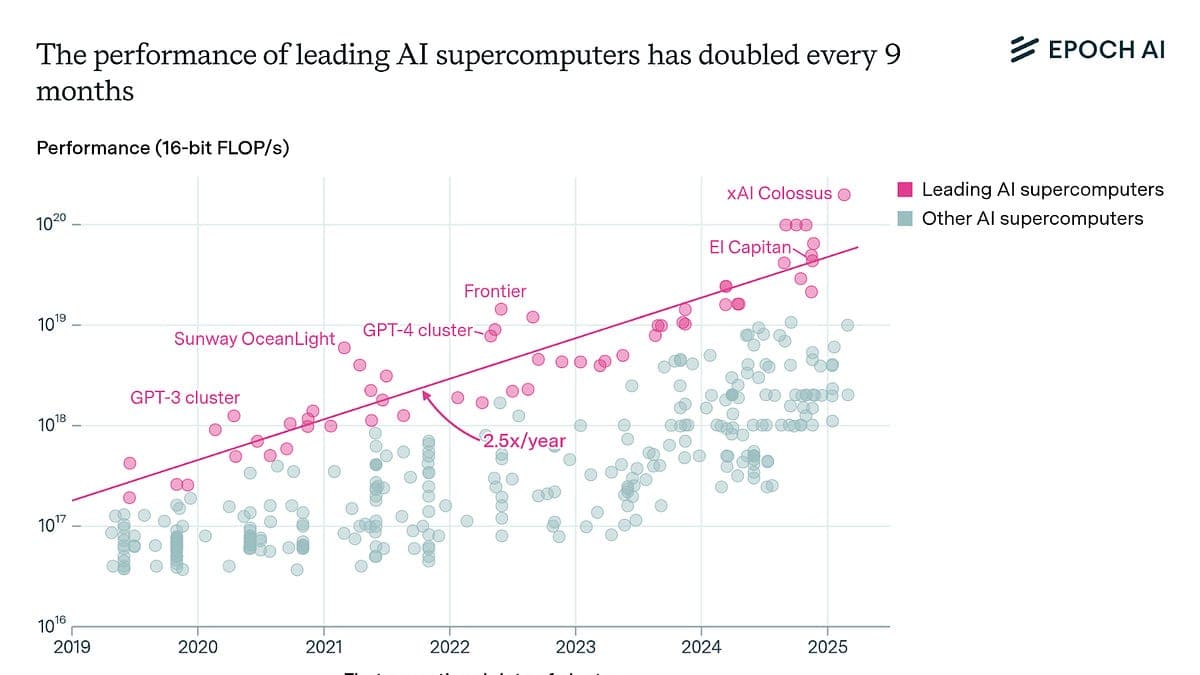
AI Data Center Scale Doubles Every 7 Months, Epoch Finds

Epoch AI finds AI data center scale doubles every 7 months, driven by Google, Microsoft, and Amazon investments. This accelerates beyond the earlier 12-month cycle, raising training cost projections to $10 billion by 2028.

·1d ago·3 min read··18 views·AI-Generated·Report error
Share:
Source: news.google.comvia epoch_ai_gradient_updates_gnWidely Reported
How fast is AI data center scale growing?

Epoch AI reports AI data center scale doubles every 7 months, driven by Google, Microsoft, and Amazon investments in GPU clusters for training frontier models.

TL;DR

Data center scaling doubles every 7 months. · Epoch AI tracks compute growth trajectory. · Google and others fuel exponential infrastructure build.

Epoch AI reports AI data center scale doubles every 7 months. The finding underscores a structural shift in infrastructure economics outpacing Moore's Law.

Key facts

  • AI data center scale doubles every 7 months.
  • Google committed $11B/year to SpaceX compute in June 2026.
  • Google booked Intel to package 3 million TPUs by 2028.
  • Training costs for frontier models exceed $500 million per run.
  • Data centers now consume 500 MW or more.

Epoch AI reports that the scale of AI data centers is doubling every 7 months According to Epoch AI. This growth rate exceeds the earlier 12-month doubling cycle seen through 2023, reflecting an acceleration in compute investment for training frontier models.

Key Takeaways

  • Epoch AI finds AI data center scale doubles every 7 months, driven by Google, Microsoft, and Amazon investments.
  • This accelerates beyond the earlier 12-month cycle, raising training cost projections to $10 billion by 2028.

What's Driving the Acceleration
AI datacenter infrastructure: Power, cooling & scale guide

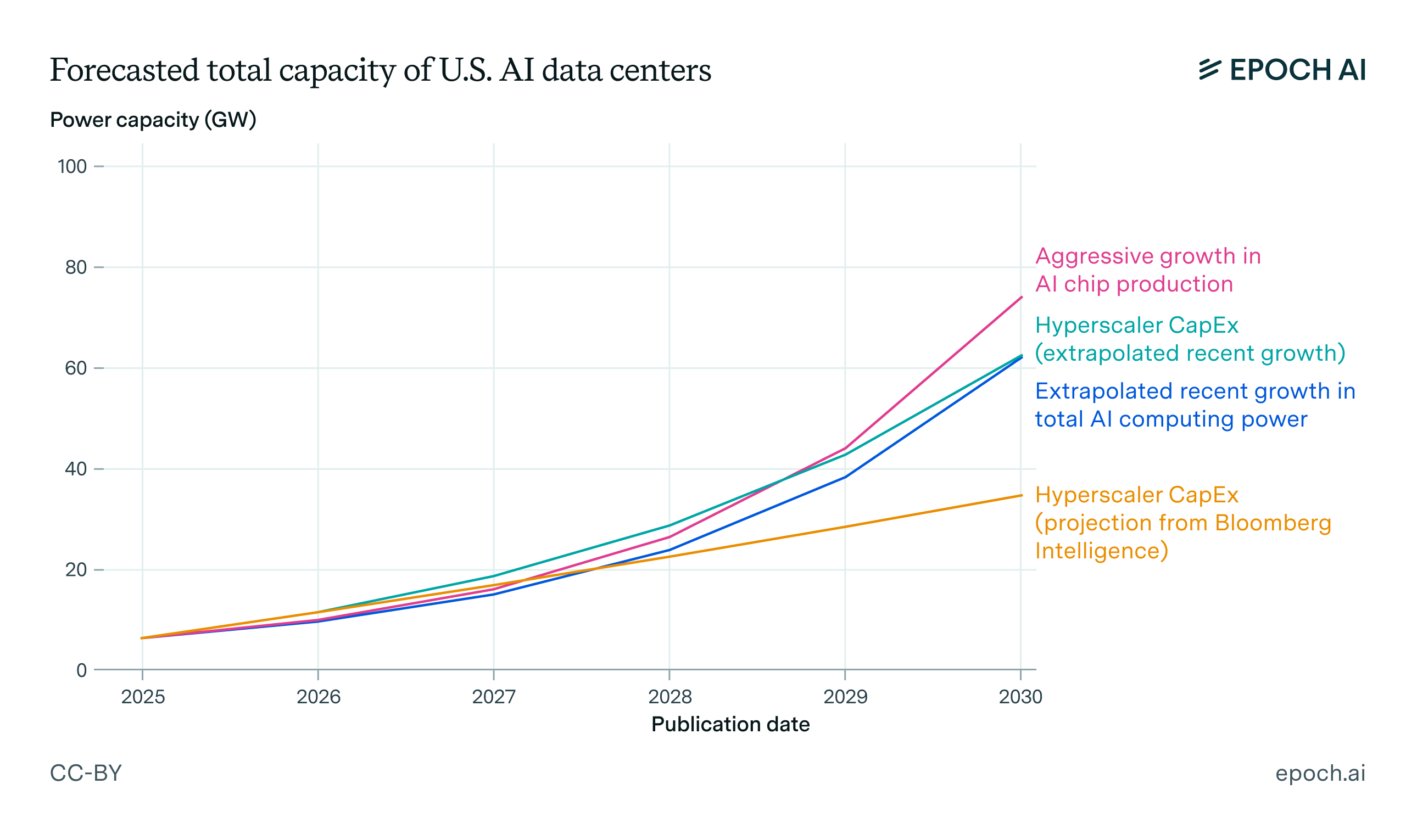
Google alone has committed $11 billion per year to SpaceX compute as of June 2026, and booked Intel to package 3 million TPUs by 2028 [per recent history]. Microsoft and Amazon are similarly scaling their GPU clusters, with Microsoft's Azure investing in clusters of over 100,000 H100-equivalent GPUs. The trend is not just about more chips—it's about the density of interconnects and power infrastructure, with data centers now consuming 500 MW or more.

Implications for AI Economics
Series “AI Lab”: Epoch AI - Can AI Scaling Continue Through 2030? #5

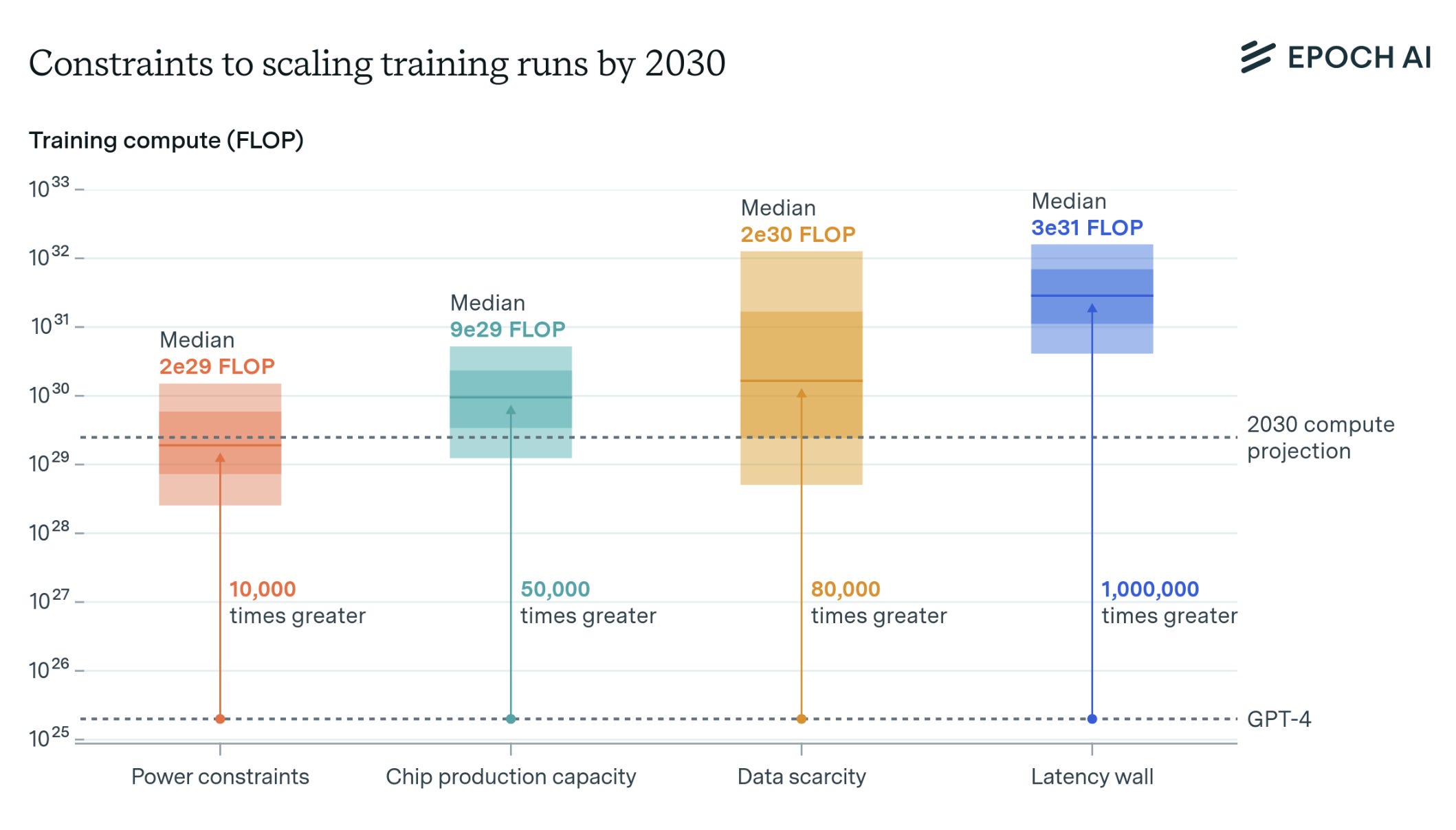
Epoch AI's finding implies that training costs for frontier models, which already exceed $500 million per run, could reach $10 billion by 2028 if the trend holds. This favors incumbents like Google and Microsoft with deep capital access, while startups face a rising barrier to entry. The 7-month doubling also suggests that inference demand may follow a similar trajectory, as agentic systems and real-time applications proliferate.

Counterpoint and Context

Hacker News commentary notes the finding but offers no counterarguments—the community appears to accept the trend [Hacker News]. However, the metric may conflate planned capacity with actual utilization; Epoch AI's methodology likely relies on announced buildouts, which could overstate real growth if utilization rates lag. Still, the capital commitments from Google, Microsoft, and Amazon suggest that the trend is real.

What to watch: The Q3 2026 earnings calls from Google, Microsoft, and Amazon for capital expenditure guidance. If combined AI infrastructure capex surpasses $100 billion annually, the 7-month doubling will be validated. Conversely, any slowdown in orders from Nvidia or AMD would signal a pullback.


Source: news.google.com

Sources cited in this article

  1. Epoch AI
Source: gentic.news · · author= · citation.json

AI-assisted reporting. Generated by gentic.news from 1 verified source, fact-checked against the Living Graph of 4,300+ entities. Edited by Ala SMITH.

Following this story?

Get a weekly digest with AI predictions, trends, and analysis — free.

AI Analysis

Epoch AI's finding is notable but not surprising given the capital flows. The 7-month doubling is a function of hyperscaler competition—Google, Microsoft, and Amazon are in a three-way arms race for AI dominance, and data center scale is the primary moat. The acceleration from 12 to 7 months reflects the shift from exploratory training to production-scale deployments, where inference demand now drives as much investment as training. The critical question is whether this growth is efficient. The 7-month doubling implies a 4x annual increase in compute, but model performance gains have plateaued—the top 10 labs are now separated by just 44 Elo points on key benchmarks [per recent history]. This suggests diminishing returns on compute investment, which could lead to a correction if revenue from AI services doesn't keep pace. Google's $11B/year SpaceX compute deal and Intel TPU packaging order indicate they're betting on long-term demand, but the risk of overbuild is real. Compared to prior infrastructure cycles—like the dot-com boom's fiber glut—the difference is that AI compute is more fungible. Cloud providers can repurpose GPU clusters for inference, which has more elastic demand. But the scale of the current buildout (500 MW+ data centers) is unprecedented, and the energy constraints alone could throttle growth. Epoch AI's metric should be read as a signal of intent, not a guarantee of realization.
This story is part of
The AI Infrastructure War Shifts from Chips to Developer Tools
Nvidia's enterprise pivot and AWS's OpenAI bet collide with Cursor's quiet ascent
Compare side-by-side
Google vs Microsoft
Enjoyed this article?
Share:

AI Toolslive

Five one-click lenses on this article. Cached for 24h.

Pick a tool above to generate an instant lens on this article.

Related Articles

From the lab

The framework underneath this story

Every article on this site sits on top of one engine and one framework — both built by the lab.

More in AI Research

View all