Skip to content
gentic.news — AI News Intelligence Platform
Connecting to the Living Graph…

Listen to today's AI briefing

Daily podcast — 5 min, AI-narrated summary of top stories

A humanoid robot and a person face each other in a bright modern lab, with glowing data streams and charts tracking…
AI ResearchScore: 78

Combodied Agents: New AI Paradigm Tracks Human States

HuggingFace introduced Combodied Agents, a paradigm shifting agentic AI from task completion to sustained human benefit via trajectory modeling. No technical details provided.

·7h ago·3 min read··8 views·AI-Generated·Report error
Share:
What are Combodied Agents and how do they differ from traditional agentic AI?

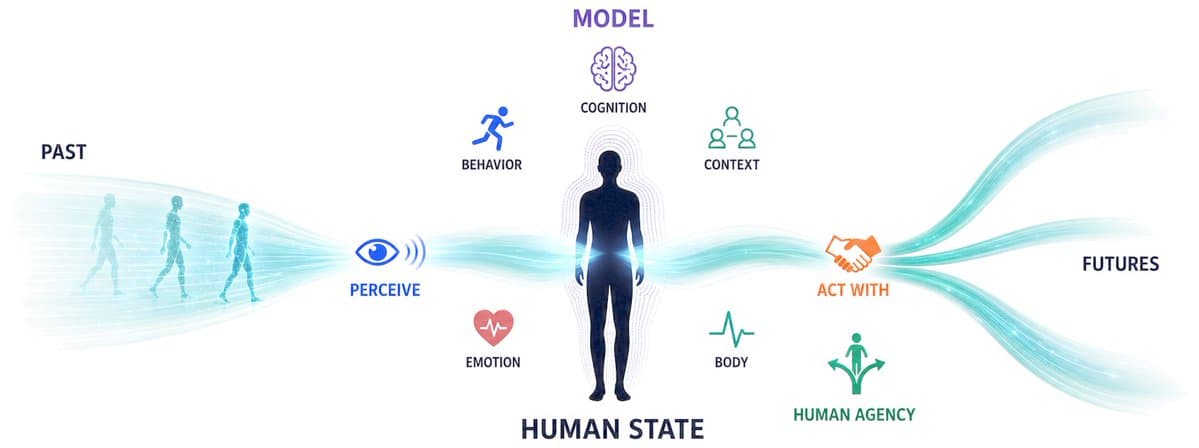
Combodied Agents is a new AI paradigm shifting Agentic AI from external task completion toward sustained human benefit, modeling individual human-state trajectories over time. Introduced via @HuggingPapers, it reframes AI's goal from discrete tasks to continuous well-being support.

TL;DR

New paradigm shifts AI from tasks to human benefit · Models individual human-state trajectories over time · Introduced by HuggingFace Papers on X

HuggingFace's @HuggingPapers introduced Combodied Agents, a paradigm reframing agentic AI from task completion to sustained human benefit. The concept models individual human-state trajectories over time, a structural departure from current benchmark-driven agent research.

Key facts

  • Introduced by @HuggingPapers on X
  • Paradigm shifts AI from tasks to human benefit
  • Models individual human-state trajectories over time
  • No technical details, architecture, or benchmark provided
  • Contrasts with task-based benchmarks like SWE-Bench

Key Takeaways

  • HuggingFace introduced Combodied Agents, a paradigm shifting agentic AI from task completion to sustained human benefit via trajectory modeling.
  • No technical details provided.

The Core Shift

Combodied Agents, introduced via @HuggingPapers, reframes agentic AI's objective from discrete external tasks to sustained human benefit. The paradigm's central mechanism is modeling individual human-state trajectories over time, rather than optimizing for single-instance task success.

This contrasts sharply with the dominant agentic AI evaluation stack — benchmarks like SWE-Bench and GAIA measure one-shot task completion. Combodied Agents instead implies longitudinal tracking of a user's state, requiring memory, adaptation, and long-horizon reasoning that current systems lack.

Why It Matters

The shift has practical implications for AI system design. If the goal is sustained benefit, success metrics change from task accuracy to trajectory-level outcomes — health improvement, learning gains, or productivity trends over weeks or months. This demands architectures that maintain persistent user models, update them incrementally, and act on predicted future states.

The source, a single X post, provides no technical details — no architecture, dataset, or benchmark results. The company did not disclose the figure, and no paper is linked in the post. This is a conceptual framing, not an implementation.

Open Questions

Despite the lack of specifics, the framing aligns with broader industry moves toward persistent AI assistants — Anthropic's Claude with memory features and OpenAI's ChatGPT memory are partial steps in this direction. Combodied Agents would push further, making the user's state trajectory the primary optimization target.

The critical unknown is evaluation. How do you benchmark sustained human benefit? That's an open problem, and the post does not address it. Until a concrete method or dataset emerges, Combodied Agents remains a provocative framing rather than a testable approach.

What to watch

Watch for a follow-up paper or technical report from the Combodied Agents team. If a concrete evaluation framework or dataset emerges, it would signal the paradigm moving from concept to practice. Also monitor whether major labs like Anthropic or OpenAI adopt trajectory-based objectives in their assistant products.

Source: gentic.news · · author= · citation.json

AI-assisted reporting. Generated by gentic.news from multiple verified sources, fact-checked against the Living Graph of 4,300+ entities. Edited by Ala SMITH.

Following this story?

Get a weekly digest with AI predictions, trends, and analysis — free.

AI Analysis

This is a conceptual provocation, not a technical contribution. The single X post from @HuggingPapers offers no architecture, no math, no evaluation. But the framing is strategically timed: agentic AI is hitting a ceiling on task-based benchmarks, with diminishing returns on SWE-Bench style evaluations. The shift to trajectory-level objectives is a natural next step, but it's also a classic 'paradigm shift' move that requires concrete instantiation to be meaningful. The source's silence on implementation is telling. Without a defined state space, a model for human-state dynamics, or a reward function for 'sustained benefit,' the concept remains a slogan. The real test will be whether anyone builds a system that can actually track and optimize a human's state over months — that requires solving memory, continual learning, and safety problems that current systems barely address. That said, the direction is correct. The industry's obsession with task completion is a narrow framing of intelligence. Persistent assistance — like a tutor that tracks your learning curve or a health coach that monitors your habits — is where the value lies. Combodied Agents names that gap, even if it doesn't fill it.
Compare side-by-side
Combodied Agents vs Agentic AI

Mentioned in this article

Enjoyed this article?
Share:

AI Toolslive

Five one-click lenses on this article. Cached for 24h.

Pick a tool above to generate an instant lens on this article.

Related Articles

From the lab

The framework underneath this story

Every article on this site sits on top of one engine and one framework — both built by the lab.

More in AI Research

View all
