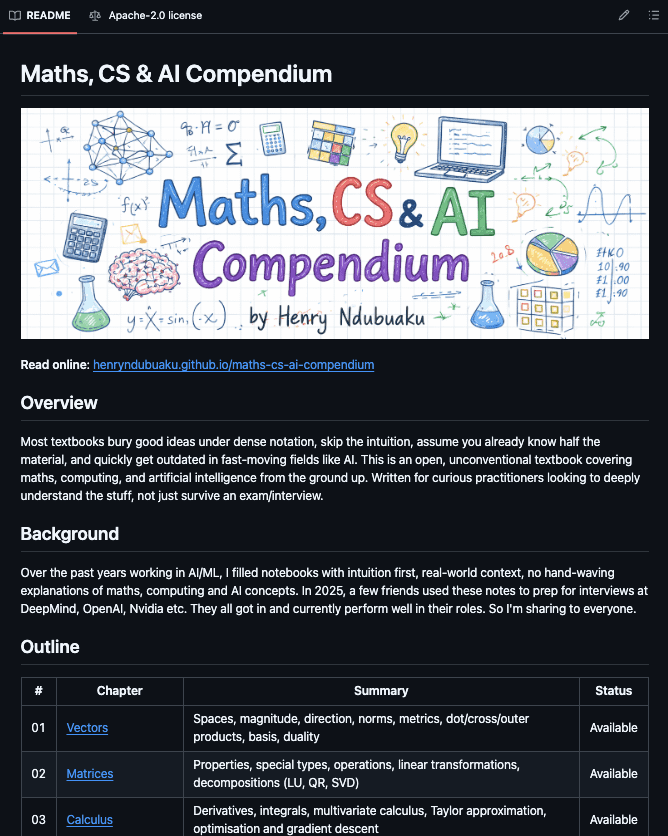
AI engineer Henry Ndubuaku has released the Maths, CS & AI Compendium, a free, open-source textbook designed to provide an intuitive foundation in the core technical concepts required for modern AI engineering and research. The project, hosted on GitHub, aims to distill years of professional notebook-keeping into a structured, publicly accessible resource.
What's Inside the Compendium
The textbook is structured to prioritize conceptual understanding. According to the announcement, each chapter follows a specific pedagogical sequence:
- Intuition First: Explains the core idea and why it works in plain language.
- Mathematical Formulation: Presents the formal notation and equations.
- Real-World Context: Connects the concept to practical applications in AI and systems.
As of the announcement, six of a planned eighteen chapters are live. The published content spans a wide technical spectrum:
- Foundational Mathematics: Vectors, matrices, spaces, transformations, Singular Value Decomposition (SVD).
- Calculus for ML: Derivatives, gradient descent, Taylor approximation, multivariate calculus.
- Statistics & Probability: Bayesian methods, information theory, probability distributions.
- Machine Learning: Classical ML, deep learning, reinforcement learning, distributed training.
- Hardware & Systems: GPU programming (CUDA, Triton), SIMD, TPU architecture, ARM chips.
- Production AI: Inference systems, model quantization, streaming LLMs, edge deployment, large-scale infrastructure.
The author explicitly positions the compendium against traditional academic textbooks, which he claims "bury the idea under 3 pages of notation."
Origin and Reported Impact
The project originated from Ndubuaku's personal notebooks, compiled over years of working in AI. A notable claim in the announcement is that early drafts of these notes were used by several friends to prepare for technical interviews at DeepMind, OpenAI, and Nvidia, resulting in job offers at all three organizations. This anecdotal success motivated the decision to open-source the material.
The resource is described as a "textbook," distinct from a video course or playlist. It is available for free on GitHub, with remaining chapters slated for future release.
gentic.news Analysis
The release of this compendium taps into a clear and growing market need: bridging the gap between academic theory and the applied, systems-level knowledge required to build and deploy AI at scale. While excellent foundational textbooks exist (e.g., Deep Learning by Goodfellow, Bengio, and Courville), they often stop at the algorithmic level. This resource explicitly extends into the hardware and infrastructure stack—covering CUDA, Triton, and quantization—which is precisely the knowledge gap many engineers face when moving from model prototyping to production.
The reported success of the notes in landing roles at top AI labs is its most powerful validation. It highlights that the hiring bar at firms like DeepMind and OpenAI increasingly tests for a hybrid skillset: deep mathematical fluency combined with practical systems engineering intuition. This aligns with a broader trend we've covered, where AI engineering is becoming a distinct discipline from pure ML research, requiring mastery of the full stack from linear algebra to kernel programming.
However, the value proposition hinges entirely on execution. The critical question for practitioners is not the breadth of topics listed, but the quality and clarity of the explanations. The promised pedagogical approach—intuition before notation—is commendable but difficult to achieve consistently. The open-source nature allows the community to vet, contribute to, and improve the content, which could be a significant advantage over static commercial offerings.
Frequently Asked Questions
Where can I access the Maths, CS & AI Compendium?
The textbook is hosted for free on GitHub. You can find it by searching for "Maths, CS & AI Compendium" or the author's name, Henry Ndubuaku. The repository contains the open-source content, likely in a format like Markdown or PDF, allowing anyone to read, use, or contribute to the material.
Is this resource suitable for complete beginners?
Based on the described content covering topics from vectors to distributed training and CUDA, the compendium appears designed for learners with some initial exposure to programming or basic math. It is likely most valuable for students, engineers, or researchers who have encountered these concepts in a fragmented or overly theoretical way and seek a unified, intuitive understanding geared toward real-world AI implementation.
How does this compare to other online learning resources like courses or YouTube playlists?
The author distinguishes it as a textbook, not a course or video series. This implies a focus on written, reference-style depth and structure, as opposed to the sequential, lecture-based format of a course. It is intended for self-paced study and deep dives into specific topics, potentially serving as a long-term reference manual for concepts needed throughout an AI engineering career.
What is the license for this open-source textbook?
The announcement states it is "100% Open Source," but the specific license (e.g., MIT, Creative Commons) is not detailed in the source material. Users should check the GitHub repository directly to understand the licensing terms, which govern how they can use, share, and modify the content.