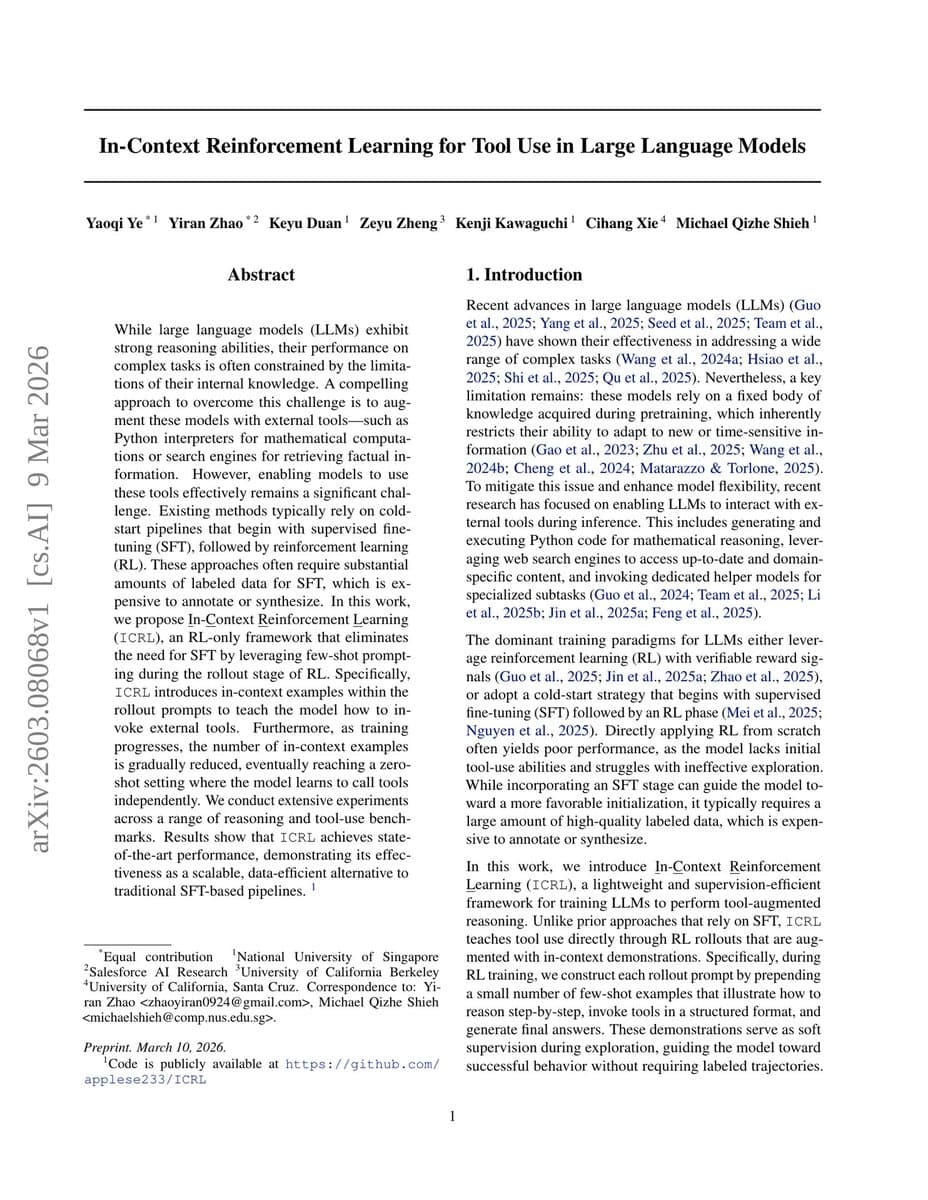
A new approach called In-Context Reinforcement Learning (ICRL) is revolutionizing how artificial intelligence systems learn to use external tools, potentially saving millions in computational costs while making AI assistants more capable and adaptable. According to research highlighted by HuggingFace's research tracking account @HuggingPapers, this method fundamentally changes how large language models (LLMs) acquire practical skills.
What Is In-Context Reinforcement Learning?
ICRL represents a significant departure from traditional approaches to teaching AI systems to use tools. Instead of relying on expensive supervised fine-tuning—where models undergo extensive retraining on labeled datasets—ICRL teaches LLMs through in-context examples during reinforcement learning rollouts.
The process works by showing the model examples of tool usage within the context of reinforcement learning trials. As the model interacts with these examples during its learning process, it gradually develops the ability to use tools effectively. What makes this particularly innovative is how the system gradually fades from few-shot to zero-shot capability—starting with multiple examples and eventually requiring none.
The Problem ICRL Solves
Teaching AI systems to use external tools—whether calculators, databases, APIs, or specialized software—has traditionally been a resource-intensive process. Supervised fine-tuning requires:
- Massive labeled datasets showing correct tool usage
- Substantial computational resources for retraining large models
- Significant human effort to create training examples
- Limited flexibility once training is complete
These barriers have made it challenging to create AI assistants that can seamlessly integrate with the growing ecosystem of digital tools. ICRL addresses these limitations by leveraging the in-context learning capabilities that modern LLMs already possess, combined with reinforcement learning's trial-and-error approach.
How the Transition Works
The "fading" process from few-shot to zero-shot capability represents one of ICRL's most elegant features. Initially, the model receives several examples of successful tool usage within its context window. As training progresses through reinforcement learning rollouts:
- Early stages: Multiple clear examples guide tool selection and usage
- Intermediate stages: Fewer examples require more inference from the model
- Final stages: No examples needed—the model has internalized the patterns
This gradual reduction in scaffolding mirrors how humans learn complex skills, moving from explicit instruction to internalized knowledge.
Implications for AI Development
The development of ICRL has several important implications for the field of artificial intelligence:
Cost Reduction: By eliminating supervised fine-tuning, ICRL could dramatically reduce the computational costs associated with teaching AI systems new skills. This makes advanced AI capabilities more accessible to researchers and organizations with limited resources.
Rapid Adaptation: Models trained with ICRL could potentially learn to use new tools much faster than through traditional methods. This adaptability is crucial as the digital tool landscape continues to evolve rapidly.
Transfer Learning Potential: The patterns learned through ICRL might transfer more effectively to related tasks than those learned through supervised fine-tuning, though this requires further research.
Practical Applications
ICRL-enabled AI systems could transform numerous domains:
- Customer service: AI that can seamlessly access and update CRM systems
- Research assistance: Models that can properly use scientific databases and analysis tools
- Programming aids: AI coders that effectively utilize development environments and APIs
- Data analysis: Assistants that can employ statistical software and visualization tools
Challenges and Considerations
While promising, ICRL faces several challenges that researchers must address:
Safety concerns: As AI systems gain greater tool-using capabilities, ensuring they use tools appropriately and safely becomes increasingly important.
Evaluation complexity: Measuring tool-use proficiency is more complex than evaluating text generation quality, requiring new benchmarks and testing methodologies.
Integration issues: Different tools have varying interfaces and requirements, creating standardization challenges for ICRL approaches.
The Future of Tool-Using AI
ICRL represents a significant step toward more capable and economically viable AI systems. As research progresses, we may see:
- Hybrid approaches combining ICRL with other learning methods
- Standardized tool interfaces designed specifically for AI interaction
- Specialized ICRL frameworks for different domains and tool types
- Open-source implementations making the technique widely accessible
The research, as reported by @HuggingPapers, suggests we're moving toward AI systems that can learn to use tools in ways that are both more human-like in their learning process and more scalable in their implementation.
Source: @HuggingPapers on X/Twitter, referencing research on In-Context Reinforcement Learning for tool use.