What Happened
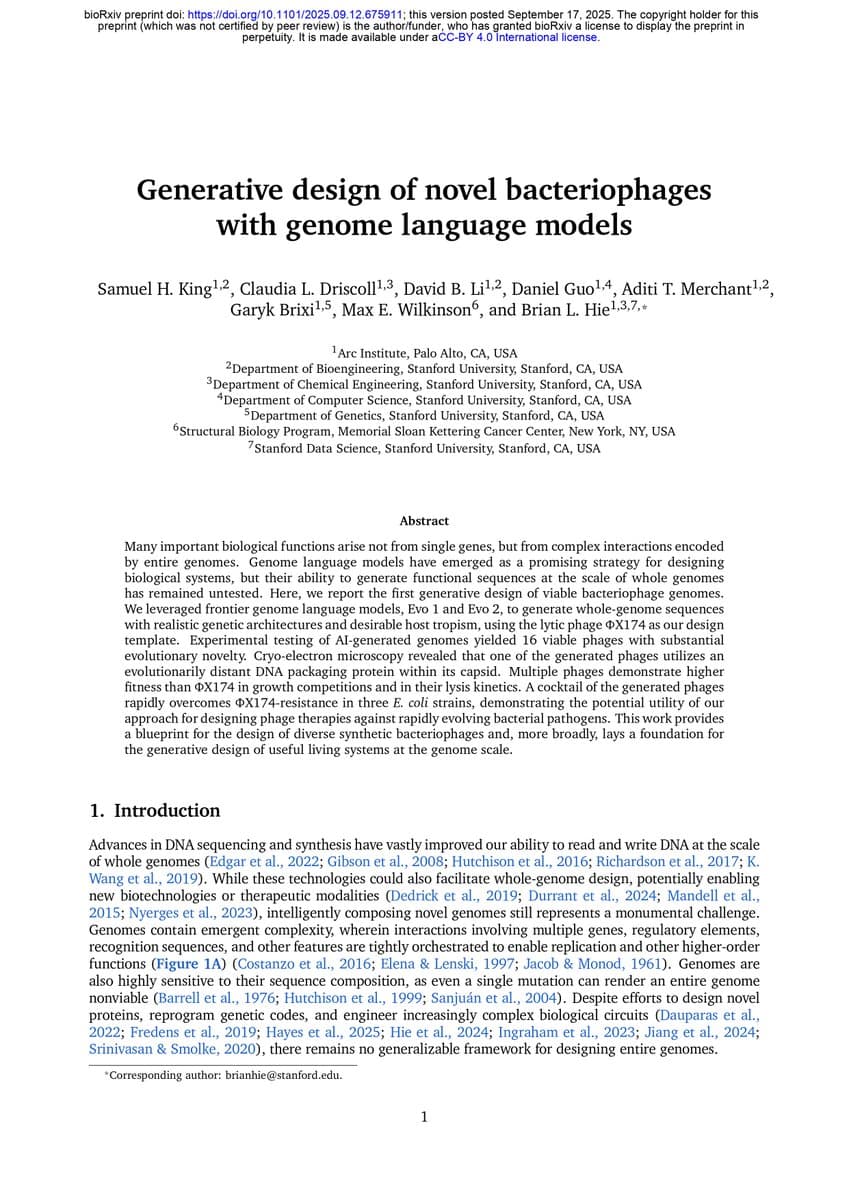
A team from Stanford University and the Arc Institute fed a language model a DNA sequence and asked it to write a new virus. According to a tweet from Singh, the model generated hundreds of candidate sequences. Of those, 16 produced viable viruses. Most notably, one of the functional designs incorporated a DNA packaging protein that does not exist in any known organism on Earth.
The tweet linked to an external resource (currently unavailable to us), and no peer-reviewed paper has been published yet. The model and exact training data were not specified.
This is a striking demonstration of how large language models—already used for protein design and gene synthesis—can be applied to generate entire viral genomes that function in a biological context.
Context
AI-driven biological sequence design is not new. Tools like ESMFold and AlphaFold predict protein structures from sequences, and generative models such as ProtGPT2 and ProGen create novel proteins with desired functions. However, designing a complete viral genome that remains functional and includes a novel protein goes further.
If the claim holds under peer review, it would represent a leap: the AI did not just recombine known elements but produced a sequence for a protein that appears novel. This suggests the model learned the grammar of viral DNA well enough to invent plausible new components.
Frequently Asked Questions
Is this a new AI model?
The tweet does not name the model. It is likely a custom transformer-based language model trained on viral genome sequences. Researchers often adapt models like Evo (a genome-scale language model from Arc Institute and others) or similar architectures.
How did they test whether the viruses worked?
The tweet states 16 “worked” but does not explain how. Typically, testing synthetic viral genomes involves synthesizing the DNA, introducing it into cells or a suitable host, and checking for viral replication or production of viral particles. The details are not yet public.
Does this pose a biosafety risk?
Potentially yes. AI-driven design of functional viruses raises dual-use concerns—it could accelerate both beneficial virus-based therapies (e.g., phage therapy, oncolytic viruses) and harmful bioweapons. However, the researchers presumably conducted this under appropriate biosafety containment. The community is actively discussing governance frameworks for such research.
Has this been peer-reviewed?
No. The information comes from a tweet. Until a preprint or publication appears, the claims should be treated with caution. The results are plausible given prior work, but verification is needed.
gentic.news Analysis
This development sits at the intersection of generative AI and synthetic biology—a space we have tracked previously (e.g., coverage of Profluent's AI-designed CRISPR proteins and AlphaFold's protein structure breakthroughs). What sets this apart is the target: an entire viral genome, not just a single protein. Successfully generating a functional virus with a novel protein suggests the model captured higher-order genomic organisation, including regulatory elements and interaction networks.
The involvement of the Arc Institute, co-founded by Patrick Hsu and others, is notable. Arc has been a leader in genome-scale language models; their Evo model (Nature, 2024) learned across millions of genomes. This tweet may build on that lineage.
If confirmed, this work pushes the boundary of what AI can create in biology. It also forces a conversation: how do we ensure that such powerful design capabilities are used responsibly? Unlike AlphaFold, which had a clear beneficial mission, generative viral design is inherently dual-use. The research community and policymakers need to act now—before the technology outpaces the safeguards. The fact that the team publicly announced this (via tweet) without a paper raises its own questions about responsible disclosure.
From a technical standpoint, the result that 16 out of “hundreds” of candidates worked is impressive—a success rate far higher than random mutagenesis. This suggests the model can navigate the vast sequence space of viral genomes with surprising precision. The discovery of a functional protein with no known natural homolog hints that AI can uncover “neomorphic” biological parts, which could be harnessed for designing synthetic virus-like particles for gene therapy or vaccine delivery.